If you’ve ever asked a smart speaker to dim the lights, tracked your steps with a fitness band, or gotten an alert that your washing machine finished a cycle, you’ve already interacted with an IoT device. The term “IoT” gets thrown around constantly in tech conversations, but many people still aren’t sure exactly what it means or how far it reaches into daily life. This guide breaks down what IoT devices are, how they work, where you’ll find them, and why understanding them matters — especially when it comes to security.
What Does IoT Actually Mean?
IoT stands for the Internet of Things — a network of physical objects, or “things,” embedded with sensors, software, and connectivity that allows them to collect and exchange data over the internet. Unlike traditional computers or smartphones, these devices are often purpose-built for a single job: monitoring temperature, tracking location, detecting motion, or automating a household task.
So, what are IoT devices, in practical terms? They’re everyday objects that have been given a digital upgrade. A regular thermostat becomes a smart thermostat when it can sense the room temperature, connect to Wi-Fi, and adjust itself based on your schedule or a command from your phone. A regular light bulb becomes a smart bulb when it can be switched on remotely or set to change color based on the time of day. The physical object stays largely the same — what changes is the layer of intelligence and connectivity added on top.
How Do IoT Devices Work?
Every IoT device, regardless of its size or purpose, generally relies on four core components working together:
- Sensors or actuators – These gather data from the physical environment (temperature, motion, light, sound) or perform an action (unlocking a door, adjusting a valve).
- Connectivity – Devices transmit data using Wi-Fi, Bluetooth, cellular networks, Zigbee, or other wireless protocols.
- Data processing – Collected data is sent to the cloud or processed locally on the device itself, where it’s analyzed and turned into something useful.
- User interface – Most IoT devices pair with an app or dashboard, giving people a way to monitor and control the device remotely.
Put simply, IoT devices sense, share, and sometimes act — all without requiring a person to be physically present. This is the foundation of what makes “smart” homes, cities, and industries possible.
Common Types of IoT Devices
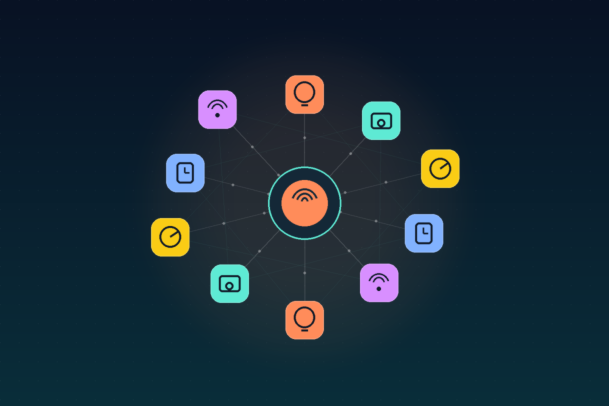
IoT devices show up in far more places than most people realize. Here are some of the most common categories:
- Smart home devices – Thermostats, security cameras, video doorbells, smart locks, robotic vacuums, and voice assistants like smart speakers.
- Wearables – Fitness trackers, smartwatches, and health-monitoring patches that track heart rate, sleep, and activity levels.
- Industrial IoT (IIoT) – Sensors on factory equipment that monitor performance, predict maintenance needs, and reduce downtime.
- Connected vehicles – Cars equipped with GPS tracking, remote diagnostics, and driver-assistance sensors.
- Smart city infrastructure – Traffic sensors, connected streetlights, and environmental monitors that help cities manage resources efficiently.
- Healthcare devices – Remote patient monitors, connected insulin pumps, and smart pill dispensers that transmit health data to providers in real time.
- Retail and logistics tech – Inventory sensors, smart shelves, and GPS-tracked shipping containers that streamline supply chains.
This diversity is part of what makes IoT so powerful — and also part of what makes it complicated to secure, since each category comes with its own risks and requirements.
Why IoT Devices Matter
The appeal of IoT devices comes down to convenience, efficiency, and data-driven decision-making.
Convenience: Automating routine tasks — turning off lights when you leave home, reordering groceries when supplies run low, or adjusting the thermostat before you arrive — saves time and mental effort.
Efficiency: Businesses use IoT sensors to monitor equipment health, track inventory in real time, and optimize energy use, often cutting costs significantly in the process.
Better decisions: Because IoT devices constantly generate data, organizations can spot patterns and make proactive decisions rather than reactive ones. A factory can replace a part before it fails. A city can reroute traffic before congestion builds. A hospital can flag a patient’s declining vitals before a crisis.
It’s this always-on, always-collecting nature that has made IoT one of the fastest-growing areas of technology, with tens of billions of connected devices already in use worldwide and more added every day.
The Security Challenge Behind IoT Devices
Here’s the part that often gets overlooked in the excitement around smart technology: every IoT device is a potential entry point for cyberattacks.
Many IoT devices are built with convenience and cost in mind, not security. That often means weak or default passwords, infrequent software updates, limited built-in encryption, and minimal visibility once a device is deployed. A single unsecured smart camera or connected sensor can give an attacker a foothold into an entire home or business network.
Some of the most pressing IoT security concerns include:
- Weak authentication – Many devices ship with default credentials that users never change.
- Lack of updates – Manufacturers don’t always provide long-term firmware support, leaving known vulnerabilities unpatched.
- Data privacy risks – IoT devices often collect sensitive information, from location data to health metrics, that can be exposed if not properly protected.
- Botnet recruitment – Compromised IoT devices have been used in large-scale attacks, turning everyday gadgets into unwitting participants in cybercrime.
- Expanded attack surface – Every new connected device added to a network is another potential doorway for intruders.
As homes fill up with smart gadgets and businesses deploy IoT sensors across factories, offices, and supply chains, the attack surface grows just as fast as the convenience does. This is why endpoint visibility and proactive threat prevention have become essential, not optional, for anyone relying on connected devices.
Best Practices for Securing IoT Devices
Whether you’re managing a smart home or an enterprise network full of connected sensors, a few foundational habits go a long way:
- Change default credentials immediately after setting up any new device.
- Keep firmware and software updated to patch known vulnerabilities.
- Segment IoT devices onto a separate network so a compromised device can’t easily reach more sensitive systems.
- Disable unused features like remote access or unnecessary open ports.
- Monitor device activity for unusual behavior that could indicate a compromise.
- Choose vendors with a track record of security support, including regular updates and clear privacy policies.
For organizations managing dozens or thousands of connected endpoints, manual oversight isn’t realistic. That’s where dedicated endpoint security and threat management solutions come in, offering the visibility and automated protection needed to keep IoT environments safe at scale.
IoT Devices vs. Traditional Devices
It helps to draw a clear line between an IoT device and a “regular” electronic device. A traditional appliance — say, an old-fashioned oven — performs its function in isolation. It has no awareness of the outside world beyond the dial you turn. An IoT-enabled oven, by contrast, can tell you remotely when your dish is done, suggest cook times based on the recipe you’re following, and alert you if it’s been left on longer than expected.
The distinction isn’t about how “smart” the device looks on the outside. It’s about whether the device can sense, communicate, and sometimes act on data without a person manually operating it every step of the way. That data exchange is what turns a passive object into an active participant in a larger network — and it’s also what introduces new considerations around bandwidth, compatibility, and, of course, security.
The Future of IoT Devices
The IoT landscape isn’t slowing down. Analysts expect the number of connected devices worldwide to keep climbing well past current estimates over the next several years, driven by falling sensor costs, faster wireless networks, and growing demand for automation in both homes and industries.
A few trends are shaping where IoT is headed next:
- Edge computing – Instead of sending every bit of data to the cloud, more devices are processing information locally, reducing latency and improving response times.
- AI-powered devices – IoT sensors are increasingly paired with machine learning models that can detect patterns and anomalies on their own, from predicting equipment failure to recognizing unusual network behavior.
- 5G connectivity – Faster, more reliable networks are enabling IoT devices to transmit larger volumes of data in real time, which is especially important for use cases like autonomous vehicles and remote healthcare monitoring.
- Interoperability standards – Efforts like Matter are working to make smart home devices from different manufacturers work together seamlessly, reducing the fragmentation that has long frustrated consumers.
As these trends mature, IoT devices will likely become even more embedded in daily routines — which makes it all the more important to build security into the foundation of any connected deployment, rather than treating it as an afterthought.
The Bottom Line
IoT devices have quietly transformed how we live and work, connecting everyday objects to the internet in ways that make life more convenient, businesses more efficient, and cities more responsive. But that convenience comes with real responsibility. As the number of connected devices continues to climb, so does the importance of securing them properly.
Understanding what IoT devices are is the first step. Protecting the network they live on is the next — and it’s not one you want to leave to chance.
Ready to Strengthen Your IoT Security?
As connected devices multiply across homes, offices, and industries, having strong endpoint protection isn’t optional — it’s essential. Xcitium helps organizations gain visibility, prevent breaches, and stop threats before they spread across connected networks.
Please give us a star rating based on your experience.

 (16 votes, average: 2.00 out of 5, rated)