If you’ve landed here searching “what is a Skybox,” you’re almost certainly not looking for a dome over a stadium or a texture in a video game. In IT and cybersecurity circles, Skybox refers to Skybox Security — a security posture management platform that enterprises used to map their attack surface, prioritize vulnerabilities, and keep firewall and network policies under control.
This guide breaks down what Skybox was, how it worked, why security leaders relied on it, and — critically — what changed in 2025 that every IT and security leader evaluating this space needs to know before making a decision.
What Is a Skybox, Exactly?
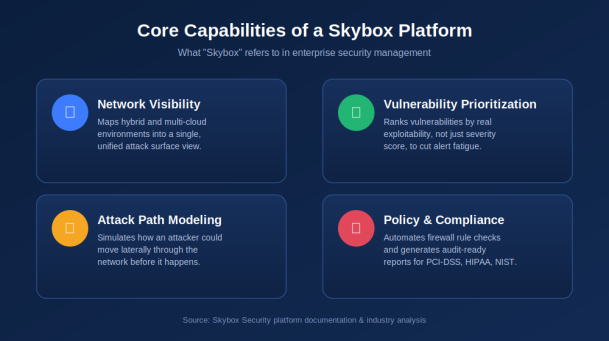
Skybox Security was a security management platform built for enterprises with sprawling, hybrid, and multi-cloud networks. Instead of just scanning for vulnerabilities and dumping a list on a dashboard, Skybox aimed to give security teams context: which vulnerabilities actually mattered, which ones an attacker could realistically reach, and which firewall rules or policy misconfigurations were quietly widening the attack surface.
At its core, Skybox combined data from firewalls, routers, switches, cloud configurations, and vulnerability scanners into a single model of the network. From that model, it could simulate attack paths, flag risky policy changes before they were pushed live, and generate compliance reports without a security analyst manually stitching spreadsheets together.
The platform was organized around a handful of core modules, and security teams typically licensed the ones that matched their biggest pain points:
- Firewall Assurance — auditing firewall rules for redundancy, risk, and compliance drift.
- Network Assurance — modeling the network topology to spot exposure and misconfigurations.
- Vulnerability & Threat Management — correlating scan data with threat intelligence to prioritize what to patch first.
- Change Management — reviewing proposed firewall and policy changes before they introduce risk.
For large enterprises in finance, healthcare, government, and telecom — industries where a single misconfigured firewall rule can trigger a breach or a compliance fine — that kind of contextual visibility was genuinely valuable.
Why IT and Security Leaders Turned to Skybox
Ask any CISO what keeps them up at night, and “too many alerts, not enough context” is near the top of the list. Vulnerability scanners are good at finding problems; they’re not always good at telling you which problems an attacker could actually exploit given your specific network layout. Skybox tried to close that gap.
A few reasons it found traction with enterprise security teams:
It cut through alert fatigue. Rather than treating every CVE with a high CVSS score as equally urgent, Skybox factored in exploitability and network exposure — so teams could focus remediation effort where it counted.
It modeled attack paths before attackers found them. By simulating how a threat could move laterally through the network, security teams could close off routes proactively instead of reacting after an incident.
It made audits less painful. For regulated industries, generating PCI-DSS, HIPAA, or NIST-aligned reports by hand is a slow, error-prone process. Automated, audit-ready reporting was one of the more concrete time-savers the platform offered.
It gave non-technical stakeholders a clearer picture. Visualized attack surfaces and risk scores are easier for boards and business executives to digest than raw vulnerability lists, which helped security leaders make the case for budget and prioritization.
None of this made Skybox a silver bullet. Large environments took real time to fully integrate, the licensing was priced for enterprise budgets, and some teams reported that reporting performance degraded once the number of tracked endpoints and vulnerabilities got large. It was a serious tool for serious network complexity — not something a small business would typically need.
It’s also worth understanding where Skybox fit relative to other tools in the security stack, since the name gets used loosely. Skybox was not a SIEM — it didn’t monitor real-time events streaming off your infrastructure. It wasn’t a next-gen firewall or an endpoint agent either. Think of it more as a modeling and analysis layer that sat on top of the data your other tools were already generating, turning raw configuration and scan data into a picture of risk that a human could actually act on. That distinction matters when you’re mapping out what a replacement platform needs to cover, because losing Skybox doesn’t just mean losing a dashboard — it can mean losing the correlation layer that made everything else make sense.
Here’s a visual summary of what the platform actually did under the hood, and the split between operational and compliance value it delivered to the teams using it.
What Happened to Skybox Security
Here’s the part that matters most for anyone researching this topic in 2026: Skybox Security ceased operations in 2025. According to industry reporting, the company shut down, and its business and technology assets were subsequently acquired by Tufin. For organizations that had built workflows around the Skybox platform, this meant an abrupt loss of product support and a scramble to figure out what came next.
This isn’t a footnote — it’s the reason the question “what is a Skybox” is worth answering carefully rather than just pointing someone to a product page. If you’re an IT or security leader currently running Skybox, evaluating it based on old case studies, or trying to figure out how to replace the capability it provided, you’re dealing with a platform that no longer has an active vendor behind it. That changes the calculus entirely: continuity of support, future updates, and long-term compliance reporting are all open questions with a discontinued product.
For teams still relying on the legacy platform, a few practical questions are worth raising internally sooner rather than later: Who is responsible for maintaining firewall rule audits if the tool stops receiving updates? What happens to compliance reporting workflows built around Skybox output when the next audit cycle comes around? And does your team have visibility into whether Tufin’s roadmap for the acquired assets aligns with your organization’s needs, or whether it’s time to look elsewhere? None of these have a one-size-fits-all answer, but waiting until a renewal deadline or an audit forces the question is the riskiest path of all.
What This Means for Your Security Strategy Today
The underlying problem Skybox addressed hasn’t gone away — if anything, it’s gotten harder. Networks are more hybrid, more cloud-dependent, and more attractive to attackers than they were when Skybox first built its platform. Security leaders still need:
- Continuous visibility into their real attack surface, not just a snapshot.
- Vulnerability prioritization grounded in actual exploitability.
- Automated compliance reporting that doesn’t require a full-time analyst to maintain.
- A platform actively developed, patched, and supported — not one left on life support after an acquisition.
That last point is where the market has shifted. Legacy exposure management tools built a decade ago are being replaced by platforms that combine posture management with active threat prevention, rather than visibility alone. If your organization is still leaning on Skybox-era tooling, or evaluating what should replace it, this is the moment to look at platforms built for where enterprise security actually stands today — not where it stood when Skybox launched.
Frequently Asked Questions
1. Is Skybox Security still available? No. Skybox Security ceased business operations in 2025, and its assets were acquired by Tufin. Organizations still running the legacy product should plan a migration path.
2. How is Skybox different from a vulnerability scanner? Scanners list every vulnerability they find. Skybox-style platforms added context — mapping which vulnerabilities were actually reachable and exploitable given the network’s real topology and policy configuration.
3. Is a Skybox-style platform right for small businesses? These platforms were built for large enterprises with complex, hybrid networks. Smaller organizations generally need a lighter-weight, more automated approach to exposure and threat management.
4. Can this kind of platform help with compliance? Yes — automated policy checks and audit-ready reporting for standards like PCI-DSS, HIPAA, and NIST were among the most valued features of the category.
Choosing What Comes Next
Understanding what a Skybox is matters most as context: it explains a category of enterprise security tooling, why it existed, and why the ground has shifted since a key vendor in that space shut down. For IT and security leaders, the real task now isn’t understanding a discontinued product — it’s choosing a modern platform that delivers the visibility and prioritization Skybox promised, backed by active development and real-time threat prevention.
If your team is reassessing its exposure management and endpoint security strategy in light of these changes, it’s worth seeing how a current, actively supported platform handles it.
Please give us a star rating based on your experience.


 (23 votes, average: 2.26 out of 5, rated)