Cyberattacks aren’t a matter of “if” anymore — they’re a matter of “when.” Every year, organizations pour money into firewalls, antivirus software, and security policies, yet breaches still happen. Why? Because most security tools are built to defend against known threats, while real attackers are constantly probing for the one weakness nobody thought to check.
That’s exactly where penetration testing comes in.
If you’ve ever asked yourself, “What is penetration testing, and why does my business need it?” — this guide breaks it down in plain language: what it is, how it works, the different types, and how it can help you build a stronger, more resilient security posture.
What is Penetration Testing?
Penetration testing, often shortened to “pen testing,” is a controlled, authorized simulation of a cyberattack against your own systems, networks, or applications. The goal is simple: find security weaknesses before real hackers do.
A pen tester — sometimes called an “ethical hacker” — uses the same tools, techniques, and mindset as a malicious attacker, but with permission and a clear objective: uncover vulnerabilities, document them, and help the organization fix them.
Think of it like hiring a professional burglar to test your house’s locks, windows, and alarm system — except instead of stealing anything, they hand you a detailed report on every way they could have gotten in.
Why Penetration Testing Matters
Many businesses assume that firewalls, antivirus software, and basic security hygiene are enough. In reality, these tools only catch known threats and common attack patterns. They can’t tell you:
- Whether an employee’s weak password could let an attacker into your entire network
- If a misconfigured cloud server is exposing sensitive customer data
- Whether your web application has a hidden flaw that lets someone bypass login screens
- How far an attacker could move through your systems once they got a foothold
Penetration testing answers these questions with evidence, not guesswork. It shows you exactly how an attack could unfold in your specific environment — not a generic checklist, but a real-world simulation.
Beyond risk reduction, pen testing is also increasingly a compliance requirement. Standards like PCI DSS, HIPAA, SOC 2, and ISO 27001 either require or strongly recommend regular penetration testing to prove that an organization is actively managing its security risks.
The 5 Phases of Penetration Testing
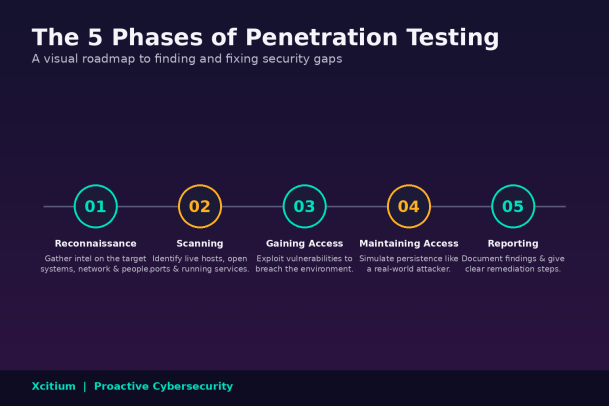
Every professional penetration test follows a structured methodology. While the exact steps can vary by provider, most tests move through five core phases.
1. Reconnaissance
Also called the “information gathering” phase, this is where the tester collects as much data as possible about the target — domain names, IP ranges, employee names, technologies in use, and publicly available information. The more the tester learns here, the more realistic the attack simulation becomes.
2. Scanning
Next, the tester uses automated tools and manual techniques to identify live systems, open ports, and running services. This phase maps out the attack surface and highlights potential entry points, such as outdated software or exposed services.
3. Gaining Access
This is where the simulated attack happens. Using the vulnerabilities identified in the scanning phase, the tester attempts to exploit weaknesses — whether that’s a software flaw, a misconfiguration, weak credentials, or a social engineering trick — to gain unauthorized access.
4. Maintaining Access
Once inside, the tester explores how far they could go. Could they escalate privileges? Move laterally to other systems? Access sensitive data? This phase simulates what a real attacker would do after the initial breach, showing how much damage a single vulnerability could cause.
5. Reporting
The final phase turns findings into action. A good penetration test doesn’t just list vulnerabilities — it prioritizes them by risk, explains their potential business impact, and provides clear, actionable remediation steps. This report becomes the roadmap for closing security gaps.
Types of Penetration Testing
Not all pen tests look the same. Depending on your goals, you might choose one or a combination of the following:
Network Penetration Testing Focuses on internal and external network infrastructure — servers, firewalls, routers, and switches — to find exploitable weaknesses.
Web Application Penetration Testing Targets websites and web apps to uncover flaws like SQL injection, cross-site scripting (XSS), broken authentication, and insecure APIs.
Mobile Application Penetration Testing Examines iOS and Android apps for issues in code, data storage, and communication with backend servers.
Cloud Penetration Testing Assesses cloud environments (AWS, Azure, Google Cloud) for misconfigurations, weak access controls, and exposed storage.
Social Engineering Testing Evaluates human vulnerability through phishing simulations, pretexting calls, or physical security tests — because people, not just systems, are often the weakest link.
Wireless Penetration Testing Checks Wi-Fi networks for weak encryption, rogue access points, and unauthorized access risks.
Black Box, White Box, and Gray Box Testing
Penetration tests are also categorized by how much information the tester has going in:
- Black Box Testing — The tester has no prior knowledge of the environment, simulating an outside attacker starting from scratch.
- White Box Testing — The tester has full access to source code, network diagrams, and credentials, allowing for a deep, thorough assessment.
- Gray Box Testing — A middle ground, where the tester has partial knowledge, simulating an attacker with some inside information (such as a disgruntled employee or a compromised account).
Each approach has trade-offs between realism, depth, and cost — the right choice depends on your specific security goals.
Penetration Testing vs. Vulnerability Scanning
These two terms are often confused, but they’re not the same thing.
Vulnerability scanning is an automated process that scans systems for known vulnerabilities and produces a list of potential issues. It’s fast, low-cost, and good for regular monitoring — but it doesn’t verify whether those vulnerabilities are actually exploitable.
Penetration testing goes further. A human expert actively attempts to exploit vulnerabilities, chain them together, and demonstrate real-world impact. It’s more time-intensive and requires skilled professionals, but it delivers far deeper insight into your actual risk exposure.
In short: vulnerability scanning tells you what might be a problem. Penetration testing tells you what is a problem — and how bad it could get.
How Often Should You Perform a Penetration Test?
There’s no one-size-fits-all answer, but general best practices suggest:
- At least once a year, as a baseline for most organizations
- After major changes — new applications, infrastructure updates, mergers, or significant network changes
- Before compliance audits, to meet regulatory requirements
- After a security incident, to verify that vulnerabilities have been properly remediated
Cyber threats evolve constantly, and so should your testing schedule. A test that passed last year doesn’t guarantee safety today.
Choosing the Right Penetration Testing Partner
Not all pen testing services are created equal. When evaluating a provider, look for:
- Certified, experienced testers (OSCP, CEH, GPEN, or similar credentials)
- A clear, well-documented testing methodology
- Detailed, actionable reporting — not just a list of jargon-filled findings
- Post-test support to help you remediate and re-test vulnerabilities
- A track record across your specific industry and technology stack
The right partner won’t just find problems — they’ll help you understand and fix them, strengthening your overall security posture for the long term.
Final Thoughts
Penetration testing isn’t just a checkbox for compliance — it’s one of the most effective ways to understand your real-world security risk before an attacker does. By simulating genuine attack scenarios, organizations gain the visibility they need to prioritize fixes, strengthen defenses, and protect what matters most: their data, their customers, and their reputation.
Cyber threats aren’t slowing down, and neither should your defenses. Regular, expert-led penetration testing is one of the smartest investments you can make in your organization’s security future.
Ready to Find Your Security Gaps Before Attackers Do?
Don’t wait for a breach to discover your vulnerabilities. Xcitium’s security experts can help you identify, prioritize, and fix the weaknesses in your systems before they become costly incidents.
Please give us a star rating based on your experience.


 (23 votes, average: 2.57 out of 5, rated)