Every laptop, server, mobile device, and cloud workload connected to your network is a potential doorway for attackers. As organizations embrace remote work, BYOD policies, and hybrid cloud environments, the number of these doorways — or “endpoints” — has exploded. For IT leaders and CISOs, understanding what an endpoint protection service is and how it fits into a broader security strategy is no longer optional. It’s foundational.
This guide breaks down what endpoint protection services actually do, how they differ from traditional antivirus software, and what to look for when evaluating a provider for your organization.
What is an Endpoint Protection Service?
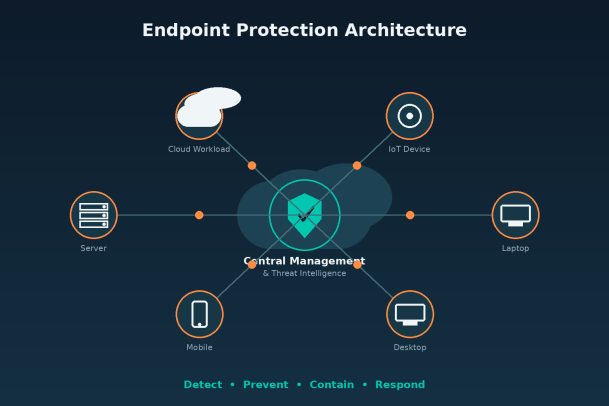
An endpoint protection service is a security solution designed to detect, prevent, and respond to threats targeting endpoints — the laptops, desktops, servers, mobile devices, and IoT hardware that connect to a corporate network. Unlike traditional antivirus tools that rely primarily on signature-based detection, modern endpoint protection services combine multiple layers of defense, including behavioral analysis, machine learning, threat intelligence, and centralized management, to stop both known and unknown threats.
At its core, an endpoint protection service typically includes:
- Threat prevention — blocking malware, ransomware, and exploits before they execute
- Detection and response (EDR) — continuously monitoring endpoint activity to identify suspicious behavior
- Centralized management — a single console for visibility, policy enforcement, and reporting across every device
- Automated remediation — isolating or rolling back compromised endpoints without manual intervention
- Threat intelligence integration — using global data on emerging attack patterns to stay ahead of new threats
Rather than treating each device as an isolated unit, an endpoint protection service ties everything together into one coordinated defense system, giving security teams a unified view of risk across the entire organization.
Why Endpoint Protection Matters More Than Ever
A decade ago, most corporate devices sat behind a well-defined network perimeter, protected by firewalls and on-premises security appliances. That perimeter has effectively disappeared. Employees work from home, coffee shops, and airports. Contractors connect from personal devices. Applications run across multiple cloud providers. Every one of these access points is now, in effect, part of the network edge.
This shift has made endpoints the single most targeted entry point for cyberattacks. According to industry threat reports, the overwhelming majority of successful breaches begin at the endpoint — through phishing emails, malicious downloads, or exploited vulnerabilities in unpatched software. Ransomware in particular has evolved to specifically target endpoints as a launchpad for lateral movement across a network.
For CISOs, this means endpoint protection is no longer a “nice to have” layered on top of a firewall. It’s often the last line of defense — and increasingly, the first place an attack is either stopped or allowed to spread.
How Endpoint Protection Services Work
Most modern endpoint protection platforms operate through a lightweight agent installed on each device, paired with a cloud-based or on-premises management console. Here’s a simplified look at how the pieces typically work together:
- Continuous monitoring — The agent watches processes, file activity, network connections, and system behavior in real time.
- Threat detection — Suspicious activity is flagged using a combination of signature databases, heuristics, behavioral analysis, and machine learning models trained on global threat data.
- Prevention and containment — When a threat is identified, the platform can block execution, quarantine the file, or isolate the device from the network to prevent lateral spread.
- Investigation and response — Security teams get visibility into what happened, when, and how, enabling faster root-cause analysis.
- Remediation — Some platforms can automatically roll back changes made by malware, restoring the endpoint to its last known-good state.
The image below illustrates how a central management layer connects and protects the range of devices typical in a modern enterprise environment.
Endpoint Protection vs. Traditional Antivirus
It’s easy to conflate endpoint protection with antivirus software, but the two are fundamentally different in scope and capability.
| Capability | Traditional Antivirus | Endpoint Protection Service |
|---|---|---|
| Detection method | Signature-based | Behavioral, heuristic, AI/ML-driven |
| Threat coverage | Known malware | Known and unknown (zero-day) threats |
| Visibility | Limited, device-by-device | Centralized, organization-wide |
| Response capability | Manual cleanup | Automated containment and remediation |
| Deployment model | Standalone software | Integrated platform with cloud management |
| Reporting | Minimal | Detailed forensics and compliance reporting |
Antivirus software answers the question “is this file bad?” An endpoint protection service answers the much broader question: “what is happening across every device in my environment, and how do I stop it before it spreads?”
Key Components IT Leaders Should Look For
When evaluating endpoint protection services, IT leaders and CISOs should look beyond marketing claims and assess the underlying architecture. Some of the most important components include:
Endpoint Detection and Response (EDR): EDR capabilities provide the visibility needed to investigate incidents, trace the origin of an attack, and understand its full scope — critical for both remediation and compliance reporting.
Default-deny / containment technology: Rather than relying solely on detecting known bad files, some platforms use a “default-deny” approach that automatically contains any unrecognized file until it’s verified as safe, dramatically reducing the risk of zero-day attacks slipping through.
Extended Detection and Response (XDR): Many organizations are moving toward XDR, which correlates data across endpoints, networks, email, and cloud workloads for a more complete picture of an attack in progress.
Scalability and centralized management: A single console should give administrators the ability to deploy policies, push updates, and respond to incidents across thousands of devices without added complexity.
Low performance impact: Endpoint agents should operate efficiently in the background without degrading device performance or frustrating end users — a common complaint with older, heavier antivirus suites.
Integration with existing security stack: The best solutions integrate cleanly with SIEM, SOAR, and identity management tools already in place, rather than operating as a disconnected silo.
Common Challenges When Choosing an Endpoint Protection Service
Selecting the right platform isn’t just a checkbox exercise. IT leaders commonly run into a few recurring challenges:
- Alert fatigue — Poorly tuned detection engines can flood security teams with false positives, burning out analysts and increasing the risk that a real threat gets missed.
- Fragmented visibility — Point solutions that don’t integrate well can leave blind spots between endpoint, network, and cloud security layers.
- Deployment complexity — Some enterprise platforms require significant configuration and tuning before they deliver real value, delaying time-to-protection.
- Cost vs. coverage trade-offs — Budget constraints can push organizations toward solutions that look comprehensive on paper but leave gaps in behavioral detection or automated response.
A strong endpoint protection strategy addresses these challenges directly, prioritizing solutions that reduce noise, unify visibility, and deploy quickly without requiring a large dedicated security team to manage.
Endpoint Protection as Part of a Layered Security Strategy
No single tool is a silver bullet. Endpoint protection services work best as one layer within a broader, defense-in-depth security strategy that also includes network security, identity and access management, email security, and employee awareness training. However, because endpoints are where users, applications, and data intersect most directly, they remain one of the highest-leverage places to invest in strong, automated protection.
For CISOs building or refining a security roadmap, the questions worth asking include:
- Does our current solution detect threats based on behavior, not just known signatures?
- Can we contain an infected device automatically, before it spreads laterally?
- Do we have full visibility into every endpoint — including remote and BYOD devices?
- How quickly can our team investigate and remediate an incident from detection to resolution?
If the honest answer to any of these is “not well enough,” it’s a strong signal that your current endpoint strategy needs a closer look.
Final Thoughts
Endpoint protection has evolved from a simple antivirus checkbox into a sophisticated, essential layer of enterprise cybersecurity. For IT leaders and CISOs, choosing the right endpoint protection service means looking beyond basic malware detection and toward platforms that offer real-time behavioral analysis, automated containment, and centralized visibility across every device in the organization — wherever that device happens to be.
As threats continue to grow more sophisticated, the organizations best positioned to defend themselves are the ones that treat endpoint protection not as an afterthought, but as a core pillar of their security architecture.
Ready to See Endpoint Protection in Action?
Don’t leave your organization’s endpoints exposed to evolving threats. See how a modern, default-deny approach to endpoint protection can give your team the visibility and control it needs.
Please give us a star rating based on your experience.


 (18 votes, average: 2.44 out of 5, rated)