Every day, your organization generates and transmits an enormous volume of sensitive data — customer records, financial statements, employee information, intellectual property, and internal communications. All of it is a target. Whether that data sits on a laptop, moves across a network, or lives in the cloud, one technology stands between it and a costly breach: encryption.
If you’ve ever typed “encryption, what is it?” into a search bar, you’re not alone. It’s one of the most searched cybersecurity terms, and for good reason. Encryption is no longer a niche IT concern — it’s a board-level business decision that affects compliance, customer trust, and organizational resilience. This guide breaks down what encryption is, how it works, why it matters, and what business leaders and IT professionals need to know to use it effectively.
What Is Encryption?
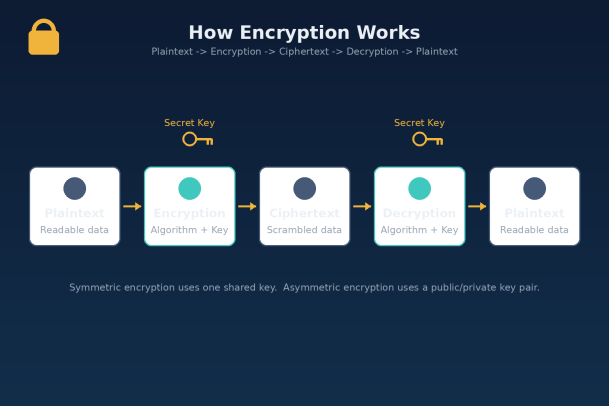
Encryption is the process of converting readable data, known as plaintext, into an unreadable format, known as ciphertext, using a mathematical algorithm and a key. Only someone with the correct key can reverse the process — a process called decryption — and turn the ciphertext back into usable information.
Think of encryption as a lockbox for digital information. Anyone can see the box, but only those holding the right key can open it and see what’s inside. If a cybercriminal intercepts encrypted data without the key, all they get is scrambled, meaningless text.
Encryption is used everywhere in modern business technology: securing emails, protecting files stored in the cloud, safeguarding online transactions, and encrypting the data on employee laptops and mobile devices. It is a foundational layer of any serious cybersecurity strategy, not an optional add-on.
Why Encryption Matters for Business
For business leaders, encryption isn’t just a technical safeguard — it’s a risk management tool with direct implications for the bottom line.
1. Protecting Sensitive Data Customer payment details, employee records, trade secrets, and proprietary business data all need protection. Encryption ensures that even if this data is stolen, it remains useless to attackers without the decryption key.
2. Regulatory Compliance Regulations such as GDPR, HIPAA, PCI DSS, and CCPA either require or strongly recommend encryption for data at rest and in transit. Failing to encrypt sensitive information can result in significant fines, legal liability, and reputational damage following a breach.
3. Maintaining Customer Trust Customers expect their data to be handled responsibly. A single breach involving unencrypted data can erode years of brand trust in a matter of days. Demonstrating strong encryption practices is increasingly a competitive differentiator, not just a compliance checkbox.
4. Reducing the Cost and Impact of Breaches Studies on data breach costs consistently show that organizations with strong encryption practices experience lower breach-related costs than those without. Encryption limits what attackers can actually do with stolen data, which can mean the difference between a contained incident and a full-blown crisis.
How Encryption Works: The Basics
To understand encryption at a practical level, it helps to break the process into its core components:
- Plaintext: The original, readable data before it’s encrypted.
- Algorithm (Cipher): The mathematical formula used to transform plaintext into ciphertext.
- Key: A string of bits used by the algorithm to perform the encryption and decryption.
- Ciphertext: The scrambled, unreadable output of the encryption process.
The diagram below illustrates this flow at a high level, along with the two primary types of encryption used in business environments today.
Types of Encryption
There are two primary categories of encryption that every IT professional and business leader should understand:
Symmetric Encryption
Symmetric encryption uses a single key to both encrypt and decrypt data. It’s fast and efficient, making it well-suited for encrypting large volumes of data, such as files on a server or a full disk. The challenge with symmetric encryption is key distribution: both the sender and receiver need access to the same secret key, and if that key is intercepted, the security of the data is compromised.
Common symmetric algorithms include AES (Advanced Encryption Standard), which is the current industry standard and widely used by governments, financial institutions, and enterprises worldwide.
Asymmetric Encryption
Asymmetric encryption, also called public-key cryptography, uses a pair of mathematically linked keys: a public key and a private key. The public key can be shared openly and is used to encrypt data, while the private key is kept secret and is the only key that can decrypt it.
This approach solves the key distribution problem inherent in symmetric encryption and is the backbone of technologies like HTTPS, digital signatures, and secure email. Common asymmetric algorithms include RSA and ECC (Elliptic Curve Cryptography).
In practice, most modern security systems use a combination of both: asymmetric encryption to securely exchange a symmetric key, and symmetric encryption to handle the bulk encryption of data because it’s faster.
Encryption at Rest vs. Encryption in Transit
Business leaders should understand that encryption needs to be applied in two distinct contexts:
Encryption at Rest protects data that is stored — on servers, databases, hard drives, or backup systems. If a device is lost, stolen, or improperly accessed, encryption at rest ensures the data remains inaccessible without the proper key.
Encryption in Transit protects data as it moves across networks — between a user’s browser and a website, between servers, or across email systems. Protocols like TLS (Transport Layer Security) are the industry standard for encrypting data in transit, and they’re what put the “S” in HTTPS.
A comprehensive data protection strategy addresses both. Data that’s encrypted at rest but sent unencrypted across a network — or vice versa — leaves a significant gap that attackers can exploit.
Common Encryption Standards and Algorithms
IT professionals evaluating or implementing encryption solutions will regularly encounter these standards:
- AES (Advanced Encryption Standard): The most widely adopted symmetric encryption standard, available in 128-bit, 192-bit, and 256-bit key lengths. AES-256 is generally considered the gold standard for sensitive data.
- RSA (Rivest-Shamir-Adleman): A widely used asymmetric algorithm, commonly used for secure data transmission and digital signatures.
- TLS/SSL: Protocols that secure data in transit, most visibly used to secure websites and web-based communications.
- End-to-End Encryption (E2EE): Ensures data is encrypted from the point of origin to its final destination, with no intermediate party — including the service provider — able to access the plaintext content.
Practical Encryption Challenges for Businesses
Despite its importance, implementing encryption effectively comes with real-world challenges that organizations need to plan for:
Key Management: Encryption is only as strong as the security of its keys. Poor key management — weak storage, infrequent rotation, or lack of access controls — can undermine even the strongest encryption algorithm.
Performance Overhead: Encrypting and decrypting data requires processing power. For large-scale systems, this needs to be factored into infrastructure planning, though modern hardware has significantly reduced this impact.
Regulatory Complexity: Different industries and regions have different encryption requirements. Multinational organizations often need to navigate a patchwork of standards across GDPR, HIPAA, PCI DSS, and other frameworks.
Balancing Security and Usability: Overly complex encryption implementations can frustrate employees and slow down workflows, leading to risky workarounds. The right solution integrates encryption seamlessly into existing processes.
Endpoint Vulnerabilities: Encryption protects data, but it doesn’t protect against compromised endpoints. If an attacker gains access to a device or account with legitimate decryption access, encryption alone won’t stop them — which is why encryption should be one layer within a broader, multi-layered security strategy.
Best Practices for Implementing Encryption
For IT professionals building or refining an encryption strategy, a few best practices consistently stand out:
- Encrypt data both at rest and in transit across all systems, not just the ones deemed “sensitive.”
- Use industry-standard algorithms like AES-256 and avoid outdated or deprecated ciphers.
- Implement strong key management practices, including regular key rotation and strict access controls.
- Apply encryption as part of a layered security strategy that includes endpoint protection, network monitoring, and access management — not as a standalone solution.
- Audit and update encryption practices regularly to keep pace with evolving standards and emerging threats, including the long-term implications of quantum computing on current cryptographic methods.
- Educate employees on the role encryption plays in protecting company and customer data, and how their own device and account security ties into it.
Encryption Is One Layer — Not the Whole Strategy
It’s worth emphasizing: encryption protects data, but it doesn’t stop malware, prevent phishing attacks, or secure a compromised endpoint. A ransomware attack that gains access to a system before data is decrypted can still encrypt files with its own malicious key, or exfiltrate data before your encryption ever comes into play. This is why encryption needs to work alongside endpoint protection, threat detection, and containment technologies as part of a comprehensive, defense-in-depth security posture.
For business leaders, this is the key takeaway: encryption is essential, but it’s not sufficient on its own. Real protection comes from combining strong encryption practices with proactive threat prevention across every endpoint, network, and cloud environment your business relies on.
Final Thoughts
Encryption is a foundational pillar of modern cybersecurity — protecting sensitive data, supporting regulatory compliance, and preserving customer trust. But as cyber threats grow more sophisticated, encryption alone isn’t enough to keep your organization safe. Businesses need a complete security strategy that combines encryption with advanced threat prevention, endpoint protection, and continuous monitoring.
If you’re ready to strengthen your organization’s security posture beyond encryption alone, it’s time to see what a proactive, layered defense looks like in action.
Please give us a star rating based on your experience.


 (16 votes, average: 2.56 out of 5, rated)