A single click on a harmless-looking email attachment. A quick download of a “free” software update. A visit to a website that looks perfectly legitimate. In seconds, malicious code can slip into your systems and begin working quietly in the background, often without anyone noticing until the damage is already done.
So, how can malicious code do damage? The short answer is: in far more ways than most people realize. Malicious code isn’t just about annoying pop-ups or slow computers anymore. Today’s threats can steal sensitive data, lock entire networks for ransom, spy on employees, hijack devices, and cripple business operations for days or even weeks.
In this guide, we’ll break down what malicious code is, the hidden ways it causes harm, the warning signs to watch for, and the practical steps you can take to protect your organization.
What is Malicious Code
Malicious code is any software, script, or piece of programming designed to harm a computer system, network, or its users. It’s an umbrella term that covers viruses, worms, trojans, ransomware, spyware, adware, rootkits, and other harmful programs, often grouped together under the name malware.
Unlike ordinary software bugs, which are accidental, malicious code is created deliberately. Its authors may be motivated by money, espionage, political goals, revenge, or simply the challenge of breaking in. What makes it especially dangerous is that it’s often designed to hide. Modern malicious code can disguise itself as legitimate files, run silently in memory, and change its behavior to avoid detection by traditional security tools.
How Does Malicious Code Get In
Before understanding the damage, it helps to know how malicious code enters a system in the first place. The most common entry points include:
Phishing emails remain the number one delivery method. Attackers send messages with infected attachments or links that look like invoices, shipping notices, or password reset requests.
Compromised websites can deliver malicious code through “drive-by downloads,” where simply visiting a page is enough to trigger an infection on an unpatched browser.
Fake or pirated software is a popular vehicle. Cracked applications, bogus browser extensions, and counterfeit updates often carry hidden payloads.
Removable media such as USB drives can still spread infections, especially in environments where devices are shared.
Unpatched vulnerabilities in operating systems, applications, and network devices give attackers an open door without requiring any user interaction at all.
Supply chain attacks target trusted vendors and software providers, so malicious code arrives inside a legitimate product update.
Once inside, the real damage begins.
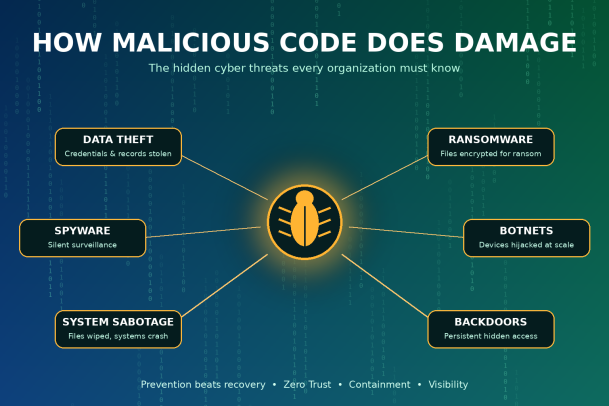
How Can Malicious Code Do Damage? 8 Hidden Threats
1. Stealing Sensitive Data
Data theft is one of the most common and costly outcomes of a malicious code infection. Information stealers and trojans are built to harvest login credentials, banking details, customer records, intellectual property, and personal information.
Some malware captures keystrokes as users type passwords. Others scrape browser-saved credentials or quietly copy files to attacker-controlled servers. Because this often happens silently, organizations may not discover a breach for months, and by then the stolen data may already be sold on underground markets or used for further attacks.
2. Encrypting Files for Ransom
Ransomware is arguably the most disruptive form of malicious code today. It encrypts files, databases, and sometimes entire servers, making them unusable until a ransom is paid.
Modern ransomware groups often use “double extortion”: they steal data before encrypting it, then threaten to publish it if the victim refuses to pay. Hospitals, schools, manufacturers, and local governments have all been brought to a standstill by ransomware, with recovery costs frequently far exceeding the ransom demand itself once downtime, legal fees, and reputational harm are factored in.
3. Spying on Users and Activities
Spyware is designed to watch rather than destroy. It can monitor browsing activity, record screens, access webcams and microphones, track location, and log communications.
For businesses, spyware can expose confidential strategy discussions, merger plans, or trade secrets. For individuals, it can lead to identity theft, blackmail, and a serious invasion of privacy. Because spyware aims to stay hidden for as long as possible, its damage accumulates quietly over time.
4. Corrupting or Destroying Systems
Not all malicious code wants to profit. Some is designed purely to cause destruction. Wiper malware, for example, permanently erases data or overwrites critical system files, rendering machines unbootable.
Viruses and worms can also corrupt files, consume system resources, and crash applications. In industrial environments, malicious code targeting control systems can even affect physical equipment, turning a digital attack into a real-world safety risk.
5. Hijacking Devices into Botnets
Malicious code can turn your computers, servers, routers, and even smart devices into “zombies” controlled remotely by attackers. These compromised machines are linked together into botnets that can number in the hundreds of thousands.
Botnets are then used to launch distributed denial-of-service (DDoS) attacks, send spam, spread more malware, or mine cryptocurrency. Your devices become unwilling participants in criminal activity, consuming your bandwidth and electricity while potentially exposing your organization to legal and reputational consequences.
6. Creating Backdoors for Future Attacks
Some of the most dangerous malicious code doesn’t cause immediate visible harm. Instead, it installs a backdoor, a hidden access point that lets attackers return whenever they choose.
Rootkits and remote access trojans (RATs) are often used for this purpose. They can survive reboots, hide from antivirus scans, and give attackers administrator-level control. This persistence allows threat actors to move laterally through a network, escalate privileges, and plan larger attacks at their convenience.
7. Draining Resources and Performance
Cryptojacking malware secretly uses your processing power to mine cryptocurrency. Adware floods systems with unwanted advertisements. Other types of malicious code consume memory, storage, and network bandwidth.
While these may seem less severe than ransomware, the effects add up: slower systems, overheating hardware, shortened device lifespans, higher cloud computing bills, and lost employee productivity.
8. Damaging Reputation and Compliance
The damage from malicious code extends well beyond technology. A breach can erode customer trust, trigger regulatory investigations, and lead to significant fines under data protection laws such as GDPR, HIPAA, or India’s DPDP Act.
Partners may reconsider working with a compromised organization, and negative media coverage can linger for years. For many businesses, reputational damage is the most expensive and longest-lasting consequence of an attack.
Warning Signs of a Malicious Code Infection
Malicious code is designed to hide, but it often leaves clues. Watch for these red flags:
- Unexplained slowdowns, frequent crashes, or unusually high CPU and memory usage
- Unexpected pop-ups, new browser toolbars, or changed homepage settings
- Files that are missing, renamed, or suddenly inaccessible
- Security software that has been disabled without your knowledge
- Unusual outbound network traffic or data transfers at odd hours
- New user accounts or privilege changes nobody authorized
- Colleagues or customers receiving strange emails sent from your accounts
If you notice any of these, isolate the affected device from the network and involve your IT or security team immediately.
How to Protect Your Organization from Malicious Code
The good news is that most malicious code attacks can be prevented or contained with the right combination of technology, processes, and awareness.
Keep everything patched. Regularly update operating systems, applications, browsers, and firmware. Many attacks succeed simply because a known vulnerability was never fixed.
Train your people. Employees are your first line of defense. Regular security awareness training helps them recognize phishing attempts, suspicious links, and social engineering tactics.
Adopt a Zero Trust approach. Never assume a file, user, or device is safe by default. Verify every access request and limit permissions to only what’s necessary.
Use advanced endpoint protection. Traditional signature-based antivirus struggles against new and evolving threats. Modern endpoint solutions use behavioral analysis, auto-containment, and threat intelligence to stop unknown malicious code before it executes harmful actions.
Back up critical data. Maintain regular, tested backups stored offline or in immutable storage so you can recover quickly from ransomware or wiper attacks.
Segment your network. Dividing your network into zones limits how far malicious code can spread if one device is compromised.
Monitor continuously. Endpoint detection and response (EDR) and managed detection services provide round-the-clock visibility, helping you spot and stop threats early.
Have an incident response plan. Know exactly who does what when an attack happens. A rehearsed plan dramatically reduces downtime and damage.
Why Prevention Beats Recovery
Recovering from a malicious code attack is expensive, stressful, and time-consuming. Systems must be rebuilt, data restored, investigations conducted, and customers reassured. Even then, some losses, like stolen data or damaged trust, can never be fully reversed.
Prevention-first security flips the equation. Instead of reacting after harm is done, it stops unknown files from ever gaining the ability to cause damage. Technologies such as auto-containment allow unknown applications to run in an isolated environment where they can’t touch your real system, protecting productivity without taking chances on security.
Final Thoughts
So, how can malicious code do damage? It can steal your data, lock your files, spy on your people, destroy your systems, hijack your devices, open hidden backdoors, drain your resources, and tarnish your reputation, often all at once and without warning.
The threats are hidden, but your defenses don’t have to be. By understanding how malicious code works and investing in proactive, prevention-focused security, you can keep attackers out and keep your business running smoothly.
Stop Malicious Code Before It Strikes
Don’t wait for an attack to reveal the gaps in your security. Xcitium’s Zero Trust, prevention-first platform uses patented auto-containment technology to neutralize unknown threats before they can cause harm, giving you complete protection across every endpoint.
See how Xcitium can protect your organization from ransomware, zero-day attacks, and hidden malicious code.
Please give us a star rating based on your experience.

 (150 votes, average: 1.21 out of 5, rated)