For professionals working in defense, intelligence, government contracting, or critical infrastructure sectors, a security clearance is often the key that unlocks career advancement. Whether you’re targeting a role with a federal agency, a defense contractor, or a cybersecurity firm supporting classified programs, understanding how to obtain security clearance is essential to positioning yourself for these opportunities.
This guide walks through the entire process — from figuring out which clearance level you need, to surviving the background investigation, to maintaining your clearance once it’s granted.
What is a Security Clearance
A security clearance is a formal determination by the U.S. government (or another national authority) that an individual is eligible to access classified national security information. Clearances aren’t just paperwork — they represent a judgment about an individual’s trustworthiness, reliability, and loyalty, based on an extensive investigation into their background.
Clearances are typically required for:
- Military personnel and veterans transitioning into defense roles
- Government employees and contractors
- Cybersecurity professionals supporting federal networks
- Engineers and scientists working on classified research
- IT specialists managing sensitive systems infrastructure
Because classified systems are high-value targets for adversaries, organizations that hold clearances are also expected to maintain strong technical safeguards — a topic we’ll return to at the end of this guide.
The Three Main Levels of Security Clearance
Before starting the process, it helps to understand the tiers involved, since the level required determines the depth of investigation you’ll undergo.
1. Confidential
The entry-level clearance. It grants access to information that, if disclosed, could cause damage to national security. Reinvestigation is typically required every 15 years.
2. Secret
A more common clearance for military and contractor roles. It permits access to information that could cause “serious damage” if disclosed. Reinvestigation occurs roughly every 10 years.
3. Top Secret
The highest standard tier, required for access to information that could cause “exceptionally grave damage” to national security. Top Secret clearances involve the most rigorous investigations and require reinvestigation every 5 years. Some Top Secret roles also require additional Sensitive Compartmented Information (SCI) access, which involves an even deeper vetting process.
Step-by-Step: How to Obtain Security Clearance
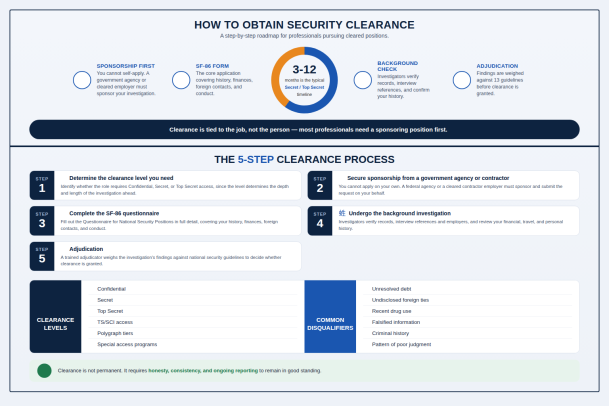
Step 1: Determine the Clearance Level You Need
Not every job requires the same level of clearance. Review the job posting or consult with your prospective employer’s security office to confirm exactly which tier applies. Applying for a higher clearance than necessary only slows down the process and adds unnecessary investigative burden.
Step 2: Secure Sponsorship From a Government Agency or Contractor
This is the step many professionals overlook: you cannot apply for a security clearance on your own. Clearances must be sponsored by a federal agency or a cleared government contractor that has a legitimate need for you to access classified information. In practice, this means you generally need a job offer — or at least a conditional offer — before the clearance process can begin.
Step 3: Complete the SF-86 Questionnaire
Once sponsored, you’ll complete the Standard Form 86 (SF-86), “Questionnaire for National Security Positions,” through the government’s e-QIP or eApp system. This lengthy form covers:
- Residential history (typically 7–10 years)
- Employment history
- Education
- Foreign contacts and travel
- Financial history, including debts and bankruptcies
- Criminal record
- Drug and alcohol use
- Mental health treatment (in limited, specific circumstances)
Accuracy and completeness are critical here. Omissions or inconsistencies — even unintentional ones — are one of the most common reasons applications get delayed or denied.
Step 4: Undergo the Background Investigation
The Defense Counterintelligence and Security Agency (DCSA), which handles most federal background investigations, will begin verifying the information you submitted. This can include:
- Interviews with former employers, neighbors, and personal references
- Verification of education and employment records
- Credit and financial history checks
- Criminal background checks at the local, state, and federal level
- For higher-level clearances, in-person interviews with the applicant
Investigation timelines vary significantly. Confidential and Secret clearances can sometimes be completed in a few months, while Top Secret investigations — especially those requiring SCI access — can take a year or longer, depending on agency backlogs.
Step 5: Adjudication
Once the investigation is complete, an adjudicator reviews the findings against 13 federal adjudicative guidelines, which include factors like foreign influence, financial considerations, personal conduct, and use of information technology. The adjudicator weighs the “whole person” — meaning a single negative factor (like past financial trouble) doesn’t automatically disqualify you if it’s outweighed by other positive indicators, such as steady employment and financial recovery.
If approved, you’ll receive formal notification of your clearance eligibility, and your sponsoring organization will be notified so you can begin accessing classified material as needed for your role.
Common Reasons Clearance Applications Get Delayed or Denied
Understanding common pitfalls can help you avoid unnecessary setbacks:
- Undisclosed foreign contacts or travel — Even innocent connections (family members abroad, international friendships) must be disclosed. Failing to report them looks worse than the contact itself.
- Unresolved debt or financial mismanagement — Significant unpaid debt, especially to the government, is a frequent red flag.
- Inconsistent information — Discrepancies between your SF-86 and what investigators find elsewhere can trigger deeper scrutiny.
- Substance use issues — Recent or unresolved drug or alcohol concerns can delay adjudication.
- Criminal history — Not always disqualifying, but must be disclosed and explained honestly.
How Long Does the Process Take?
Timelines vary by clearance level, agency workload, and the complexity of an applicant’s background:
| Clearance Level | Typical Timeline |
|---|---|
| Confidential | 1–3 months |
| Secret | 3–6 months |
| Top Secret | 6–18+ months |
Applicants with extensive foreign travel, dual citizenship, significant debt, or complicated personal histories should expect longer timelines, as these factors often require additional investigative steps.
Tips to Speed Up Your Security Clearance Process
- Be exhaustive and honest on the SF-86. Investigators cross-reference everything; inconsistencies are far more damaging than the underlying facts themselves.
- Get your financial house in order early. Pay down significant debt and resolve any collections accounts before applying.
- Keep records handy. Addresses, employment dates, and reference contact information should be organized and easily accessible.
- Respond quickly to investigator requests. Delays in providing additional documentation or scheduling interviews can add weeks to your timeline.
- Maintain your clearance once granted. Clearances require periodic reinvestigation, and certain life events (foreign travel, financial changes, legal issues) may need to be reported in the interim.
Frequently Asked Questions
1. Can I apply for a security clearance without a job offer? No. Clearances require sponsorship from a federal agency or a cleared contractor with a demonstrated need for you to access classified information. You cannot self-initiate the process, though you can prepare in advance by organizing your financial and residential history.
2. Does a past mistake automatically disqualify me? Not necessarily. Adjudicators use a “whole person” concept, weighing the nature, recency, and circumstances of any issue against mitigating factors like time elapsed, financial recovery, or completed rehabilitation. Full disclosure and honesty consistently matter more than the underlying issue itself.
3. Do clearances transfer between jobs? In many cases, yes — a process known as “reciprocity” allows a cleared individual moving to a new cleared position to avoid a full reinvestigation, provided there’s no gap in eligibility and no new disqualifying information. However, reciprocity isn’t guaranteed and depends on the receiving agency’s policies.
4. What happens if my clearance is denied? Applicants typically have the right to appeal a denial through a structured process, which may include a written response to a Statement of Reasons (SOR) and, in some cases, a hearing before an administrative judge. Many denials are successfully overturned on appeal when applicants provide additional context or documentation.
Maintaining Your Clearance Over Time
Obtaining a clearance isn’t a one-time event — it comes with ongoing obligations. Cleared individuals are generally required to report:
- Foreign travel, especially to countries of security concern
- Changes in marital status or new foreign national contacts
- Significant financial changes, including new debt or bankruptcy
- Arrests or legal proceedings
- Contact with foreign intelligence services
Failing to report these changes in a timely manner can jeopardize your clearance even if the underlying event wouldn’t have been disqualifying on its own. Most agencies also conduct Continuous Evaluation (CE), an ongoing automated review of public records, financial data, and other information — meaning clearance holders are effectively being monitored between formal reinvestigation cycles.
Why Security Clearance Also Means Security Responsibility
Earning a clearance is only part of the equation. Professionals and organizations that handle classified or sensitive government information are also expected to operate within strict cybersecurity frameworks, such as NIST 800-171, CMMC, and FISMA. A single unpatched endpoint or unmanaged device can jeopardize not just compliance status, but the classified information itself.
This is where having strong endpoint protection and a Zero Trust security architecture becomes essential — not just for individual professionals, but for the contractors and agencies that employ them. Robust endpoint detection, application control, and continuous monitoring help ensure that cleared personnel and the systems they access remain protected against increasingly sophisticated cyber threats.
Ready to Strengthen Your Organization’s Security Posture?
Holding a security clearance comes with the responsibility of protecting sensitive systems and data at the highest standard. If your organization needs a proven cybersecurity platform built for Zero Trust environments — from endpoint protection to threat containment — Xcitium can help you meet compliance requirements and defend against advanced threats.
Please give us a star rating based on your experience.


 (12 votes, average: 2.33 out of 5, rated)