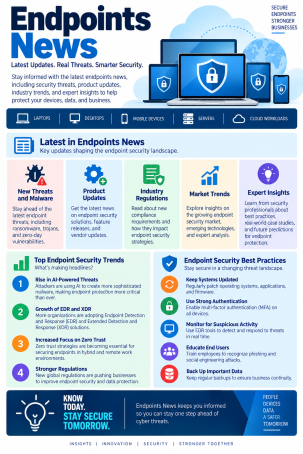
Every device connected to your network — every laptop, phone, server, and remote worker’s home setup — is a potential doorway for attackers, and that doorway count keeps growing. Staying on top of endpoints news isn’t optional anymore for security teams; it’s how you keep pace with a threat landscape that shifts faster than most patch cycles. The global endpoint security market itself is expanding rapidly as organizations race to close the gaps that legacy antivirus tools simply can’t cover.
This roundup breaks down the biggest developments shaping endpoint protection right now — from AI-powered detection to the identities-and-endpoints convergence reshaping how security teams think about the attack surface — along with what each trend actually means for your organization.
Why Endpoints News Matters for Modern Cybersecurity
The traditional network perimeter has effectively dissolved. Remote work, bring-your-own-device policies, and hybrid cloud infrastructure mean that endpoints — not the network edge — have become the primary battleground between attackers and defenders. Following endpoint security news closely helps security leaders anticipate emerging attack techniques before they show up in their own environment, rather than reacting after the fact.
Cybercriminals are also moving faster than ever, increasingly relying on “living-off-the-land” techniques that abuse legitimate system tools to avoid detection — a tactic that makes signature-based defenses far less effective and makes staying current on endpoint trends genuinely operational, not just informational.
Top Endpoint Security Trends Making Headlines
AI-Powered Threat Detection Takes Center Stage
Artificial intelligence and machine learning have moved from a marketing buzzword to a core function inside modern EDR platforms. These systems analyze behavioral patterns across endpoints in real time, flagging anomalies — unusual login times, unexpected privilege escalation, abnormal data transfers — that wouldn’t trigger any traditional signature-based alert. The result is faster detection, fewer false positives, and the ability to catch entirely novel threats that have never been seen before.
The Shift Toward Cloud-Native EDR Platforms
As organizations increasingly operate across hybrid and multi-cloud environments, security tools built for on-premises networks alone are falling short. Cloud-native EDR platforms offer centralized visibility across on-prem devices, cloud workloads, and remote endpoints from a single console, eliminating the blind spots that come from stitching together multiple disconnected tools.
EDR-to-XDR Convergence
One of the most consistent themes in current endpoint security news is the expansion of EDR into XDR (Extended Detection and Response). Rather than monitoring endpoints in isolation, XDR platforms correlate data across endpoints, networks, email, and cloud services to give security teams a unified picture of an attack as it unfolds — often revealing connections a siloed tool would miss entirely.
Rising Focus on Identity-Endpoint Convergence
Attackers increasingly target identities rather than devices directly, using stolen credentials to move laterally once inside a network. In response, security vendors are tightly integrating identity verification and endpoint monitoring, treating compromised credentials and compromised devices as two sides of the same detection problem.
OT and IoT Endpoints Enter the Spotlight
Operational technology (OT) and Internet of Things (IoT) devices — from manufacturing equipment to smart building systems — are increasingly recognized as endpoints requiring the same rigor as laptops and servers. These environments often run on legacy systems that can’t support traditional agents, pushing vendors to develop lightweight, specialized monitoring solutions built specifically for OT constraints.
What These Endpoint Security Developments Mean for Your Organization
Staying informed is only useful if it translates into action. Here’s how to apply these trends to your own security posture:
- Audit your current EDR coverage. Confirm every device type — including remote, mobile, and IoT/OT endpoints — is actually covered, not just traditional workstations.
- Evaluate AI-driven detection capabilities. If your current tools rely solely on signature-based detection, you’re likely missing novel and fileless threats.
- Consider consolidating toward XDR. Fragmented, siloed tools create visibility gaps; a unified platform closes them.
- Reassess identity and access controls alongside endpoint policy. Treat MFA, least-privilege access, and endpoint monitoring as one integrated strategy, not separate initiatives.
- Don’t overlook non-traditional endpoints. OT and IoT devices are increasingly targeted precisely because they’re often the least monitored part of the network.
How Often Should You Track Endpoint Security News?
Given how quickly attack techniques evolve, security teams benefit from checking trusted endpoint security sources at least weekly, with deeper trend reviews monthly or quarterly to reassess tooling and policy. Subscribing to a reputable vendor blog, threat intelligence feed, or industry newsletter ensures new attack techniques and platform developments don’t slip past your team unnoticed.
FAQ: Endpoints News
1. What counts as an “endpoint” in cybersecurity?
An endpoint is any device that connects to a network, including laptops, desktops, servers, mobile phones, IoT devices, and increasingly, operational technology (OT) systems used in manufacturing and infrastructure.
2. Why is endpoint security news important for small businesses, not just enterprises?
Attackers frequently target smaller organizations precisely because they assume weaker defenses. Staying current on endpoint security trends helps smaller teams prioritize limited security budgets on the protections that matter most.
3. What’s driving the shift from EDR to XDR?
Security teams need visibility that spans beyond individual endpoints to include network traffic, cloud activity, and email — XDR consolidates these data sources so analysts can spot attacks that span multiple systems, which siloed EDR tools often miss.
4. How is AI changing endpoint security?
AI enables behavioral-based detection that can identify suspicious activity even when no known malware signature exists, significantly improving detection speed and reducing false alerts compared to traditional antivirus approaches.
5. Are IoT and OT devices really considered endpoints?
Yes. Any network-connected device — including smart sensors, industrial control systems, and connected building infrastructure — is a potential entry point for attackers and increasingly falls under modern endpoint security strategies.
Stay Ahead of the Endpoint Threat Landscape
Reading about endpoint security trends is a great starting point, but real protection comes from deploying tools built to act on them. Xcitium’s advanced endpoint protection platform combines AI-driven detection, real-time containment, and unified visibility to keep your organization ahead of emerging threats.
Request a demo today and see how Xcitium turns the latest endpoint security developments into real, actionable protection for your organization.
Please give us a star rating based on your experience.


 (27 votes, average: 2.37 out of 5, rated)