Every click, purchase, login, and network packet leaves a trace. For most of business history, organizations looked at those traces only in the rear-view mirror, asking what happened and why. Today, the most competitive companies ask a far more valuable question: what is likely to happen next?
That shift is exactly what predictive analytics makes possible. So, what is predictive analytics, how does it work, and why has it become essential for everything from retail forecasting to cybersecurity? This guide breaks it down in plain terms, walks through the process and core techniques, and shows how organizations use data-driven forecasting to make faster, smarter decisions.
What is Predictive Analytics
Predictive analytics is a branch of advanced analytics that uses historical data, statistical modeling, data mining, and machine learning to forecast future outcomes. Instead of simply reporting on the past, it identifies patterns and relationships in data and uses them to estimate the probability of what comes next.
Think of it as a weather forecast for your business. A meteorologist cannot guarantee rain tomorrow, but by analyzing decades of atmospheric data, they can say there is an 80% chance of it. Predictive analytics works the same way: it assigns likelihoods to events such as a customer churning, a machine failing, a transaction being fraudulent, or a user account being compromised.
It helps to see where predictive analytics sits among the four main types of analytics:
- Descriptive analytics answers “What happened?” through reports and dashboards.
- Diagnostic analytics answers “Why did it happen?” by drilling into root causes.
- Predictive analytics answers “What is likely to happen?” using models and probabilities.
- Prescriptive analytics answers “What should we do about it?” by recommending actions.
Predictive analytics is the bridge between understanding the past and acting on the future. Without it, prescriptive decisions are little more than educated guesses.
How Predictive Analytics Works
While the algorithms can get complex, the overall workflow follows a clear, repeatable path. Most predictive analytics projects move through five stages.
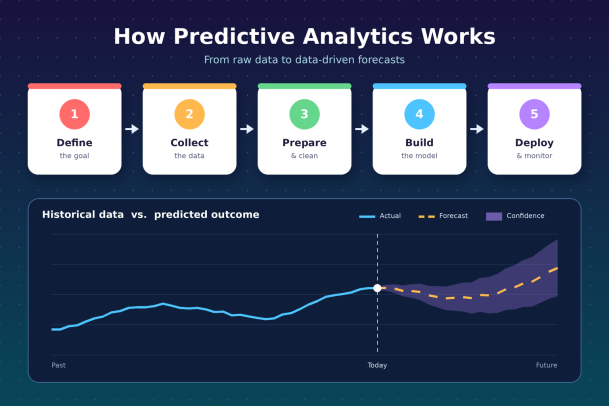
- Define the goal. Every successful project starts with a specific business question, such as “Which customers are likely to cancel in the next 90 days?” or “Which endpoints show early signs of compromise?” A clear objective determines what data you need and how success will be measured.
- Collect the data. Relevant data is gathered from sources like CRM systems, transaction logs, IoT sensors, web analytics, and security telemetry. The richer and more representative the data, the more reliable the predictions.
- Prepare and clean. Raw data is messy. This stage removes duplicates, fills gaps, corrects errors, and engineers features (new variables that make patterns easier to detect). Data preparation often consumes the majority of a project’s time, and it is where accuracy is won or lost.
- Build the model. Data scientists select and train statistical or machine learning models on historical data, then validate them against data the model has never seen. The goal is a model that generalizes well rather than one that simply memorizes the past.
- Deploy and monitor. The validated model is put into production, where it scores new data in real time or in batches. Because markets, behaviors, and threats change, models are continuously monitored and retrained to prevent “model drift.”
Key Predictive Analytics Techniques and Models
There is no single “predictive analytics algorithm.” Instead, practitioners choose from a toolkit of techniques depending on the question and the data.
- Regression analysis estimates the relationship between variables. Linear regression predicts continuous values like sales revenue, while logistic regression predicts yes-or-no outcomes like whether a customer will churn.
- Decision trees split data into branches based on conditions, producing easy-to-explain rules. Ensembles such as random forests and gradient boosting combine many trees for higher accuracy.
- Classification models sort data into categories, for example labeling an email as spam or legitimate, or a file as safe or malicious.
- Time series forecasting models such as ARIMA and exponential smoothing analyze data points collected over time to forecast demand, traffic, or resource usage.
- Clustering groups similar records together without predefined labels. It is often used for customer segmentation and for spotting unusual behavior that does not fit any known group.
- Neural networks and deep learning detect highly complex, non-linear patterns in large datasets, powering image recognition, natural language processing, and advanced threat detection.
The best model is rarely the most complex one. It is the one that balances accuracy, speed, and explainability for the decision it supports.
Real-World Applications of Predictive Analytics
Predictive analytics is no longer reserved for tech giants. It now drives everyday decisions across nearly every industry.
Cybersecurity. Security teams use predictive models to analyze user behavior, network traffic, and endpoint activity, flagging anomalies before they escalate into breaches. By learning what “normal” looks like, these systems can detect zero-day malware, insider threats, and credential abuse that signature-based tools miss.
Finance and banking. Banks score credit risk, detect fraudulent transactions in milliseconds, and forecast market movements. A purchase that deviates sharply from a cardholder’s usual pattern can be blocked before the money leaves the account.
Healthcare. Hospitals predict patient readmission risk, anticipate disease outbreaks, and identify patients who would benefit from early intervention, improving outcomes while reducing costs.
Retail and e-commerce. Retailers forecast demand to optimize inventory, personalize product recommendations, and set dynamic prices. Predicting what customers want before they search for it is a major driver of conversion.
Manufacturing. Predictive maintenance analyzes sensor data to anticipate equipment failures, letting teams fix machines before they break and avoid costly unplanned downtime.
Marketing. Marketers predict customer lifetime value, identify the leads most likely to convert, and target churn-prevention campaigns at customers showing early warning signs.
Benefits of Predictive Analytics
Organizations that put predictive analytics to work gain advantages that compound over time.
- Proactive decision-making. Teams act on what is likely to happen instead of reacting after the fact, whether that means restocking shelves or isolating a suspicious process.
- Reduced risk. Early warnings about fraud, defaults, equipment failure, or cyberattacks give organizations time to intervene before losses occur.
- Operational efficiency. Accurate forecasts reduce waste, from excess inventory to over-provisioned infrastructure and unnecessary maintenance.
- Better customer experiences. Anticipating needs enables personalized offers, faster service, and timely outreach that builds loyalty.
- Competitive advantage. Companies that see trends first can move first, capturing opportunities while competitors are still reading last quarter’s reports.
Challenges and Best Practices
Predictive analytics is powerful, but it is not magic. The most common obstacles include:
- Poor data quality. Incomplete, biased, or outdated data produces unreliable predictions. Garbage in still means garbage out.
- Model drift. A model trained on last year’s behavior may lose accuracy as customers, markets, or attackers change tactics.
- Bias and fairness. Models can inherit biases hidden in historical data, leading to unfair outcomes in lending, hiring, or healthcare.
- Skills gaps. Building and maintaining models requires data science expertise that many organizations lack.
- Privacy and security. Predictive systems depend on large volumes of sensitive data, which must be protected and governed responsibly.
To overcome these hurdles, start with a focused, high-value use case rather than a sprawling initiative. Invest in data governance and quality from day one. Favor explainable models where decisions affect people, and monitor performance continuously so you can retrain before accuracy slips. Finally, protect the data pipeline itself: a predictive system is only as trustworthy as the infrastructure it runs on.
The Future of Predictive Analytics
Predictive analytics is evolving quickly. Advances in AI and machine learning are making models more accurate, while automated machine learning (AutoML) platforms are putting forecasting tools in the hands of business users, not just data scientists.
Real-time analytics is another major shift. Instead of running predictions overnight, organizations increasingly score data as it streams in, enabling instant responses to fraud attempts, equipment anomalies, and security threats. Edge computing pushes this even further by running models directly on devices and endpoints.
At the same time, predictive analytics is increasingly paired with prescriptive and autonomous systems. The future is not only knowing what will happen but automatically taking the right action, such as containing an unknown file or quarantining a compromised device, before a human ever needs to step in.
Conclusion: Turn Data Into Foresight
So, what is predictive analytics? It is the practice of turning historical data into reliable forecasts, giving organizations the foresight to act before problems arise and opportunities pass. From predicting customer churn to stopping fraud and anticipating cyberattacks, data-driven forecasting has become a core capability for any organization that wants to stay ahead.
The key is pairing smart analytics with technology that can act on those insights instantly. Nowhere is that more critical than in cybersecurity, where the gap between detection and damage can be measured in seconds.
Ready to see how proactive, intelligence-driven protection can keep your organization one step ahead of threats? Discover how Xcitium combines advanced threat analysis with real-time containment to stop attacks before they cause harm.
Please give us a star rating based on your experience.


 (14 votes, average: 2.36 out of 5, rated)