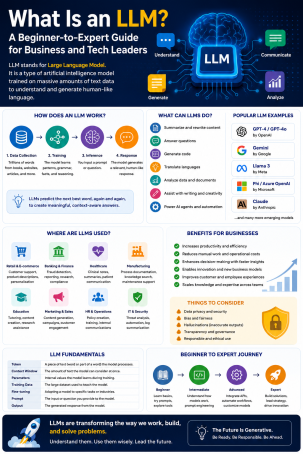
Chances are you’ve talked to one today, whether you knew it or not. Chatbots, search assistants, code generators, and customer service tools are all powered by the same underlying technology — but what is an LLM, exactly, and why does it matter for your organization’s security? In simple terms, an LLM (large language model) is a type of artificial intelligence trained on massive amounts of text so it can understand, generate, and predict human language. LLMs now sit inside everyday business tools, from email assistants to internal chatbots, which means understanding how they work — and how they can be exploited — has become essential reading for anyone responsible for online security.
In this guide, we’ll explain what an LLM is, how it works, where it’s used, and the cybersecurity risks organizations need to manage before adopting one.
What Is an LLM (Large Language Model)?
An LLM, or large language model, is a type of artificial intelligence trained on enormous volumes of text data to recognize patterns in human language and generate new text in response to a prompt. Rather than following fixed, hard-coded rules like traditional software, an LLM works statistically — predicting the most likely next word in a sequence based on everything it has learned during training.
The “large” in large language model refers to two things: the size of the training data (often trillions of words scraped from books, websites, and other text) and the number of parameters — the internal values the model adjusts as it learns. Some modern LLMs contain hundreds of billions of parameters, which is part of what allows them to write essays, summarize documents, translate languages, generate code, and hold natural conversations.
Well-known examples of LLMs include GPT-based models, Claude, Gemini, and Llama — each trained differently, but built on the same core idea: learning language by example, at massive scale.
How Does an LLM Work?
Understanding what an LLM is also means understanding the architecture behind it. Most modern LLMs are built on a design called the transformer, introduced in 2017, which changed how machines process language.
Tokens and Embeddings
Before an LLM can process text, it breaks a prompt down into small chunks called tokens — which can be whole words or pieces of words. Each token is then converted into a numerical representation called an embedding, a multi-dimensional vector that captures the token’s meaning and its relationship to other words.
Self-Attention: How LLMs Understand Context
The breakthrough behind transformers is a mechanism called self-attention. It allows the model to weigh how relevant every other word in a sentence is to the word it’s currently processing, which is how an LLM figures out that “bank” means something different in “river bank” versus “savings bank.” This context-awareness is what separates modern LLMs from older, simpler language models.
Training and Fine-Tuning
LLMs are typically built in stages:
- Pretraining – The model learns general language patterns from a massive, broad dataset.
- Fine-tuning – The model is further trained on more specific or curated data to improve accuracy for particular tasks.
- Instruction tuning / alignment – The model is trained to better follow instructions and produce helpful, safe responses, often using human feedback.
Once trained, the LLM generates text one token at a time, calculating the probability of every possible next token and selecting the most likely one — repeating this process until the response is complete.
Key Benefits of LLMs for Businesses
Understanding what an LLM is naturally raises the question: why are so many organizations adopting them? The practical benefits include:
- Speed: LLMs can draft, summarize, or analyze large volumes of text in seconds.
- Scalability: A single model can support customer service, internal support, and content generation simultaneously.
- Natural interaction: Employees and customers can use plain language instead of learning rigid commands or interfaces.
- Automation: Repetitive writing, summarizing, and research tasks can be offloaded to an LLM, freeing up staff time.
- Adaptability: The same base model can be fine-tuned or prompted for many different tasks, from legal review to code generation.
Is an LLM Secure? Common Risks and Best Practices
Because LLMs process natural language input directly from users — and are increasingly connected to internal data, tools, and systems — they introduce a new category of cybersecurity risk that traditional security tools weren’t built to catch. For any organization focused on internet security, treating an LLM as “just software” is a mistake.
Common LLM Security Risks
- Prompt injection: Attackers craft input designed to override the model’s original instructions, potentially exposing sensitive data or triggering unintended actions. Prompt injection is widely considered the top security risk facing LLM-powered applications.
- Indirect prompt injection: Malicious instructions hidden inside a document, webpage, or email that the LLM later reads and unknowingly follows.
- Data leakage: Sensitive information — customer records, credentials, or proprietary data — can be exposed through a model’s responses if it was included in training data or a connected data source.
- Model or system prompt exfiltration: Attackers attempt to trick the model into revealing its confidential internal instructions.
- Hallucinations: LLMs can generate confident-sounding but factually incorrect answers, which can mislead users or amplify the impact of other attacks.
- Data poisoning: Corrupting the data a model is trained or fine-tuned on to manipulate its future behavior.
LLM Security Best Practices
- Apply strong access controls — use role-based access control (RBAC) and multi-factor authentication (MFA) for anyone interacting with LLM systems or APIs.
- Sanitize and validate inputs to reduce the risk of prompt injection reaching the model.
- Limit data exposure — only give the model access to the data it needs, and avoid retaining sensitive inputs longer than necessary.
- Enforce least-privilege tool use for any LLM connected to external tools, databases, or agents.
- Monitor and log LLM interactions continuously to catch unusual prompts, outputs, or API calls in real time.
- Red-team and test regularly, probing your own LLM deployment for jailbreaks and injection vulnerabilities before attackers do.
- Align with recognized frameworks, such as the OWASP Top 10 for LLM applications, NIST AI guidance, or ISO 27001, to structure your controls.
Treating LLM security as an ongoing process — not a one-time setup — is what separates organizations that safely benefit from this technology from those that become a case study.
Common Use Cases for LLMs
- Customer service: Chatbots and virtual assistants that resolve queries in natural language
- Content creation: Drafting articles, marketing copy, and internal documentation
- Code generation: Writing, explaining, and debugging software code
- Summarization: Condensing long reports, emails, or research into key points
- Translation: Converting text between languages while preserving context and meaning
- Search and knowledge retrieval: Powering AI-assisted search and internal knowledge bases
Getting Started with LLMs Securely
If your organization is adopting an LLM — whether through a public chatbot, an internal copilot, or an AI agent connected to your systems — the goal isn’t just capability, it’s capability you can trust. Before rolling out or scaling an LLM deployment, review your endpoint protection, data access policies, and monitoring coverage, since these are the layers that catch a compromised prompt or a leaking integration before it turns into a breach. Pairing LLM adoption with strong cybersecurity fundamentals — encryption, access control, and continuous monitoring — is what turns a powerful productivity tool into one your security team can stand behind.
Frequently Asked Questions About LLMs
1. What is an LLM in simple terms?
An LLM (large language model) is a type of AI trained on huge amounts of text so it can understand language and generate human-like responses to a prompt, without being explicitly programmed with fixed rules.
2. What is an LLM used for?
LLMs are used for tasks like chatbots, content writing, code generation, document summarization, translation, and AI-assisted search, across industries including customer service, software development, and marketing.
3. Is ChatGPT an LLM?
Yes. ChatGPT is a conversational application built on top of an LLM (from the GPT model family). The LLM is the underlying model that generates the language; ChatGPT is the interface that lets people interact with it.
4. Are LLMs secure?
LLMs can be used securely when organizations apply strong access controls, input validation, monitoring, and least-privilege data access. Without those safeguards, LLMs are vulnerable to risks like prompt injection, data leakage, and model manipulation.
5. What is the difference between an LLM and traditional AI?
Traditional, rule-based software follows fixed, explicitly programmed instructions. An LLM instead learns statistical patterns from training data and generates responses probabilistically, allowing it to handle open-ended natural language rather than rigid commands.
Protect Your Organization’s LLM Deployments with Xcitium
Now that you know what an LLM is and how it works, the next step is making sure every deployment is protected. As LLMs become embedded in more business workflows, attackers are actively developing new techniques to exploit them — and a single unprotected integration can expose sensitive data across your entire organization.
Xcitium helps organizations secure their systems, endpoints, and data with proactive, zero-trust protection built for today’s AI-driven threat landscape.
Request a Free Demo to see how Xcitium can help safeguard your AI systems and overall business data.
Please give us a star rating based on your experience.


 (25 votes, average: 2.28 out of 5, rated)