Ever wondered why some of the world’s most successful companies still bring in outside experts to solve problems they seemingly could handle in-house? The answer lies in one simple truth: no organization can be an expert at everything, and that is exactly what is consulting designed to solve.
At its core, consulting is the practice of providing expert advice, strategic guidance, or specialized services to organizations that need outside expertise to solve a problem, improve performance, or navigate change. Businesses hire consultants when they lack the internal knowledge, time, or resources to tackle a specific challenge — whether that’s streamlining operations, planning a merger, or defending against a cyberattack. In fact, the global market for these services was valued at well over $160 billion in recent years, reflecting just how much organizations rely on outside expertise to stay competitive. This guide breaks down how it works, the main types of services available, and why cybersecurity consulting specifically has become one of the fastest-growing and most critical areas of the industry.
What Is Consulting? A Clear Definition
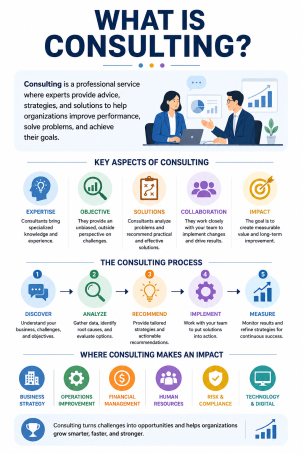
Consulting is a professional service in which an individual or firm — the consultant — provides expert knowledge, analysis, and recommendations to help a client organization solve a problem or achieve a goal. Consultants are typically brought in for their specialized skills, objective outside perspective, and experience solving similar challenges across multiple industries.
Unlike full-time employees, consultants are usually engaged on a project basis, often for a defined period or a specific deliverable. This allows organizations to access high-level expertise without the long-term cost of hiring a permanent specialist.
Main Types of Consulting Services
This field spans many industries and specialties. Understanding the different types helps clarify where cybersecurity services fit within the broader landscape.
Management Consulting
Management consultants help organizations improve overall performance by analyzing existing business problems and developing plans for growth, efficiency, or restructuring.
IT and Technology Consulting
This category focuses on helping businesses select, implement, and optimize technology systems — including software, infrastructure, and digital transformation strategies.
Cybersecurity Consulting
This specialty has emerged as one of the most in-demand consulting fields, as organizations face a constant stream of ransomware, phishing, data breaches, and compliance requirements. A cybersecurity consultant evaluates an organization’s security posture, identifies vulnerabilities, and recommends solutions to protect networks, endpoints, and sensitive data.
Financial and Risk Advisory
These consultants advise on financial strategy, risk management, and regulatory compliance, helping organizations make sound decisions and avoid costly missteps.
Human Resources Advisory
HR consultants assist with talent strategy, organizational structure, culture, and workforce planning.
Why Cybersecurity Consulting Matters for Online Security
For organizations focused on online security and internet security, this specialty has quickly become one of the most valuable services available. Here’s why:
- Rising threat complexity — Attackers constantly evolve their tactics, from ransomware to social engineering, making it difficult for internal teams to keep pace alone.
- Compliance pressure — Regulations like GDPR, HIPAA, and industry-specific frameworks require specialized knowledge to navigate correctly.
- Resource gaps — Many organizations, especially small and mid-sized businesses, lack a dedicated in-house security team.
- Objective risk assessment — An outside consultant can identify blind spots that internal teams may overlook due to familiarity or bias.
- Faster incident response — Experienced cybersecurity consultants help organizations build and test incident response plans before a breach happens, not after.
What Does a Cybersecurity Consultant Actually Do?
A cybersecurity consultant’s responsibilities typically include:
- Conducting security assessments — Evaluating networks, endpoints, and applications for vulnerabilities.
- Performing penetration testing — Simulating real-world attacks to expose weaknesses before criminals find them.
- Developing security policies — Creating clear guidelines for data handling, access control, and acceptable use.
- Recommending security tools — Advising on endpoint protection, firewalls, and threat detection platforms suited to the organization’s needs.
- Guiding compliance efforts — Helping organizations meet regulatory and industry security standards.
- Training employees — Reducing human error, which remains one of the leading causes of security breaches.
- Building incident response plans — Preparing teams to react quickly and effectively if an attack occurs.
How to Choose the Right Consulting Partner
Whether you’re evaluating a management consultant or a cybersecurity firm, a few key factors matter most:
- Relevant experience — Look for a track record in your specific industry or security challenge.
- Clear methodology — A strong consultant should be able to explain their process, not just their conclusions.
- Proven results — Ask for case studies, references, or measurable outcomes from past engagements.
- Communication style — Effective engagements depend on clear, ongoing collaboration between the consultant and your internal team.
- Scalability — Choose a partner who can grow with your organization as needs evolve, especially as cyber threats become more sophisticated.
Frequently Asked Questions About Consulting
1. What is consulting, in simple terms?
Consulting is the practice of hiring an outside expert or firm to provide specialized advice, analysis, or services that help an organization solve a problem or improve performance.
2. How is cybersecurity consulting different from general IT services?
While IT services focus broadly on technology systems and infrastructure, cybersecurity consulting specifically addresses security risks, threat detection, compliance, and protecting an organization’s networks and data from attacks.
3. Why do companies hire consultants instead of using in-house staff?
Companies often hire consultants for specialized expertise they don’t have internally, an objective outside perspective, and flexibility — since consultants can be engaged for a specific project without a long-term hiring commitment.
4. How much does cybersecurity consulting typically cost?
Costs vary widely based on the scope of work, the consultant’s experience, and the size of the organization, ranging from project-based fees for a single assessment to ongoing retainer agreements for continuous security support.
5. When should a business consider hiring a cybersecurity consultant?
Businesses should consider hiring a cybersecurity consultant when facing rapid growth, new compliance requirements, a recent security incident, or when they lack the internal expertise to properly assess and manage cyber risk.
Strengthen Your Security Strategy With the Right Expertise
Understanding how this process works helps clarify why so many organizations turn to outside experts — especially when it comes to protecting against today’s evolving cyber threats. Whether you’re building a security program from scratch or strengthening an existing one, the right guidance and tools make all the difference.
Ready to strengthen your organization’s security posture?
Request a demo with Xcitium and see how proactive cybersecurity solutions can support your security strategy.
Please give us a star rating based on your experience.


 (18 votes, average: 2.44 out of 5, rated)