Every time a firewall blocks a suspicious connection, a bank flags a fraudulent transaction, or an antivirus tool quarantines a file, an algorithm is doing the work behind the scenes. The word gets thrown around constantly in tech conversations, board meetings, and vendor pitches — but many business and security leaders have never had a clear, jargon-free answer to the question: what is an algorithm, really?
This guide breaks down the concept in plain language, then connects it directly to how algorithms shape cybersecurity defenses and business decision-making today.
What Is an Algorithm?
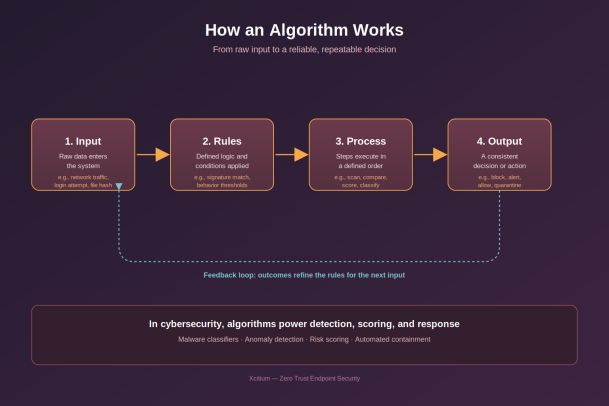
An algorithm is a finite, well-defined set of steps designed to solve a specific problem or complete a specific task. It takes an input, applies a sequence of logical operations, and produces a predictable output.
Think of it like a recipe. A recipe takes raw ingredients (input), follows a precise sequence of instructions (the algorithm), and produces a finished dish (output). Follow the same recipe with the same ingredients, and you get the same result every time. That consistency and repeatability is the defining trait of any algorithm, whether it’s baking bread or detecting ransomware.
In computing terms, an algorithm is:
- Finite — it has a clear beginning and end; it doesn’t run forever.
- Well-defined — every step is unambiguous and precise.
- Input-driven — it operates on data provided to it.
- Output-producing — it generates a result, decision, or action.
- Repeatable — given the same input and conditions, it produces the same output.
Algorithms existed long before computers. Ancient mathematicians used step-by-step procedures to solve equations. What’s changed is scale: today, algorithms run billions of times per second across networks, devices, and cloud systems, making decisions far faster than any human could.
A Simple Everyday Example
Imagine sorting a stack of resumes by years of experience. The algorithm might look like this:
- Take the first resume and note the years of experience.
- Compare it to the next resume.
- If the next one has more experience, move it ahead; if not, leave the order as is.
- Repeat until every resume has been compared.
- Output the sorted stack.
That’s a basic sorting algorithm. It’s mechanical, repeatable, and produces the same order every time you run it on the same stack. Scale that same logic up to millions of security events per second, and you start to see why algorithms matter far beyond software development — they matter to how a business operates and protects itself.
Why Algorithms Matter in Cybersecurity
Modern cyber threats move faster than manual review ever could. A human analyst cannot personally inspect every packet crossing a network or every file downloaded by an employee. Algorithms fill that gap by applying consistent logic at machine speed, and they sit at the core of nearly every security control in use today.
Here’s where algorithms show up directly in cybersecurity operations:
1. Malware Detection and Classification
Antivirus and endpoint protection platforms use algorithms to compare files against known malicious signatures, and increasingly, to score files based on behavioral patterns rather than exact matches. This lets them catch new or modified threats that don’t match anything in a static database.
2. Anomaly and Behavioral Detection
Rather than looking for a known bad signature, behavioral algorithms establish a baseline of “normal” activity — typical login times, typical data transfer volumes, typical application usage — and flag deviations. This is how many modern platforms catch insider threats or compromised accounts that use legitimate credentials.
3. Encryption and Data Protection
Cryptographic algorithms (like AES or RSA) are the mathematical backbone of secure communication. They take readable data, apply a defined transformation using a key, and produce unreadable ciphertext — reversible only with the correct key. Every secure website connection, VPN tunnel, and encrypted backup depends on these algorithms.
4. Risk Scoring and Prioritization
Security teams are flooded with alerts. Scoring algorithms weigh factors like asset value, exploit severity, and exposure to rank which alerts need attention first, helping smaller security teams focus limited time where it matters most.
5. Automated Response and Containment
In advanced setups, algorithms don’t just detect a problem — they act on it. If a process shows ransomware-like behavior (rapid file encryption, for instance), an algorithm can automatically isolate the endpoint from the network before the damage spreads, without waiting for a human to intervene.
This is the layer where a concept like “algorithm” stops being academic and becomes something that directly determines how quickly a business can detect, contain, and recover from an attack.
Why This Matters for Business Leaders, Not Just IT Teams
It’s tempting to treat “algorithm” as a purely technical word that belongs to developers and analysts. In practice, algorithmic decisions now shape business outcomes directly:
- Speed of response. An algorithm that flags and contains a breach in seconds, rather than hours, is the difference between a contained incident and a headline-making data breach.
- Cost control. Automated, algorithm-driven detection reduces the manual workload on security teams, which matters when skilled security staff are expensive and hard to hire.
- Trust and compliance. Encryption algorithms and access-control logic underpin the compliance requirements (HIPAA, PCI-DSS, GDPR, and similar frameworks) that businesses are legally required to meet.
- Vendor evaluation. When evaluating a security vendor, understanding what their algorithms actually do — signature-based vs. behavioral, reactive vs. automated — helps leaders ask sharper questions instead of taking marketing claims at face value.
A leader doesn’t need to write code to make good decisions here. But understanding that “the algorithm decides” isn’t magic — it’s a specific, auditable set of rules — makes it much easier to hold vendors, teams, and tools accountable for results.
Common Types of Algorithms Business Leaders Should Recognize
| Type | What It Does | Where You’ll See It |
|---|---|---|
| Sorting/Searching | Organizes or locates data efficiently | Databases, log analysis |
| Cryptographic | Secures data through mathematical transformation | Encryption, secure connections |
| Classification | Sorts inputs into categories (safe/malicious, spam/not spam) | Malware detection, email filtering |
| Behavioral/Anomaly | Detects deviations from a normal baseline | Insider threat detection, fraud detection |
| Optimization | Finds the most efficient path or allocation | Network routing, resource allocation |
Algorithms Are Only as Good as Their Design
It’s worth being direct about a limitation: an algorithm is only as effective as the logic and data behind it. A poorly designed detection algorithm can produce excessive false positives (wasting analyst time) or, worse, false negatives (missing real threats). This is why the quality of a security vendor’s underlying algorithms — not just the existence of “AI” or “machine learning” in their marketing — is what actually determines protection quality.
This is also why layered approaches matter. No single algorithm catches everything. Combining signature-based detection, behavioral analysis, and automated containment creates overlapping safety nets, so a weakness in one layer doesn’t leave the entire system exposed.
Frequently Asked Questions
1. Is an algorithm the same thing as artificial intelligence? No. An algorithm is a set of defined steps; AI is a broader field that often uses algorithms (particularly machine learning algorithms) that adjust their own rules based on data over time. Every AI system relies on algorithms, but not every algorithm involves AI. A simple sorting routine or a fixed encryption process is an algorithm, but it isn’t “intelligent” in the way a self-adjusting fraud-detection model is.
2. Can algorithms make mistakes? Yes. An algorithm only does what it’s designed to do, based on the data and rules it’s given. If the underlying logic is flawed, or the training data for a machine-learning algorithm is biased or incomplete, the output will reflect those flaws. This is why regular testing, tuning, and human oversight remain essential, even in highly automated security environments.
3. How is a “rule-based” algorithm different from a “machine learning” algorithm? A rule-based algorithm follows explicit, human-written conditions (“if this file matches a known malicious signature, block it”). A machine learning algorithm is trained on large volumes of data to recognize patterns on its own, and can adapt to detect threats it has never explicitly seen before. Most modern security platforms use a blend of both.
4. Why should a non-technical executive care about algorithm design? Because algorithm design directly affects business risk. A poorly tuned detection algorithm can let a real breach slip through or bury security teams in false alarms, both of which have real financial and reputational costs. Executives don’t need to write the code, but understanding the basic logic helps them ask better questions during vendor selection and incident reviews.
Bringing It Together
An algorithm, at its core, is simply a reliable, repeatable set of steps for turning an input into a decision. That simple concept scales up into some of the most important protections a modern business relies on: malware detection, encryption, fraud prevention, and automated incident response.
For cybersecurity and business leaders alike, understanding algorithms isn’t about becoming a data scientist. It’s about recognizing that the tools protecting your business run on specific, definable logic — logic that can be evaluated, questioned, and improved. The businesses that ask the right questions about how their security algorithms work are the ones best positioned to catch threats before they become breaches.
Want to see how well-designed, layered detection algorithms can protect your business in real time?
Please give us a star rating based on your experience.


 (16 votes, average: 2.31 out of 5, rated)