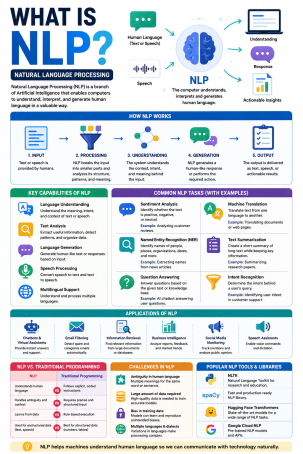
Have you ever wondered how Google search knows exactly what you mean, or how a spam filter catches a phishing email before it hits your inbox? What is NLP? The answer lies in Natural Language Processing (NLP) — a branch of artificial intelligence that enables machines to understand, interpret, and respond to human language. NLP is a field of AI that combines linguistics, computer science, and machine learning so computers can process text and speech the way humans naturally communicate.
In today’s cybersecurity, IT, and business environments, NLP plays a far bigger role than most people realize — powering everything from spam detection to threat intelligence and automated security reporting. For professionals focused on online security, cybersecurity, and internet security, understanding what NLP is and how it works isn’t just interesting technology trivia — it’s becoming essential to how modern threats are detected and stopped. This guide breaks down the meaning of NLP, how it functions, and why it matters for security-conscious organizations.
What Is NLP? Breaking Down the Basics
Natural Language Processing (NLP) is a subfield of artificial intelligence focused on the interaction between computers and human language. Rather than requiring rigid, structured commands, NLP allows systems to interpret natural, everyday language — whether it’s typed text, spoken words, or even the tone behind a message.
NLP relies on a combination of techniques, including:
Text Analysis
Extracting meaning, patterns, and relationships from large volumes of written text, such as emails, chat logs, or security alerts.
Speech Recognition
Converting spoken words into text so systems can process voice commands or transcribe conversations for analysis.
Sentiment Analysis
Determining the emotional tone behind a piece of text — useful for flagging aggressive, manipulative, or suspicious language patterns.
Named Entity Recognition (NER)
Identifying and classifying key pieces of information within text, such as names, organizations, locations, or IP addresses.
Together, these techniques allow machines to move beyond simple keyword matching and actually understand context, intent, and meaning within human language.
How Does NLP Work?
At a high level, NLP systems process language through several stages. First, text is broken down into smaller units — words, phrases, or sentences — through a process called tokenization. Next, the system analyzes grammar and structure (syntax) before interpreting meaning (semantics). Modern NLP models, particularly those built on machine learning and deep learning architectures, are trained on massive datasets of human language so they can recognize patterns, predict intent, and generate coherent responses.
This is the same underlying technology behind tools like chatbots, voice assistants, translation software, and increasingly, cybersecurity platforms that need to interpret unstructured data at scale.
Why NLP Matters for Cybersecurity and Internet Security
NLP has moved well beyond search engines and virtual assistants — it’s now a core component of modern security operations. Here’s where it makes a measurable difference:
Phishing and Spam Detection
NLP-powered email security tools analyze the language, tone, and structure of incoming messages to identify phishing attempts, even when attackers use sophisticated social engineering tactics that traditional filters might miss.
Threat Intelligence Analysis
Security teams are flooded with unstructured data — forum posts, dark web chatter, incident reports, and threat feeds. NLP helps automatically extract relevant indicators of compromise (IOCs) and summarize threat intelligence from massive volumes of text far faster than manual review.
Automated Security Reporting
Instead of manually sifting through logs and alerts, NLP can help generate readable summaries of security incidents, saving analysts valuable time during investigations.
Chatbot-Based Security Support
Many organizations now use NLP-driven chatbots to handle first-line security questions, guide employees through reporting suspicious activity, or triage support tickets before escalating to human analysts.
Actionable Ways to Apply NLP in Your Security Strategy
If you’re looking to bring NLP-driven capabilities into your organization’s security posture, consider these practical steps:
- Evaluate NLP-enabled email security tools. Look for platforms that go beyond keyword-based spam filters and use language-context analysis to catch more sophisticated phishing attempts.
- Incorporate NLP into threat intelligence workflows. Use tools that can automatically parse and summarize large volumes of unstructured threat data.
- Train staff to recognize AI-assisted social engineering. As attackers also use NLP-generated text to craft convincing phishing messages, employee awareness training should account for increasingly natural-sounding scam attempts.
- Audit NLP-based tools for data privacy compliance. Since NLP systems often process sensitive text data, ensure any tools you adopt align with your organization’s data privacy and compliance requirements.
- Start small and scale. Begin by piloting NLP capabilities in one area — such as email filtering or ticket triage — before expanding across broader security operations.
The Double-Edged Sword: NLP as Both Defense and Threat
It’s worth noting that NLP isn’t only a defensive tool — cybercriminals use the same underlying technology to generate more convincing phishing emails, fake customer support chats, and deepfake-adjacent text scams. This makes it increasingly important for security teams to understand NLP from both angles: as a detection tool and as a capability attackers are actively weaponizing. Staying ahead requires pairing NLP-powered defenses with strong human awareness and layered security controls.
Final Thoughts: Why Understanding NLP Matters Now
So, what is NLP? It’s the technology quietly powering everything from your search engine results to the spam filter protecting your inbox — and increasingly, the systems defending organizations against sophisticated cyber threats. As natural language processing continues to advance, its role in both offensive and defensive cybersecurity will only grow. Organizations that understand and adopt NLP-driven security tools today will be better positioned to detect threats that traditional, rule-based systems simply can’t catch.
Ready to see AI-driven security in action? NLP-powered tools are just one piece of a modern, layered defense strategy.
Want to protect your organization with AI-driven, Zero Trust security? Request a demo with Xcitium today and discover how intelligent, NLP-enhanced threat detection can strengthen your defenses.
Frequently Asked Questions About NLP
1. What is NLP in simple terms?
NLP, or Natural Language Processing, is a branch of artificial intelligence that allows computers to understand, interpret, and generate human language — whether spoken or written.
2. How is NLP used in cybersecurity?
NLP is used in cybersecurity for phishing and spam detection, analyzing threat intelligence from unstructured text sources, automating security incident reporting, and powering chatbot-based security support tools.
3. What’s the difference between NLP and AI?
AI (artificial intelligence) is the broader field focused on creating systems that can perform tasks requiring human-like intelligence. NLP is a specialized subfield of AI focused specifically on understanding and processing human language.
4. Can NLP be used maliciously?
Yes. Cybercriminals can use NLP-based tools to generate more convincing phishing emails, fake chat interactions, and social engineering content, making awareness of NLP’s dual-use nature important for security teams.
5. Do I need technical expertise to use NLP tools?
Not necessarily. Many modern security platforms integrate NLP capabilities behind the scenes — for example, in email filtering or automated reporting — so organizations can benefit from NLP without needing in-house data science expertise.
Please give us a star rating based on your experience.


 (18 votes, average: 2.39 out of 5, rated)