What Is a Bias?
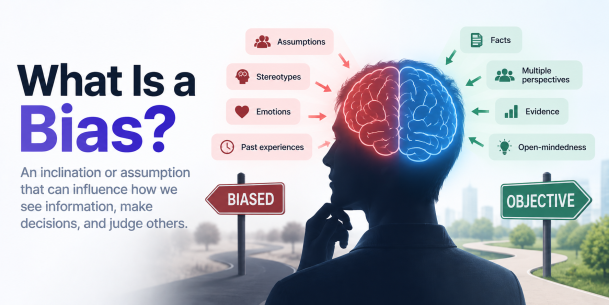
A bias is a tendency, preference, assumption, or systematic influence that affects how a person interprets information, makes decisions, or judges people and situations. Bias can be conscious or unconscious. It can also affect research, statistics, algorithms, artificial intelligence, hiring, cybersecurity decisions, and everyday life.
In simple terms, bias can cause people or systems to favor one perspective or outcome over another instead of evaluating all available information objectively.
What Does Bias Mean?
Bias means having an inclination or tendency that influences judgment.
A bias does not always involve intentionally treating someone unfairly. People can develop biases without realizing it because the human brain frequently uses past experiences, assumptions, and mental shortcuts to process information quickly.
For example, imagine someone believes that expensive products are always better.
When comparing two laptops, that person might automatically assume the more expensive laptop is superior without comparing its specifications.
That assumption can influence the decision before all the evidence is considered.
Simple Example of Bias
Imagine two employees propose similar ideas during a meeting.
A manager already considers one employee highly talented. The manager immediately praises that employee’s idea while examining the other employee’s proposal more critically.
The difference in evaluation may be influenced by an existing impression rather than the quality of the ideas themselves.
This is a simple example of how bias can affect judgment.
What Are the Main Types of Bias?
Bias can appear in many forms.
| Type of Bias | Meaning | Simple Example |
|---|---|---|
| Cognitive bias | Mental shortcut that influences judgment | Assuming something memorable is more common |
| Confirmation bias | Favoring information that supports existing beliefs | Reading only articles that agree with you |
| Implicit bias | Automatic attitudes outside conscious awareness | Unconsciously making assumptions about someone |
| Explicit bias | Conscious belief or preference | Openly favoring one group or option |
| Selection bias | Data or participants are selected unrepresentatively | Surveying only one type of customer |
| Sampling bias | A sample does not represent the population | Surveying gym users about national exercise habits |
| Observer bias | Expectations affect observations | Recording results according to expectations |
| Response bias | Answers are systematically inaccurate | Giving an answer because it seems socially acceptable |
| Survivorship bias | Focusing on successes while ignoring failures | Studying only successful businesses |
| Algorithmic bias | A system produces systematically skewed outcomes | A model performing unevenly across relevant groups |
The exact meaning of bias therefore depends on the context.
What Is Cognitive Bias?
Cognitive bias is a systematic tendency in thinking that can influence how people interpret information and make decisions.
Humans cannot carefully analyze every piece of information they encounter.
Instead, the brain often relies on mental shortcuts.
These shortcuts can be useful for making quick decisions, but they can also lead to errors.
Common cognitive biases include:
- Confirmation bias
- Anchoring bias
- Availability bias
- Halo effect
- Hindsight bias
- Framing effect
- Survivorship bias
What Is Confirmation Bias?
Confirmation bias is the tendency to favor information that supports what you already believe while giving less attention to conflicting evidence.
For example, suppose someone believes a particular smartphone brand is the best.
They may:
- Search primarily for positive reviews
- Remember favorable experiences
- Dismiss negative reviews
- Interpret ambiguous information positively
As a result, their original belief becomes stronger even if the complete evidence is mixed.
How to reduce confirmation bias
Ask:
- What evidence contradicts my opinion?
- Am I considering multiple sources?
- Would I judge this evidence differently if it supported the opposite conclusion?
- What information could prove my assumption wrong?
What Is Implicit Bias?
Implicit bias refers to automatic attitudes or associations that can influence judgment without conscious awareness.
People may not deliberately hold or endorse these assumptions.
Implicit biases can influence decisions involving:
- Hiring
- Education
- Workplace interactions
- Customer service
- Leadership
- Performance evaluations
- Everyday social interactions
Recognizing the possibility of implicit bias can encourage more structured and evidence-based decisions.
What Is Explicit Bias?
Explicit bias is a conscious belief, preference, or attitude that a person recognizes and may deliberately express.
The main difference is awareness:
| Implicit Bias | Explicit Bias |
|---|---|
| Can operate automatically | Conscious |
| Person may not recognize it | Person recognizes the belief |
| Can influence decisions unintentionally | May deliberately influence decisions |
| Often requires reflection to identify | Usually easier to identify |
Both forms can influence decisions and behavior.
What Is Unconscious Bias?
Unconscious bias describes assumptions or preferences that influence decisions without a person consciously recognizing them.
The term is often used in workplace discussions involving:
- Recruitment
- Promotions
- Performance reviews
- Leadership
- Team selection
- Employee evaluation
Using standardized criteria, structured interviews, multiple reviewers, and documented decision processes can help reduce opportunities for subjective assumptions to dominate decisions.
What Is Anchoring Bias?
Anchoring bias occurs when people rely too heavily on the first piece of information they receive.
That initial information becomes an “anchor” for later judgments.
For example, imagine a product initially costs $1,000 but is discounted to $700.
A buyer may judge $700 primarily in comparison with the original $1,000 price instead of independently considering whether the product is actually worth $700.
Anchoring commonly influences:
- Negotiations
- Pricing
- Salary discussions
- Forecasts
- Estimates
- Purchasing decisions
What Is Availability Bias?
Availability bias occurs when people judge something based heavily on information that is easy to remember.
Recent, dramatic, or emotional events are often easier to recall.
For example, after seeing several news reports about a particular cyberattack, someone may assume that attack is the most common cybersecurity threat even without checking broader threat data.
Memorable does not necessarily mean statistically common.
What Is the Halo Effect?
The halo effect occurs when one positive characteristic influences someone’s overall judgment.
For example, if someone has a positive impression of a company’s design, they might automatically assume its products are also more secure or reliable.
The opposite can happen as well: one negative characteristic may influence the entire evaluation.
Independent criteria can help reduce this effect.
What Is Hindsight Bias?
Hindsight bias is the tendency to believe that an event was more predictable after it has already happened.
After a security incident, for example, people might say:
“We should have known this would happen.”
However, the warning signs may not have been nearly as obvious before the incident.
Hindsight bias matters in incident reviews because organizations should evaluate decisions using information that was actually available at the time.
What Is Survivorship Bias?
Survivorship bias happens when people focus on successful or visible examples while overlooking those that failed or disappeared.
Imagine studying 20 successful startups to discover the secret to building a successful company.
The analysis might find that many founders took major risks.
But thousands of unsuccessful startups may have taken similar risks.
Ignoring those failures can create a misleading conclusion.
What Is Selection Bias?
Selection bias occurs when the people, information, or observations selected for analysis do not properly represent the population being studied.
For example, imagine a company wants to measure customer satisfaction but surveys only customers who renewed their subscriptions.
The survey excludes people who left because they were dissatisfied.
The resulting satisfaction score may therefore be misleading.
What Is Sampling Bias?
Sampling bias is a type of selection problem in which some members of a population are more likely to be included than others.
For example:
A researcher wants to understand how frequently adults exercise.
The researcher surveys people leaving a fitness center.
Because gym users are more likely to exercise regularly than the overall population, the sample may overestimate exercise frequency.
Increasing the number of gym users surveyed does not necessarily solve the underlying sampling problem.
What Is Response Bias?
Response bias occurs when survey or interview responses systematically differ from people’s actual beliefs, experiences, or behavior.
This can happen because respondents:
- Want to appear socially acceptable
- Misunderstand a question
- Want to please the interviewer
- Are influenced by question wording
- Cannot accurately remember an event
Neutral questions and carefully designed surveys can help reduce response bias.
What Is Bias in Research?
Research bias is a systematic influence that can distort how a study is designed, conducted, measured, analyzed, interpreted, or published.
Bias can occur during:
- Participant selection
- Data collection
- Measurement
- Analysis
- Interpretation
- Publication
Common research biases include:
- Selection bias
- Sampling bias
- Observer bias
- Response bias
- Recall bias
- Publication bias
- Researcher bias
Bias can reduce the validity or reliability of research findings.
Bias vs. Random Error
Bias and random error are not the same.
| Bias | Random Error |
|---|---|
| Systematically influences results | Causes unpredictable variation |
| May repeatedly push results in one direction | Can produce values above or below the true value |
| More observations may not eliminate it | More observations may reduce its effect |
| Often comes from design or measurement problems | Often comes from natural variability |
For example, imagine a scale that always displays your weight as 2 kg heavier than it really is.
That is a systematic bias.
A scale that randomly varies slightly above and below the correct weight demonstrates random error.
What Is Algorithmic Bias?
Algorithmic bias occurs when an automated system produces systematically skewed or uneven outcomes because of factors such as its data, design, assumptions, objectives, or deployment environment.
Potential sources include:
- Unrepresentative training data
- Historical patterns in data
- Poor feature selection
- Incorrect assumptions
- Measurement problems
- Inappropriate model objectives
- Deployment in situations different from those used for testing
Algorithmic bias does not necessarily mean a developer intentionally created unfair results.
It can emerge from the interaction between data, design choices, and real-world deployment.
What Is AI Bias?
AI bias refers to systematic patterns in an artificial intelligence system’s outputs that can produce inaccurate, distorted, or uneven results.
AI systems learn patterns from data.
If training or evaluation data does not adequately represent the environment where the model will operate, performance can vary.
Potential AI bias can arise from:
- Training data
- Data labeling
- Sampling
- Model design
- Evaluation methods
- Human decisions
- Deployment conditions
Organizations should therefore test AI systems across relevant scenarios instead of assuming that overall accuracy guarantees equally reliable performance everywhere.
Bias in AI vs. Human Bias
| Human Bias | AI Bias |
|---|---|
| Influenced by human cognition and experience | Influenced by data, design and deployment |
| Can be conscious or unconscious | Can emerge without intentional discrimination |
| Affects individual or group decisions | Can affect automated decisions at scale |
| Reduced through awareness and structured processes | Reduced through data, testing, monitoring and governance |
The two can also interact.
Human decisions influence which data is collected, how systems are designed, and how automated outputs are interpreted.
How Can Bias Affect Cybersecurity?
Bias can influence cybersecurity decisions when analysts rely too heavily on assumptions instead of evidence.
Examples include:
Confirmation Bias
An analyst forms an early theory about an incident and focuses only on evidence supporting it.
Automation Bias
A security analyst trusts an automated security alert or classification without independently examining contradictory evidence.
Availability Bias
A recent ransomware incident causes a team to overestimate ransomware while underestimating other relevant risks.
Anchoring Bias
The first incident classification influences the entire investigation even after new evidence appears.
Normalcy Bias
Unusual activity is dismissed because the organization has not experienced a serious breach before.
Recognizing these tendencies can help security teams make more evidence-driven decisions.
How Can Bias Affect Decision-Making?
Bias can influence:
- Which evidence people notice
- How information is interpreted
- Which risks receive attention
- How alternatives are compared
- How people are evaluated
- How confident someone feels about a decision
The problem is not simply that people “have opinions.”
Bias becomes important when assumptions systematically interfere with objective evaluation.
Is Bias Always Bad?
Not every preference or mental shortcut automatically causes harm.
Mental shortcuts can help people make decisions quickly when time and information are limited.
However, bias becomes problematic when it:
- Distorts evidence
- Produces inaccurate conclusions
- Causes unfair decisions
- Hides important information
- Creates systematic errors
- Prevents alternatives from being considered
The goal is generally not to eliminate every human preference, which may be unrealistic, but to recognize and manage biases that could distort important decisions.
How Can You Recognize Your Own Bias?
Ask yourself:
- What assumptions am I making?
- What evidence supports my conclusion?
- What evidence contradicts it?
- Am I relying too heavily on one source?
- Did my first impression influence me?
- Would I reach the same conclusion if the situation were reversed?
- Am I ignoring unsuccessful or less visible examples?
- Could someone with another perspective interpret this differently?
These questions encourage deliberate thinking rather than automatic judgment.
How Can Bias Be Reduced?
Bias cannot always be completely eliminated, but its effects can often be reduced.
1. Use Multiple Sources
Do not rely on one source of information.
2. Look for Contradictory Evidence
Actively search for evidence that challenges your current conclusion.
3. Define Objective Criteria
Establish evaluation criteria before making a decision.
4. Use Diverse Reviewers
Multiple perspectives can expose assumptions one person may overlook.
5. Use Representative Data
Research and AI systems should use data appropriate for the population or environment being studied.
6. Standardize Processes
Structured interviews, checklists, scoring systems, and documented procedures can reduce inconsistent judgment.
7. Test Outcomes
Measure whether decisions or systems produce unexpected patterns.
8. Reevaluate Decisions
New evidence should be allowed to change earlier conclusions.
Bias Examples in Everyday Life
| Situation | Possible Bias |
|---|---|
| Reading only news that supports your opinion | Confirmation bias |
| Assuming an expensive product is better | Anchoring/price bias |
| Judging someone from one positive trait | Halo effect |
| Thinking a recent event happens frequently | Availability bias |
| Studying only successful companies | Survivorship bias |
| Surveying only loyal customers | Selection bias |
| Trusting an automated recommendation without checking | Automation bias |
| Saying an event was obvious after it happened | Hindsight bias |
Frequently Asked Questions
What is bias in simple words?
Bias is a tendency or assumption that influences how someone judges information, people, or situations.
What is an example of bias?
Favoring information that agrees with an existing belief is an example of confirmation bias.
What is cognitive bias?
Cognitive bias is a systematic tendency in thinking that can affect judgment and decisions.
What is unconscious bias?
It is a bias that influences judgment without conscious awareness.
What is confirmation bias?
It is the tendency to favor evidence that supports what you already believe.
What is selection bias?
Selection bias occurs when selected data or participants do not adequately represent the target population.
What is bias in research?
Research bias is a systematic influence that can distort study results or conclusions.
What is AI bias?
AI bias is a systematic pattern that can produce skewed or uneven results from an AI system.
Can bias be eliminated?
Not always, but structured processes, representative data, multiple perspectives, and evidence-based decisions can reduce it.
Is bias always intentional?
No. Bias can be conscious or unconscious.
Please give us a star rating based on your experience.


 (21 votes, average: 2.33 out of 5, rated)