Every time a patient books an appointment, fills a prescription or logs into a health portal, sensitive data changes hands. Diagnoses, insurance numbers, lab results and billing records now live in cloud apps, connected devices and third-party systems. That makes healthcare one of the most targeted industries for cybercriminals, and it is exactly why HIPPA matters.
If you have ever searched for “HIPPA,” you are not alone. It is one of the most common ways people spell the law officially known as HIPAA, the Health Insurance Portability and Accountability Act. Whatever the spelling, the stakes are the same: protecting patient trust, avoiding steep penalties and keeping healthcare operations running safely.
In this guide, we break down what HIPPA is, who must follow it, what its core rules require and how organizations can build a security program that keeps protected health information (PHI) safe.
What is HIPPA
HIPPA, correctly spelled HIPAA, is a U.S. federal law passed in 1996 to set national standards for protecting sensitive patient health information. It was originally designed to help workers keep health insurance when they changed or lost jobs (the “portability” part). Over time, its “accountability” provisions grew into the backbone of healthcare data privacy and security in the United States.
The law is enforced by the U.S. Department of Health and Human Services (HHS), mainly through its Office for Civil Rights (OCR). Later legislation strengthened it. The HITECH Act of 2009 raised penalties, extended obligations to vendors and pushed healthcare toward electronic records. The 2013 Omnibus Rule then tied those changes together.
At its heart, HIPPA answers three questions: who can see a patient’s health information, how that information must be protected, and what happens when something goes wrong.
Who Must Comply With HIPPA
HIPPA applies to two groups of organizations.
Covered entities are the organizations that deliver or pay for care:
- Healthcare providers such as hospitals, clinics, doctors, dentists, pharmacies and labs that transmit health information electronically.
- Health plans including insurers, HMOs, Medicare, Medicaid and employer-sponsored group health plans.
- Healthcare clearinghouses that process health data between formats, such as billing services.
Business associates are vendors and partners that create, receive, store or transmit PHI on behalf of a covered entity. Think cloud hosting providers, IT and managed security services, billing companies, EHR vendors, law firms and consultants. Business associates must sign a Business Associate Agreement (BAA) and are directly liable for HIPPA violations.
This second group is often overlooked. Many of the largest healthcare breaches in recent years started not inside a hospital, but at a third-party vendor.
The Core HIPPA Rules Explained
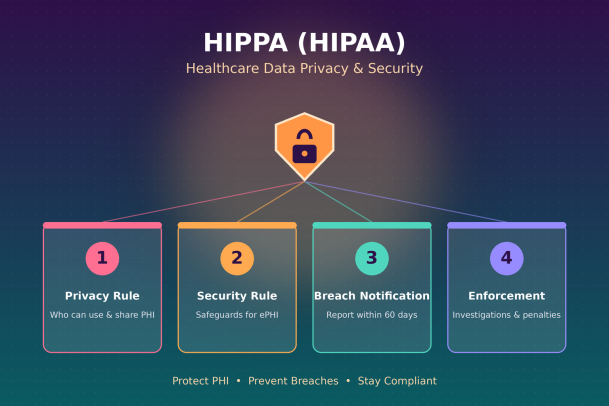
HIPPA compliance rests on four main rules. Understanding each one helps organizations see where privacy ends and security begins.
1. The Privacy Rule
The Privacy Rule controls how PHI can be used and disclosed. It gives patients rights over their own data, including the right to access their records, request corrections and know who their information has been shared with. It also introduces the “minimum necessary” standard: staff and vendors should only access the information they need to do their jobs.
2. The Security Rule
The Security Rule focuses specifically on electronic PHI (ePHI). It requires three types of safeguards:
- Administrative safeguards: risk analysis, security policies, workforce training and incident response planning.
- Physical safeguards: facility access controls, workstation security and secure disposal of devices and media.
- Technical safeguards: access controls, audit logs, integrity controls, authentication and transmission security such as encryption.
HHS proposed a major Security Rule overhaul in January 2025 that would make controls like multi-factor authentication and encryption mandatory. As of mid-2026, final action has been pushed back to at least July 2027, and the current Security Rule remains fully enforceable in the meantime. Smart organizations are adopting these controls now rather than waiting.
3. The Breach Notification Rule
When unsecured PHI is breached, covered entities must notify affected individuals without unreasonable delay and no later than 60 days after discovery. Breaches affecting 500 or more people must also be reported to HHS and, in many cases, to the media. Business associates must alert their covered entity partners.
4. The Enforcement Rule
The Enforcement Rule sets out how HHS investigates complaints and issues penalties. Fines follow a tiered structure based on the level of negligence, from violations the organization did not know about to willful neglect left uncorrected.
What Counts as Protected Health Information (PHI)?
PHI is any individually identifiable health information created, received, stored or transmitted by a covered entity or business associate. It covers a person’s past, present or future health condition, the care they receive and how they pay for it. When that data is stored or sent electronically, it becomes ePHI.
HIPPA lists 18 identifiers that can make health data identifiable, including:
- Names, addresses and dates (birth, admission, discharge)
- Phone numbers, email addresses and fax numbers
- Social Security, medical record and health plan numbers
- Account, license and device serial numbers
- IP addresses, URLs and biometric identifiers such as fingerprints
- Full-face photos and any other unique identifying code
Data that has been properly de-identified, with these identifiers removed, falls outside HIPPA’s rules. In practice, though, most operational healthcare data is PHI, which means it needs protection everywhere it travels.
Common HIPPA Violations and Their Penalties
Most HIPPA violations are not dramatic insider schemes. They are everyday security gaps that attackers find before the organization does. The most common include:
- No risk analysis: failing to identify where ePHI lives and what threatens it is one of OCR’s most frequently cited problems.
- Ransomware and malware: attackers encrypt or steal patient data, disrupting care and triggering breach notifications.
- Weak access controls: shared passwords, no multi-factor authentication and excessive user privileges.
- Unencrypted devices: lost or stolen laptops, phones and USB drives holding patient data.
- Third-party risk: vendors without BAAs or with poor security practices.
- Late breach notification: missing the 60-day deadline.
- Snooping: employees viewing records out of curiosity rather than need.
The consequences are significant. Civil penalties are tiered by culpability and adjusted for inflation each year, with annual caps now exceeding $2 million per violation category. Criminal penalties for knowingly misusing PHI can include fines and prison time. Beyond fines, organizations face corrective action plans, lawsuits, operational downtime and lasting reputational damage.
HIPPA Compliance Best Practices for Stronger Security
HIPPA compliance is not a one-time checklist. It is an ongoing security program. These steps give healthcare organizations a strong foundation:
- Run a thorough risk analysis. Map every system, device and vendor that touches ePHI, then rank threats and fix the biggest gaps first. Repeat it at least annually and after major changes.
- Enforce strong access controls. Use unique user IDs, role-based access, multi-factor authentication and the principle of least privilege.
- Encrypt data everywhere. Protect ePHI at rest and in transit. Properly encrypted data that is lost or stolen is generally not considered an unsecured breach.
- Secure every endpoint. Laptops, workstations, servers and medical devices are prime entry points. Advanced endpoint protection, detection and response tools stop threats before they reach patient data.
- Monitor and log activity. Continuous monitoring and audit logs help detect suspicious behavior early and prove compliance during investigations.
- Manage vendor risk. Sign BAAs with every business associate and verify their security posture regularly.
- Train your workforce. Phishing remains a leading cause of breaches. Regular, practical training turns staff into a line of defense.
- Prepare an incident response plan. Know who does what when a breach happens, and test the plan before you need it.
- Back up and test recovery. Secure, offline backups keep care running during a ransomware attack.
Organizations that treat these practices as part of daily operations, not just audit preparation, are far better positioned to protect patients and withstand regulatory scrutiny.
Conclusion
Whether you spell it HIPPA or HIPAA, the message is clear: patient data deserves the highest level of protection. The law sets the rules for privacy, security and breach response, but real protection comes from the technology and habits behind it. As ransomware grows more aggressive and regulators push for stronger controls, healthcare organizations cannot afford reactive security.
The good news is that you do not have to do it alone. The right security partner can help you stop threats at the endpoint, gain visibility across your environment and keep ePHI safe without slowing down care.
Ready to protect patient data and strengthen your HIPPA compliance posture? See how Xcitium’s Zero Trust endpoint protection keeps unknown threats from ever touching your sensitive healthcare data.
Please give us a star rating based on your experience.


 (20 votes, average: 2.35 out of 5, rated)