Did you know that one unprotected search box or login form can hand an attacker your entire customer database? That is the danger behind SQL injection. So, what is SQL injection, and why has it stayed on the OWASP Top 10 list of critical web application risks for years?
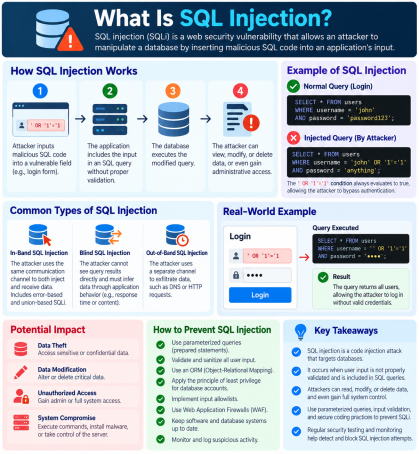
SQL injection (SQLi) is an attack where a hacker inserts malicious SQL code into an input field to manipulate the database behind a website or app. This guide explains what SQL injection is, how attacks work, the main types, and the practical steps you can take to prevent them.
What Is SQL Injection (SQLi)?
To understand what SQL injection is, start with SQL itself. Structured Query Language (SQL) is how applications talk to databases: to fetch, add, change, or delete data.
A SQL injection attack happens when an application takes user input and places it directly into a database query without proper checks. The attacker types SQL commands instead of normal data, and the database runs them as if they were legitimate. This is a classic vulnerability in web application security.
A Simple SQL Injection Example
Imagine a login form that builds this query from what the user types:
SELECT * FROM users WHERE username = 'input1' AND password = 'input2';If an attacker enters ' OR '1'='1 as the username, the query condition becomes always true, and the attacker may log in without a valid password. The application trusted the input, and that trust is the flaw.
How Does a SQL Injection Attack Work?
Most SQLi attacks follow these steps:
- Find an input point. Login forms, search bars, URL parameters, cookies, and contact forms are common targets.
- Test for weakness. The attacker enters special characters such as a single quote and watches for database errors or odd behavior.
- Craft a payload. Once a flaw is confirmed, they build malicious SQL code to read, change, or delete data.
- Extract or manipulate data. They can steal records, bypass authentication, or alter information.
- Expand access. In severe cases, attackers escalate privileges or use the database server as a stepping stone into the wider network.
Types of SQL Injection Attacks
Knowing the types of SQL injection helps you defend against each one.
In-Band SQL Injection
The attacker uses the same channel to launch the attack and collect results. It is the most common form and includes:
- Error-based SQLi: Uses database error messages to learn about the structure.
- Union-based SQLi: Uses the
UNIONoperator to combine results and pull data from other tables.
Blind SQL Injection
The application does not show data or errors, so the attacker infers information from behavior:
- Boolean-based: Sends true/false queries and watches how the page responds.
- Time-based: Forces the database to pause and measures the delay to confirm results.
Out-of-Band SQL Injection
The attacker gets data through a different channel, such as a DNS or HTTP request from the database server. It is less common and depends on specific server features.
What Damage Can a SQL Injection Attack Cause?
The impact of SQLi can be severe:
- Data theft: Customer records, passwords, payment details, and intellectual property
- Authentication bypass: Unauthorized access to admin accounts
- Data loss or tampering: Deleting or altering records
- Regulatory penalties: Fines under privacy laws such as GDPR or PCI DSS if personal data is exposed
- Reputation damage: Lost customer trust after a public data breach
- Further compromise: Malware delivery or lateral movement into other systems
How to Prevent SQL Injection: Actionable Tips
Good SQL injection prevention combines secure coding with layered defenses.
- Use parameterized queries (prepared statements). This is the single most effective defense. The database treats input strictly as data, never as code.
- Validate and sanitize input. Use allow-lists for expected formats, such as numbers only or valid email patterns. Treat validation as a second layer, not a replacement for parameterized queries.
- Apply least privilege. Give the application’s database account only the permissions it needs. It should not have admin rights or the ability to drop tables.
- Use stored procedures carefully. They help only when written safely, without building dynamic SQL from raw input.
- Hide detailed error messages. Show users a generic error and log the details privately, so attackers learn nothing about your database.
- Deploy a web application firewall (WAF). A WAF can block common SQLi patterns, though it should not be your only defense.
- Keep software patched. Update your CMS, plugins, frameworks, and database engines regularly.
- Test regularly. Run vulnerability scans, code reviews, and penetration tests to find flaws before attackers do.
- Encrypt sensitive data. Hash passwords with a strong algorithm and encrypt confidential fields so stolen data is less useful.
Warning Signs of a SQL Injection Attack
Watch for these red flags in your logs and monitoring tools:
- Unusual characters such as quotes, semicolons, or
--in form fields and URLs - Sudden spikes in database errors
- Unexpected queries or very large data exports
- Failed and successful logins from odd locations
- New or modified admin accounts you did not create
SQL Injection and Endpoint Security
SQLi targets the application layer, but the fallout often reaches your endpoints and network. Attackers who steal credentials through SQL injection can log in to real accounts, deploy ransomware, or drop malware onto devices. A layered approach helps: secure code, a WAF, database monitoring, and strong endpoint security working together.
A zero-trust mindset applies here. Treat every unknown file, process, and connection as untrusted until it is verified. Containing unknown threats before they reach your real systems limits the damage even if one layer fails.
Frequently Asked Questions (FAQ)
1. What is SQL injection in simple terms?
SQL injection is a hacking technique where an attacker types malicious database commands into a website form or URL. If the site does not handle input safely, the database runs those commands and may reveal or change private data.
2. Is SQL injection still a threat today?
Yes. Although it is well understood and preventable, SQLi remains common, especially in older applications, custom code, and unpatched plugins. Injection flaws continue to appear in the OWASP Top 10.
3. What is the best way to prevent SQL injection?
Use parameterized queries (prepared statements) everywhere your code talks to a database. Add input validation, least-privilege database accounts, a WAF, and regular testing for defense in depth.
4. Can a firewall or antivirus stop SQL injection?
A web application firewall can block many SQLi attempts, but it can be bypassed. Traditional antivirus does not protect against SQLi because the flaw sits in the application code. Fix the code first, then add layered protection.
5. What is the difference between SQL injection and cross-site scripting (XSS)?
SQL injection attacks the database behind an application to steal or alter data. XSS injects malicious scripts into web pages so they run in other users’ browsers. Both are injection flaws, but they target different parts of the system.
Conclusion: Understand SQL Injection, Then Defend Against It
Now you know what SQL injection is, how attackers exploit it, and how to stop it. Parameterized queries, input validation, least privilege, and regular testing will close most doors. But no single control is perfect, and attackers who slip through can quickly turn stolen data into wider damage.
Xcitium’s zero-trust endpoint protection contains unknown threats before they can harm your systems or steal your data, even when other defenses fall short.
👉 Request a Demo and see how Xcitium can secure your endpoints, users, and data.
Please give us a star rating based on your experience.


 (17 votes, average: 2.29 out of 5, rated)