Every time you check your bank balance on your phone, book a ride, or log in to a business app with your Google account, an API is working behind the scenes. APIs are the hidden connectors of the digital economy. They let applications share data and functions without human intervention.
For cybersecurity and IT leaders, the question “what is API?” goes beyond a technical definition. APIs now carry much of the sensitive traffic in modern organizations, and attackers know this. Each API endpoint is a potential entry point. To protect it, you first need to understand what it is, how it works, and where it is weak.
This guide explains APIs in plain language and then covers the security issues and best practices that matter most to people responsible for protecting an organization.
What is API? A Simple Definition
API stands for Application Programming Interface. An API is a set of rules and protocols that lets one software application request data or services from another.
A restaurant is a good way to picture it. You (the client) don’t walk into the kitchen (the server) to cook your meal. You give your order to a waiter (the API), who takes it to the kitchen and brings back your food. You never need to know how the kitchen works. You only need to know how to place an order.
APIs work the same way. A mobile app doesn’t need direct access to a company’s database. It sends a structured request to an API, and the API returns only the data the app is allowed to receive.
How Do APIs Work
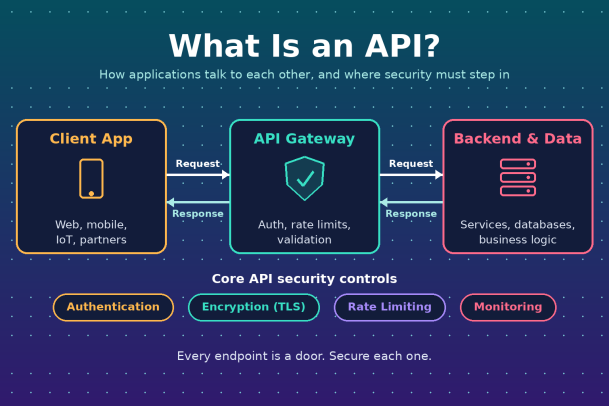
Most API interactions follow a simple request-and-response cycle:
- The client sends a request. An application sends a call to a specific API endpoint, usually a URL such as
/api/v1/customers. The request includes a method (GET, POST, PUT, or DELETE), headers, and often an authentication token. - The API processes the request. The API checks who is asking, whether they are allowed to ask, and whether the request is properly formatted.
- The server performs the action. The backend retrieves, creates, updates, or deletes data as requested.
- The API returns a response. The client receives the result, typically in JSON or XML format, along with a status code such as 200 (success), 401 (unauthorized), or 404 (not found).
This exchange happens in milliseconds, often thousands of times per second across a single enterprise environment.
Common Types of APIs
Understanding API types helps IT leaders map their attack surface more accurately.
By Access Level
- Public (Open) APIs: Available to external developers with few restrictions. Examples include weather or mapping services.
- Partner APIs: Shared with specific business partners under agreements, often for supply chain or payment integrations.
- Private (Internal) APIs: Used only within an organization to connect internal systems and microservices.
- Composite APIs: Combine several API calls into one request, which is common in microservice architectures.
By Architecture and Protocol
- REST (Representational State Transfer): The most widely used style. Lightweight, it runs over HTTP and usually returns JSON.
- SOAP (Simple Object Access Protocol): An older, more rigid protocol based on XML. Still common in banking, healthcare, and government systems.
- GraphQL: Lets clients request exactly the data they need in a single query. This is flexible, but it can expose more data than intended if not configured carefully.
- gRPC: A high-performance framework developed by Google, often used for communication between internal services.
Why APIs Matter to Cybersecurity and IT Leaders
APIs are the foundation of digital transformation. Cloud services, SaaS platforms, mobile apps, IoT devices, and AI tools all depend on them. This brings real business value: faster development, easier integration, and better customer experiences.
It also brings risk. Here is why APIs deserve a place on every security leader’s agenda.
APIs expose business logic directly. A traditional web page shows a user interface, but an API exposes the underlying functions and data. An attacker who understands your API can often skip the front end entirely.
API inventories are often incomplete. Development teams create APIs quickly, and many organizations have “shadow APIs” (undocumented endpoints) and “zombie APIs” (old versions that were never retired). You can’t protect what you don’t know exists.
Traditional security tools can miss API attacks. Many API attacks use valid requests with legitimate credentials. A firewall may see nothing unusual in a request that quietly pulls another customer’s records.
APIs connect you to third parties. Every partner integration extends your attack surface beyond your own network.
The Top API Security Risks You Should Know
The OWASP API Security Top 10 (2023 edition) is the leading reference for API threats. These are the risks IT and security leaders should understand first.
1. Broken Object Level Authorization (BOLA)
This is the most common and damaging API flaw. It happens when an API doesn’t verify that a user is allowed to access a specific object. An attacker can simply change an ID in a request, from /accounts/1001 to /accounts/1002, and view someone else’s data.
2. Broken Authentication
Weak tokens, poorly protected API keys, missing expiration, and flawed login flows let attackers impersonate legitimate users or services.
3. Broken Object Property Level Authorization
APIs sometimes return more data than the client needs, or let users change fields they shouldn’t, such as their own account role.
4. Unrestricted Resource Consumption
Without rate limiting, attackers can overwhelm APIs, run up cloud costs, or launch credential-stuffing and brute-force attacks at scale.
5. Broken Function Level Authorization
Regular users may be able to call administrative functions if the API doesn’t check permissions for each function.
6. Server-Side Request Forgery (SSRF)
Attackers trick the API into making requests to internal systems, which can expose sensitive infrastructure.
7. Security Misconfiguration
Verbose error messages, missing security headers, open cloud storage, and default settings all give attackers useful information.
8. Improper Inventory Management
This is the shadow and zombie API problem. Outdated or undocumented endpoints often lack current protections.
9. Unsafe Consumption of Third-Party APIs
Organizations often trust data from partner APIs more than user input, and attackers exploit that trust.
API Security Best Practices for IT Leaders
Securing APIs takes a layered strategy that combines technology, process, and governance.
Build and Maintain a Complete API Inventory
Start with visibility. Discover every API in your environment, including internal, external, and third-party endpoints. Document what each one does, what data it handles, and who owns it. Retire versions that are no longer needed.
Enforce Strong Authentication and Authorization
Use proven standards such as OAuth 2.0 and OpenID Connect. Issue short-lived tokens, rotate API keys regularly, and never hardcode credentials in source code. Most importantly, check authorization on every object and every function, not just at login.
Apply Zero Trust Principles
Never assume a request is safe because it comes from inside your network or carries a valid token. Verify every request, grant the least privilege needed, and continuously validate user and device trust.
Use an API Gateway
A gateway centralizes control. It handles authentication, rate limiting, request validation, and logging in one place, which reduces the chance that individual developers will miss a control.
Encrypt Everything in Transit
Require TLS for all API traffic, including internal service-to-service communication. Sensitive data should also be encrypted at rest.
Validate Input and Limit Output
Treat every input as untrusted, including data from partner APIs. Validate against strict schemas. Return only the fields the client actually needs.
Implement Rate Limiting and Throttling
Set limits on how many requests a client can make in a given period. This blocks brute-force attempts, scraping, and denial-of-service attacks.
Monitor, Log, and Respond
Log API activity and feed it into your security monitoring tools. Look for unusual patterns, such as one user accessing thousands of records, sudden traffic spikes, or calls to deprecated endpoints. Fast detection limits damage.
Test Continuously
Add API security testing to your development pipeline. Combine automated scanning with regular penetration testing that focuses on business logic flaws, which automated tools often miss.
Protect the Endpoints That Use Your APIs
APIs are only as secure as the devices and applications calling them. A compromised laptop or server holding valid API tokens can give attackers trusted access. Strong endpoint protection, combined with detection and response across your environment, closes this gap.
How APIs Fit Into a Broader Security Strategy
API security is not a separate silo. It connects directly to identity management, endpoint security, cloud security, and threat detection. An attacker who steals credentials from an unprotected endpoint can use them to abuse APIs. Malware running on a server can exfiltrate data through legitimate API calls.
This is why leading organizations take a unified approach. They combine endpoint protection, Zero Trust architecture, and extended detection and response (XDR) to see threats across the whole environment, from the device that makes an API call to the data that call reaches.
Conclusion
So, what is API? It’s the connective tissue of modern business, the interface that lets applications, clouds, partners, and devices work together. For cybersecurity and IT leaders, it is also one of the fastest-growing attack surfaces to manage.
The organizations that stay ahead do a few things well. They know every API they run. They enforce strict authentication and authorization. They apply Zero Trust principles. They monitor continuously, and they protect the endpoints that hold the keys to their APIs.
APIs will keep driving innovation. With the right strategy and tools, they don’t have to drive risk.
Strengthen Your Security From Endpoint to API
Attackers don’t need to break down the front door when an unprotected endpoint or exposed API lets them walk right in. Xcitium helps organizations stop threats before they cause damage, with Zero Trust protection, endpoint security, and detection and response built to keep your critical data and connected systems safe.
See how Xcitium can protect your organization against today’s evolving threats.
Please give us a star rating based on your experience.

 (23 votes, average: 2.00 out of 5, rated)