Every organization today generates data — from sales transactions and customer interactions to website clicks and supply chain logs. But raw data on its own doesn’t tell you anything useful. It’s just numbers sitting in a database. The real value comes from turning that data into insight, and that’s exactly what business intelligence is built to do.
If you’ve ever asked “what is business intelligence?” while researching how to make smarter, faster decisions for your company, you’re in the right place. This guide breaks down what BI actually means, how it works, why it matters, and how to get started — without the jargon.
What is Business Intelligence?
Business intelligence (BI) is the process of collecting, analyzing, and transforming raw business data into meaningful information that supports decision-making. It combines technology, tools, and processes to help organizations understand their past performance, monitor current operations, and plan for the future.
In simple terms, BI answers questions like:
- Which products are our best sellers this quarter?
- Where are we losing customers, and why?
- Which marketing channels deliver the highest return on investment?
- Are our operational costs trending up or down?
Instead of relying on gut feeling or scattered spreadsheets, BI gives decision-makers a clear, data-backed picture of what’s actually happening inside the business.
Why Business Intelligence Matters
Organizations that use data effectively tend to outperform those that don’t. Here’s why BI has become a core part of modern business strategy:
1. Faster, More Confident Decisions
When leaders have real-time dashboards instead of outdated monthly reports, they can react to problems and opportunities as they happen — not weeks later.
2. Improved Operational Efficiency
BI tools highlight inefficiencies, bottlenecks, and waste across departments, helping teams streamline processes and reduce costs.
3. Better Customer Understanding
By analyzing customer behavior, purchase history, and feedback, businesses can personalize offerings and improve retention.
4. Competitive Advantage
Companies that can spot market trends early — before competitors do — are better positioned to capitalize on them.
5. Reduced Risk
BI systems can flag anomalies, such as unusual spending patterns or security risks, enabling faster response and stronger risk management.
How Business Intelligence Works
Business intelligence isn’t a single tool — it’s a full pipeline made up of several connected stages:
Step 1: Data Collection
Data is gathered from multiple sources: CRM systems, ERP platforms, financial software, web analytics, social media, and more. This raw data can be structured (like spreadsheets) or unstructured (like emails or customer reviews).
Step 2: Data Integration and Storage
Once collected, data is cleaned, standardized, and consolidated — often into a data warehouse or data lake — so it can be analyzed consistently across the organization.
Step 3: Data Analysis
This is where BI tools apply queries, statistical models, and sometimes machine learning to identify patterns, correlations, and trends within the data.
Step 4: Data Visualization
Raw analysis results are converted into dashboards, charts, and reports that are easy for non-technical stakeholders to interpret at a glance.
Step 5: Decision-Making
Finally, business leaders and teams use these insights to guide strategy — from budget allocation to product development to marketing campaigns.
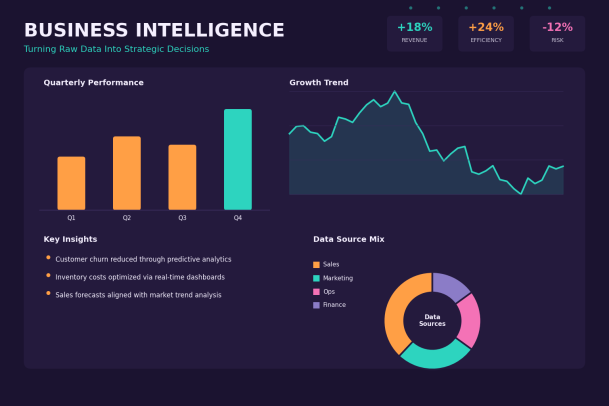
Below is a visual breakdown of how these elements typically come together on a BI dashboard, showing performance trends, key metrics, and data source distribution:
Key Components of a Business Intelligence System
A modern BI ecosystem typically includes:
- Data Warehousing – Centralized storage for structured business data
- ETL (Extract, Transform, Load) Tools – Software that moves and prepares data for analysis
- Reporting and Dashboards – Visual interfaces that display KPIs and trends
- Data Mining and Analytics Tools – Technology used to discover deeper patterns and predictive insights
- Self-Service BI Platforms – Tools that let non-technical employees explore data independently, without relying on IT teams
Popular BI platforms include Power BI, Tableau, Looker, and Qlik, though many organizations also build custom BI solutions tailored to their specific needs.
Business Intelligence vs. Business Analytics
These terms are often used interchangeably, but there’s a subtle difference:
- Business Intelligence focuses primarily on descriptive analysis — understanding what has happened and what is currently happening based on historical and real-time data.
- Business Analytics goes a step further, using statistical models and predictive techniques to forecast what might happen next and recommend actions.
In practice, most organizations use both together: BI to monitor performance, and analytics to guide forward-looking strategy.
Real-World Applications of Business Intelligence
BI isn’t limited to one industry or department. Some common use cases include:
- Retail: Tracking inventory levels, customer buying patterns, and seasonal demand
- Finance: Monitoring cash flow, detecting fraud, and forecasting revenue
- Healthcare: Analyzing patient outcomes and optimizing hospital resource allocation
- Manufacturing: Identifying production bottlenecks and predicting equipment maintenance needs
- Cybersecurity: Correlating threat data across endpoints to detect anomalies and reduce response time
That last point is particularly relevant in today’s threat landscape. Just as BI transforms scattered business data into actionable insight, modern security platforms apply similar principles — collecting endpoint, network, and threat data, then analyzing it to detect and stop attacks before they cause damage.
Common Challenges in Implementing Business Intelligence
While BI offers significant benefits, organizations often run into a few common obstacles:
- Data Silos: Information trapped in disconnected systems that don’t communicate with each other
- Poor Data Quality: Inaccurate, duplicate, or outdated data that skews analysis
- Lack of Skilled Talent: Shortage of analysts who can interpret and act on BI insights
- Resistance to Change: Teams accustomed to intuition-based decisions may be slow to adopt data-driven processes
- Security and Governance Gaps: Sensitive business data requires strict access controls and protection against breaches
Addressing these challenges typically requires a combination of the right technology, clear data governance policies, and a company culture that genuinely values data-driven decision-making.
Getting Started with Business Intelligence
If your organization is just beginning its BI journey, here’s a practical approach:
- Define clear objectives — Know what business questions you want BI to answer.
- Audit your existing data sources — Understand what data you already have and where the gaps are.
- Choose the right tools — Select a BI platform that fits your team’s technical skill level and budget.
- Start small — Pilot BI with one department or use case before scaling company-wide.
- Invest in training — Ensure employees know how to read and act on dashboards and reports.
- Prioritize data security — As you centralize more data, protecting it becomes even more critical.
The Future of Business Intelligence
BI continues to evolve rapidly, driven by advances in artificial intelligence and automation. A few trends shaping the next generation of business intelligence include:
- AI-Augmented Analytics: Machine learning models are increasingly built into BI platforms, automatically surfacing insights and anomalies without requiring a data analyst to manually dig through reports.
- Natural Language Querying: Modern BI tools let users type or speak plain-language questions (“What were our top-selling products last month?”) and receive instant visual answers, removing the need for complex query languages.
- Real-Time Data Streaming: Rather than waiting for daily or weekly reports, businesses increasingly rely on live data feeds to monitor operations as they happen.
- Embedded BI: Analytics capabilities are being built directly into everyday business applications, so employees can view relevant insights without switching to a separate dashboard tool.
- Greater Focus on Data Security: As BI systems centralize more sensitive information, protecting that data from breaches and unauthorized access is becoming a top priority alongside analysis itself.
Together, these trends point toward a future where business intelligence is faster, more accessible to non-technical users, and more deeply woven into daily operations.
Frequently Asked Questions
1. Is business intelligence the same as data science? Not exactly. Business intelligence primarily focuses on analyzing historical and current data to support decision-making through dashboards and reports. Data science tends to involve more advanced statistical modeling, machine learning, and predictive techniques, often to solve more complex or exploratory problems.
2. What skills are needed to work in business intelligence? Common BI skills include SQL, data visualization (using tools like Power BI or Tableau), data modeling, and a solid understanding of the business domain being analyzed. Strong communication skills also matter, since BI professionals need to translate technical findings into insights that non-technical stakeholders can act on.
3. Do small businesses need business intelligence tools? Yes. While BI is often associated with large enterprises, small and mid-sized businesses can benefit just as much — if not more — from understanding their sales trends, customer behavior, and operational costs. Many BI platforms now offer affordable, scalable options designed specifically for smaller teams.
4. How does business intelligence relate to cybersecurity? Both disciplines depend on collecting and analyzing large volumes of data to detect patterns and make informed decisions quickly. In cybersecurity, this means correlating threat data across endpoints and networks to identify and stop attacks — a process that mirrors how BI turns business data into actionable insight.
Final Thoughts
Business intelligence has moved from a “nice-to-have” to a core requirement for organizations that want to stay competitive. By turning raw data into clear, actionable insight, BI empowers leaders to make faster, smarter, and more confident decisions — whether that’s optimizing operations, understanding customers, or spotting risks before they escalate.
But unlocking the full value of your data also means protecting it. As businesses collect and analyze more information than ever, safeguarding that data from cyber threats becomes just as important as analyzing it.
Ready to see how strong endpoint and network security can protect the data driving your business decisions?
Discover how Xcitium’s proactive security platform helps organizations protect the data behind every business decision — before threats ever have a chance to strike.
Please give us a star rating based on your experience.


 (17 votes, average: 2.35 out of 5, rated)