Have you ever wondered how your office desk phone can make crystal-clear calls over the internet instead of a traditional phone line — and whether that convenience comes with hidden security risks? If you’ve asked yourself what is an IP phone, you’re not alone. Businesses worldwide are rapidly replacing analog phone systems with internet-based communication, and understanding how these devices work — and how to secure them — has become essential for anyone concerned with online security.
In simple terms, an IP phone (Internet Protocol phone) is a telephone that uses your internet connection, rather than traditional copper phone lines, to make and receive calls. It converts your voice into digital data packets and transmits them over an IP network, just like email or web traffic. While this technology powers modern business communication, it also introduces new attack surfaces that cybercriminals actively exploit. This guide breaks down what an IP phone is, how it works, its benefits, and — most importantly — how to keep your VoIP infrastructure secure.
What Is an IP Phone? A Clear Definition
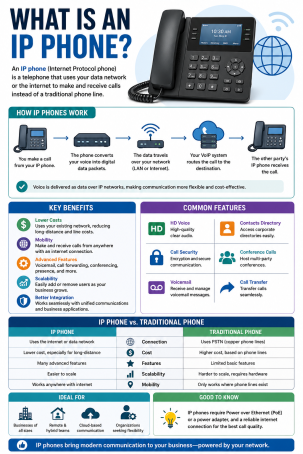
An IP phone, also known as a VoIP phone (Voice over Internet Protocol phone), is a hardware or software-based telephone that transmits voice calls as digital data over an internet network instead of using the traditional Public Switched Telephone Network (PSTN). Unlike analog phones that rely on dedicated copper wiring, an IP phone connects through an Ethernet cable, Wi-Fi, or a softphone application installed on a computer or smartphone.
Every IP phone is assigned an IP address, similar to a computer or any other networked device. This allows it to communicate directly with a company’s internal network, a cloud-based phone system, or a hosted PBX (Private Branch Exchange) provider. Because IP phones function as networked endpoints, they are subject to the same cybersecurity considerations as laptops, servers, and IoT devices.
IP Phone vs. Traditional Phone: Key Differences
Understanding the difference between an IP phone and a traditional landline helps clarify why security matters so much:
- Traditional phones use analog signals over dedicated copper lines and are largely isolated from internet-based threats.
- IP phones convert voice into digital packets, routing calls through the same network infrastructure used for internet browsing, email, and file sharing — making them reachable by network-based attacks.
- Traditional systems require physical wiring per line; IP phone systems scale easily through software configuration.
- IP phones support advanced features like video conferencing, call recording, and CRM integration, but each added feature can also expand the attack surface.
How Does an IP Phone Work?
An IP phone works by converting analog voice signals into digital data packets using a codec, then transmitting those packets across an IP network using protocols such as SIP (Session Initiation Protocol) or H.323. Here’s a simplified breakdown of the process:
- You speak into the IP phone’s microphone.
- The device digitizes your voice and compresses it into data packets.
- These packets travel across your local network and out through the internet to the recipient.
- The receiving IP phone or softphone decompresses the packets and converts them back into audio.
Because this entire process depends on network connectivity, any weakness in your network security — weak passwords, unpatched firmware, unencrypted traffic — can potentially expose your calls to interception, eavesdropping, or fraud.
Benefits of Using an IP Phone System
Despite the security considerations, businesses continue to adopt IP phone technology because of its clear operational advantages:
- Cost savings — Lower long-distance and international calling costs compared to traditional carriers.
- Scalability — Add or remove phone lines without new physical wiring.
- Remote work flexibility — Employees can use softphones from anywhere with internet access.
- Advanced features — Voicemail-to-email, auto-attendants, call analytics, and CRM integrations.
- Unified communications — Combine voice, video, and messaging into a single platform.
These benefits explain why IP phone adoption keeps climbing, but they also mean more devices connected to your network — and more potential entry points for attackers if security isn’t prioritized.
IP Phone Security Risks You Should Know
Because an IP phone operates as a networked device, it inherits many of the same cybersecurity risks as computers and servers. Common threats include:
Eavesdropping and Call Interception
If voice traffic isn’t encrypted, attackers on the same network — or intercepting traffic in transit — can potentially listen in on private conversations or capture sensitive business information.
VoIP Toll Fraud
Cybercriminals can compromise an IP phone system to make unauthorized international or premium-rate calls, generating massive phone bills before the breach is even detected.
Denial-of-Service (DoS) Attacks
Attackers can flood a VoIP network with traffic, disrupting call quality or taking phone systems offline entirely — a serious risk for customer-facing businesses.
Phishing and Vishing (Voice Phishing)
IP phone systems can be spoofed to impersonate trusted numbers, tricking employees or customers into revealing sensitive information over the phone.
Weak Authentication and Default Credentials
Many IP phones ship with default usernames and passwords. If left unchanged, they become an easy entry point for attackers to access the broader network.
How to Secure Your IP Phone System: Actionable Tips
Protecting your IP phone infrastructure doesn’t require an overhaul — it requires consistent, layered security practices. Here’s how to reduce your risk:
- Change default credentials immediately on every IP phone and VoIP server after installation.
- Enable encryption protocols such as SRTP (Secure Real-Time Transport Protocol) and TLS to protect voice data in transit.
- Segment your network so IP phones operate on a separate VLAN from general business traffic, limiting lateral movement if a device is compromised.
- Keep firmware updated to patch known vulnerabilities in your IP phone hardware and software.
- Use strong, unique passwords and enable multi-factor authentication on your VoIP admin portal.
- Monitor call logs and traffic for unusual patterns, such as spikes in international calls, which may indicate toll fraud.
- Deploy endpoint protection and firewalls that specifically monitor VoIP traffic for anomalies and known attack signatures.
- Train employees to recognize vishing attempts and verify caller identity before sharing sensitive information.
Treating your IP phone system as part of your broader cybersecurity strategy — not a standalone utility — is the single most effective way to prevent VoIP-related breaches.
Why IP Phone Security Matters for Every Business
As more organizations shift to cloud-based communication, an unsecured IP phone system can become one of the weakest links in an otherwise strong cybersecurity posture. A single compromised device can expose sensitive conversations, enable financial fraud, or serve as a gateway into your entire internal network. For businesses focused on internet security and cybersecurity, securing VoIP infrastructure should carry the same priority as securing endpoints, email, and cloud applications.
Frequently Asked Questions About IP Phones
1. What is an IP phone used for?
An IP phone is used to make and receive voice calls over the internet instead of a traditional phone line. It’s commonly used in businesses for customer service, internal communication, and remote work, often integrated with video conferencing and messaging tools.
2. Is an IP phone the same as a VoIP phone?
Yes. “IP phone” and “VoIP phone” are generally used interchangeably. Both refer to telephones that transmit voice as digital data over an IP network rather than through analog phone lines.
3. Are IP phones secure?
IP phones can be secure when properly configured with encryption, strong authentication, network segmentation, and regular firmware updates. However, without these protections, they are vulnerable to eavesdropping, toll fraud, and denial-of-service attacks.
4. Do I need special internet for an IP phone system?
You need a stable, sufficiently fast internet connection with low latency and enough bandwidth to support call quality, especially for businesses running multiple simultaneous calls. A wired connection is generally more reliable than Wi-Fi for IP phones.
5. Can an IP phone be hacked?
Yes. Like any networked device, an IP phone can be hacked if it uses default credentials, outdated firmware, or unencrypted communication. Implementing strong VoIP security practices significantly reduces this risk.
Secure Your Business Communications Today
Understanding what an IP phone is is only the first step — protecting it is what truly safeguards your business. As cyber threats targeting VoIP systems continue to grow, having a proactive cybersecurity strategy in place is no longer optional.
Ready to strengthen your organization’s security posture?
Request a free demo with Xcitium today and see how our advanced threat prevention solutions can help protect your network, endpoints, and communication systems from evolving cyber threats.
Please give us a star rating based on your experience.


 (17 votes, average: 2.41 out of 5, rated)