Every leader, whether running a P&L or defending a network, is ultimately in the business of prediction. Will this campaign lift revenue? Will this vendor default on a contract? Does this spike in login attempts signal a breach in progress? Underneath most of these predictions sits one of the oldest and most trusted tools in data science: regression analysis.
Despite being decades old, regression analysis remains a foundational technique behind modern analytics platforms, fraud detection engines, and even the machine learning models powering today’s cybersecurity tools. This guide breaks down what regression analysis is, how it works, the main types you should know, and why it matters just as much in the boardroom as it does in the security operations center (SOC).
What is Regression Analysis?
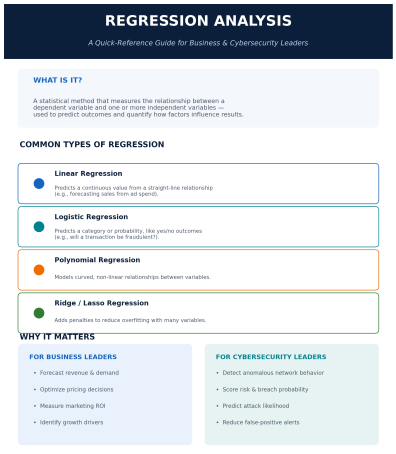
Regression analysis is a statistical method used to examine the relationship between a dependent variable (the outcome you want to predict or explain) and one or more independent variables (the factors that might influence that outcome).
In plain terms, regression answers questions like:
- How much does an extra $10,000 in ad spend increase monthly sales?
- Does employee tenure predict productivity?
- Does the number of failed login attempts predict the likelihood of an account takeover?
Regression analysis doesn’t just show that variables are related; it quantifies the strength and direction of that relationship, and lets you use that relationship to forecast future outcomes. This is what separates regression from simple correlation: correlation tells you two things move together, while regression gives you a formula you can actually use to predict one from the other.
How Regression Analysis Works
At its core, regression analysis fits a mathematical equation, called a regression model, to a set of observed data points. The model estimates coefficients for each independent variable, representing how much the dependent variable is expected to change when that variable shifts, holding everything else constant.
The process generally follows these steps:
- Define the question — What outcome are you trying to predict or explain?
- Collect and clean data — Gather historical records for the dependent and independent variables.
- Choose a regression model — Select the type of regression that best fits the data’s shape and the nature of the outcome (continuous, binary, categorical, etc.).
- Fit the model — Use statistical software to estimate the coefficients that best explain the observed data.
- Validate and interpret — Check how well the model fits (using metrics like R-squared, p-values, or error rates) and interpret what the coefficients mean in practical terms.
- Apply the model — Use the fitted equation to forecast new outcomes or explain past ones.
Key Types of Regression Analysis
Not all regression problems are the same, which is why several types of regression models exist. Here are the ones most relevant to business and security use cases:
Linear Regression The simplest and most widely used form, linear regression models a straight-line relationship between one or more independent variables and a continuous outcome. It’s commonly used to forecast metrics like revenue, demand, or churn rate based on historical trends.
Logistic Regression Despite the name, logistic regression is used for classification problems rather than predicting a continuous number. It estimates the probability of a binary outcome, such as whether a customer will churn, whether a loan will default, or whether a network event is malicious. This makes it a workhorse model in fraud detection and threat scoring systems.
Polynomial Regression When the relationship between variables isn’t a straight line but instead curves, polynomial regression fits a curved line to the data. It’s useful in scenarios where growth accelerates or decelerates, such as diminishing returns on marketing spend.
Ridge and Lasso Regression These are regularized versions of linear regression designed to handle datasets with many variables, some of which may be irrelevant or highly correlated. By adding a penalty term, they reduce the risk of overfitting, a common problem when models are trained on complex, high-dimensional data like network traffic logs or customer behavior datasets.
Multiple Regression An extension of linear regression that incorporates two or more independent variables at once, allowing analysts to isolate the effect of each factor while controlling for the others, such as separating the impact of price changes from seasonal demand shifts.
Why Regression Analysis Matters for Business Leaders
For executives, regression analysis converts raw historical data into forward-looking insight. Some of the most common applications include:
- Revenue and demand forecasting — Predicting future sales based on historical patterns, pricing changes, and market conditions.
- Marketing ROI measurement — Isolating which channels and campaigns actually drive conversions, rather than relying on gut feel.
- Pricing optimization — Understanding how price changes affect demand elasticity.
- Workforce planning — Modeling how staffing levels, training, or turnover affect output and customer satisfaction.
- Risk and credit modeling — Estimating the likelihood that a customer or partner will default on payment obligations.
The appeal of regression for business leaders is its interpretability. Unlike black-box machine learning models, a well-built regression model produces coefficients that can be explained in plain language: “for every additional dollar spent on advertising, we see an estimated $4.20 in incremental revenue.” That kind of clarity is invaluable when justifying budget decisions to a board or investors.
Why Regression Analysis Matters for Cybersecurity Leaders
Security teams face a similar prediction problem, just with higher stakes and adversaries actively trying to evade detection. Regression analysis, often as a component within larger machine learning pipelines, underpins several critical capabilities:
- Anomaly and intrusion detection — Modeling what “normal” network or user behavior looks like so that deviations, like an unusual spike in outbound traffic, can be flagged automatically.
- Risk and breach probability scoring — Estimating the likelihood that a given vulnerability, asset, or user account will be compromised, allowing security teams to prioritize limited resources.
- Fraud and account takeover detection — Logistic regression models are widely used to estimate the probability that a login attempt, transaction, or access request is fraudulent based on dozens of contextual signals.
- Reducing alert fatigue — By quantifying which factors most strongly predict genuine threats, regression-informed models help filter out noise and reduce false positives, freeing analysts to focus on real incidents.
- Predictive threat intelligence — Modeling historical attack patterns to estimate the probability and likely timing of future campaigns against specific industries or asset types.
For security operations, the interpretability of regression models is just as valuable as it is in business settings. When an analyst needs to explain to a CISO or auditor why a system flagged a particular event, a transparent regression-based risk score is far easier to justify than an opaque neural network output.
Common Pitfalls to Avoid
Regression analysis is powerful, but it’s easy to misuse. Leaders and analysts should watch for:
- Overfitting — Building a model so tailored to historical data that it fails to generalize to new situations.
- Ignoring multicollinearity — When independent variables are highly correlated with each other, coefficient estimates can become unstable and misleading.
- Mistaking correlation for causation — A strong relationship between two variables doesn’t necessarily mean one causes the other; confounding factors may be at play.
- Poor data quality — Regression models are only as reliable as the data feeding them; incomplete or biased datasets produce biased predictions.
- Assuming linearity where it doesn’t exist — Forcing a straight-line model onto a curved or complex relationship will produce poor forecasts.
Best Practices for Getting Reliable Results
To get the most value from regression analysis, both business and security teams should:
- Start with a clear, well-defined question before choosing a model.
- Validate models on separate test data, not just the data used to build them.
- Regularly retrain models as underlying conditions change, customer behavior shifts, and so do attacker tactics.
- Combine regression outputs with domain expertise rather than treating predictions as absolute truth.
- Monitor model performance over time to catch drift before it undermines decision-making.
Bringing Data-Driven Confidence to Every Decision
Regression analysis sits at the intersection of statistics and strategy. It gives business leaders a rigorous way to understand what drives growth, and gives security leaders a rigorous way to understand what drives risk. In both cases, the payoff is the same: decisions grounded in evidence rather than intuition alone.
As organizations generate more data than ever, from sales pipelines to endpoint telemetry, the leaders who understand how to apply techniques like regression analysis will be best positioned to separate meaningful signal from noise, whether that signal is a market opportunity or an active threat.
Ready to see predictive, data-driven security in action?
Xcitium combines advanced analytics and proactive containment to help your organization stop threats before they become breaches.
Please give us a star rating based on your experience.


 (17 votes, average: 2.47 out of 5, rated)