Have you ever wondered how a doctor can diagnose a rash, review lab results, or manage a chronic condition without you ever stepping into a clinic? That is the promise behind virtual care — but what is telemedicine, exactly, and can you trust it with your most sensitive health data?
In simple terms, telemedicine is the delivery of clinical healthcare services through digital communication technology, such as video calls, phone consultations, and secure messaging platforms, allowing patients and providers to connect remotely. According to recent industry estimates, the global telehealth market is projected to exceed $455 billion by 2030, a sign that virtual healthcare is no longer a temporary convenience but a permanent part of the medical landscape. Yet with this rapid growth comes a pressing concern for anyone in online security and cybersecurity circles: every video consultation, uploaded medical record, and remote monitoring device is also a potential entry point for cybercriminals. This guide breaks down how virtual care works, its real benefits, and how patients and healthcare organizations can keep these platforms secure.
What Is Telemedicine? A Clear Definition
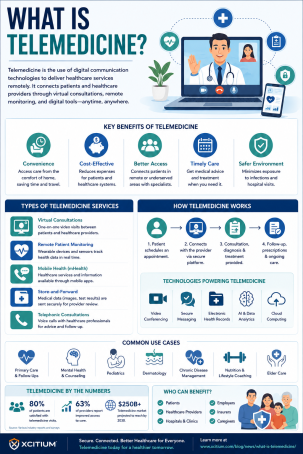
Telemedicine refers to the practice of using telecommunications technology to provide clinical health services remotely. Rather than requiring an in-person office visit, it allows a licensed provider to evaluate, diagnose, and treat patients using video conferencing, phone calls, mobile apps, or connected medical devices. It is often used interchangeably with “telehealth,” though telehealth is technically a broader term that also includes non-clinical services like provider training and administrative meetings.
The core idea behind telemedicine is simple: healthcare should not be limited by geography, mobility, or time. Whether it’s a routine follow-up, a mental health session, or a check-in for a chronic illness, this model makes care accessible from a smartphone, tablet, or computer.
How Does Telemedicine Work?
Virtual care platforms generally fall into three main categories, each designed to solve a different clinical need.
Live Video Consultations (Synchronous Telemedicine)
This is the most recognized form of telemedicine. Patients and providers connect in real time through a secure video call, much like a virtual appointment. It’s commonly used for primary care check-ins, mental health therapy, dermatology assessments, and urgent care triage.
Remote Patient Monitoring (RPM)
RPM uses connected devices — such as blood pressure cuffs, glucose monitors, or wearable heart rate trackers — to transmit patient data directly to a provider’s system. This approach is especially valuable for managing chronic conditions like diabetes, hypertension, and heart disease, since it allows continuous oversight without repeated office visits.
Store-and-Forward Telemedicine (Asynchronous Care)
Instead of a live interaction, this method involves collecting medical data — images, lab results, or patient history — and forwarding it to a specialist for review at a later time. It’s frequently used in radiology, pathology, and dermatology, where a visual record is enough for diagnosis.
The Benefits of Telemedicine for Patients and Providers
Understanding how virtual care works naturally leads to the question: why has adoption grown so quickly? A few key benefits stand out:
- Improved access to care — Patients in rural or underserved areas can consult specialists without long-distance travel.
- Reduced wait times — Virtual visits often have shorter scheduling windows than in-person appointments.
- Lower healthcare costs — Virtual care can reduce overhead for providers and cut travel and time-off costs for patients.
- Better chronic disease management — Continuous remote monitoring helps catch complications early.
- Convenience and flexibility — Care fits into a patient’s schedule rather than the other way around.
These advantages explain why virtual care adoption accelerated so dramatically in recent years and why it continues to expand across specialties like psychiatry, dermatology, and primary care.
Telemedicine and Cybersecurity: Why Online Security Matters
Here is where virtual care intersects directly with online security and internet security concerns. Every virtual care session transmits protected health information (PHI) — names, diagnoses, prescriptions, insurance details, and sometimes payment data — across networks that must remain private and tamper-proof. Unlike a stolen credit card number, a compromised health record cannot simply be reissued, which makes these platforms an especially attractive target for attackers.
Common Cybersecurity Risks in Telemedicine
- Unsecured video and messaging platforms — Consumer-grade apps that lack end-to-end encryption can expose consultations to interception.
- Phishing and social engineering — Attackers impersonate healthcare portals to trick patients or staff into revealing login credentials.
- Malware and ransomware attacks — Hospitals and virtual care vendors are frequent ransomware targets because health data is high-value and time-sensitive.
- Insecure IoT and remote monitoring devices — Wearables and home monitoring tools often ship with weak default security, creating a backdoor into larger networks.
- Weak authentication — Reused passwords or missing multi-factor authentication (MFA) make patient portals easy to breach.
Best Practices to Secure Virtual Care Platforms
For healthcare organizations and IT security teams evaluating or maintaining virtual care infrastructure, the following practices strengthen internet security posture without sacrificing usability:
- Use end-to-end encrypted, HIPAA-compliant platforms for every video or messaging session.
- Enforce multi-factor authentication (MFA) on all patient portals and provider dashboards.
- Deploy endpoint protection and threat detection across every device that connects to the network, including remote monitoring devices.
- Apply a zero-trust security model so that no device or user is automatically trusted, even inside the network perimeter.
- Train staff and patients to recognize phishing attempts targeting patient portal credentials.
- Keep software and firmware updated on all connected medical devices to close known vulnerabilities.
- Conduct regular security audits and penetration testing on virtual care platforms to catch weaknesses before attackers do.
Cybersecurity and cyber threat prevention should be treated as a core requirement of any virtual care strategy, not an afterthought bolted on after deployment.
The Future of Telemedicine
As artificial intelligence, 5G connectivity, and wearable health technology continue to mature, telemedicine is expected to become even more integrated into everyday healthcare. AI-assisted diagnostics, real-time remote surgery support, and predictive chronic-care monitoring are all on the horizon. But as these platforms grow more sophisticated, so will the cybersecurity threats aimed at them — making robust endpoint security and network defense essential for every healthcare provider that offers virtual care.
Frequently Asked Questions About Telemedicine
1. What is telemedicine used for?
It is used for a wide range of clinical services, including primary care check-ins, mental health therapy, dermatology consultations, chronic disease management, and follow-up appointments — all delivered remotely through video, phone, or messaging platforms.
2. Is telemedicine safe and secure?
It can be safe when platforms use strong encryption, secure authentication, and compliance with regulations like HIPAA. However, security depends heavily on the technology and safeguards a provider chooses to implement — weak platforms can expose sensitive patient data.
3. What is the difference between telemedicine and telehealth?
Telemedicine specifically refers to remote clinical services provided by a licensed medical professional, while telehealth is a broader term that also includes non-clinical services such as provider education, administrative meetings, and public health outreach.
4. Can hackers access telemedicine sessions?
Yes, if a virtual care platform lacks proper encryption, multi-factor authentication, or endpoint protection, cybercriminals can potentially intercept sessions, steal login credentials, or access stored patient records through phishing, malware, or unsecured devices.
5. Does insurance cover telemedicine visits?
Many insurance providers, including Medicare and Medicaid in various circumstances, cover telemedicine visits, though coverage varies by insurer, state, and the type of service provided. Patients should verify coverage details with their specific health plan.
Protect Your Telemedicine Platform Before It Becomes a Target
Understanding how virtual care works comes with understanding its risks. As it becomes standard practice, healthcare providers and organizations need cybersecurity solutions built to defend patient data, endpoints, and networks against evolving threats.
Ready to strengthen your telemedicine security posture? Request a demo with Xcitium and see how proactive endpoint protection can safeguard your virtual healthcare environment.
Please give us a star rating based on your experience.

 (20 votes, average: 2.20 out of 5, rated)