If you’ve sat through a strategy meeting or a security review in the last few years, you’ve probably heard the word “model” thrown around more times than you can count. A business model. A threat model. A machine learning model. A maturity model. A Zero Trust model.
The word is everywhere, but it rarely comes with a definition. And for leaders who need to make fast, informed decisions, that ambiguity is a problem. You can’t evaluate a “risk model” or approve a “new business model” if you’re not entirely sure what a model actually is — or why it matters.
This guide breaks down what a model really means, the different types of models that show up in business and cybersecurity conversations, and why understanding them is one of the most underrated skills a modern leader can have.
The Simple Definition of a Model
At its core, a model is a simplified representation of something more complex — a system, a process, a relationship, or a set of behaviors — built so people can understand it, predict it, or make decisions about it.
A model is never the real thing. It’s a stand-in. A map, not the territory. Its entire value comes from stripping away detail that doesn’t matter so you can focus on the detail that does.
That single idea — simplification for the purpose of decision-making — is the thread that connects every type of “model” you’ll encounter in business and security conversations. The differences are in what’s being simplified and why.
Why Models Matter to Leaders
Every organization runs on models whether it names them or not. A sales forecast is a model. A staffing plan is a model. An incident response playbook is built on a model of how attackers behave. Leaders who understand the models underneath their decisions can:
- Spot when a model is outdated or built on the wrong assumptions
- Ask sharper questions of the teams presenting recommendations
- Compare competing strategies on equal footing
- Recognize when a “gut feeling” is actually an unspoken, untested model
Ignoring models doesn’t make them go away. It just means someone else is deciding — often without telling you — which simplifications your organization is relying on.
Business Models: How Value Gets Created and Captured
In a business context, a business model describes how a company creates, delivers, and captures value. It answers a small set of foundational questions:
- Who is the customer?
- What problem are we solving for them?
- How do we deliver that solution?
- How do we get paid for it?
- What does it cost us to deliver it?
Common business model types include subscription (recurring revenue for ongoing access), freemium (a free tier that funds a paid upgrade path), marketplace (connecting buyers and sellers and taking a cut), and licensing (charging for the right to use something you own).
None of these are inherently better than another — the right model depends on the market, the product, and the cost structure behind it. But every pivot, every pricing change, and every new product line is, underneath it all, a change to the business model. Leaders who can name which lever they’re pulling make cleaner decisions than those who are just “trying something.”
Cybersecurity Models: How Risk Gets Managed
Security teams live inside models constantly, even if the language sounds different from the boardroom. A few of the most important ones for leaders to recognize:
Threat Models
A threat model is a structured way of asking: who might attack us, how would they do it, and where are we exposed? Rather than trying to defend against every conceivable attack, a threat model narrows focus to the realistic, high-impact scenarios for a specific system or organization. It’s the security equivalent of a risk-weighted forecast — a simplification that makes an otherwise infinite problem manageable.
Zero Trust Model
The Zero Trust model is a security architecture built on one principle: never automatically trust a user, device, or connection — verify everything, every time, regardless of whether it’s inside or outside the network perimeter. It replaced the older “castle and moat” model, which assumed anything inside the network was safe. As remote work, cloud infrastructure, and third-party integrations dissolved the traditional network perimeter, that older model stopped matching reality — which is exactly why it needed to be replaced.
Maturity Models
Frameworks like the NIST Cybersecurity Framework or CMMI use maturity models to describe how developed an organization’s security practices are, typically on a scale from ad hoc and reactive to optimized and proactive. These models give leaders a shared vocabulary for benchmarking progress and justifying investment, instead of relying on vague statements like “we’re doing better than last year.”
Risk Models
A risk model quantifies the likelihood and potential impact of a security event, often to answer a very practical business question: where should we spend our limited security budget for the greatest reduction in risk? A good risk model turns an overwhelming threat landscape into a prioritized list.
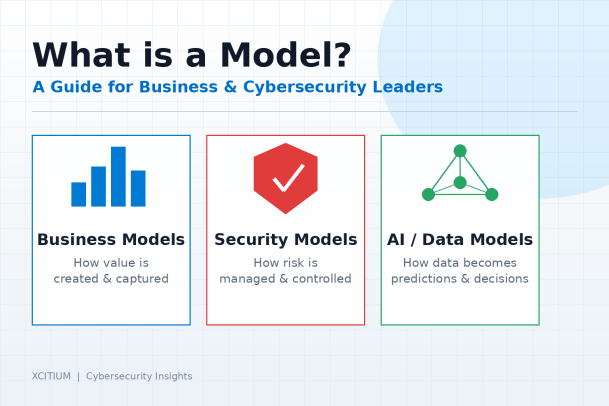
AI and Data Models: Where the Two Worlds Meet
The third category — and increasingly the most consequential — is the data or machine learning model. In this context, a model is a mathematical structure trained on historical data to recognize patterns and make predictions on new data it hasn’t seen before.
This is where business and cybersecurity conversations about “models” are converging fast:
- Fraud and anomaly detection models learn what normal transaction or network behavior looks like, so they can flag what isn’t.
- Behavioral threat detection models in modern endpoint protection platforms watch how files and processes actually behave, rather than only checking them against a list of known threats, making it possible to catch malware that has never been seen before.
- Predictive business models use historical sales, churn, or usage data to forecast what’s likely to happen next quarter.
The catch with AI models is the same catch that applies to every model: they are only as good as the data and assumptions they’re built on. A predictive model trained on last year’s attack patterns may miss a genuinely new technique. A churn model trained on one customer segment may fail badly on another. Leaders don’t need to understand the underlying math, but they do need to ask what data a model was trained on and where its blind spots are likely to be.
How to Evaluate Any Model Before You Trust It
Whether someone hands you a business model canvas, a threat model diagram, or an AI-driven risk score, the same set of questions applies:
- What is this model simplifying, and what did it leave out? Every model omits something. Knowing what’s missing tells you where the model can mislead you.
- What assumptions is it built on? A model built on assumptions that no longer hold — an old attacker profile, an outdated customer base — will produce confident, wrong answers.
- What data or evidence supports it? A model with no data behind it is closer to a guess with good formatting.
- How often is it updated? Static models age badly, especially in fast-moving areas like cyber threats or market conditions.
- What decision is this model actually meant to support? A model built for one purpose (say, general risk awareness) can give dangerously misleading results if it’s stretched to support a different decision (say, a specific investment approval).
Bringing It Together
Whether you’re reviewing a go-to-market strategy, approving a security architecture shift, or signing off on a new AI-powered detection tool, you are ultimately being asked to trust a model. Understanding what a model is — and what it isn’t — gives you the ability to push back, ask the right questions, and make calls based on substance rather than confidence alone.
For cybersecurity leaders specifically, this matters more every year. Attackers are using increasingly sophisticated methods, and the security models built for yesterday’s perimeter-based world are steadily being replaced by Zero Trust architectures, behavioral detection models, and predictive threat intelligence. Choosing the right security model — and the right partner to help implement it — is one of the highest-leverage decisions a leader can make.
See a Modern Security Model in Action
Understanding models in theory is one thing. Seeing how a modern, Zero Trust-based security architecture actually protects your business is another. Xcitium’s platform is built around exactly the kind of proactive, behavior-based security model discussed above — designed to contain threats before they ever execute, rather than reacting after the damage is done.
Request a Demo with Xcitium and see how the right security model can change the way your organization handles risk.
Please give us a star rating based on your experience.

 (21 votes, average: 2.19 out of 5, rated)