Modern applications rarely run as one giant, tightly bundled program anymore. Instead, most are built as a collection of small, independent services that work together. This approach is called microservices architecture, and understanding it has become essential for anyone responsible for building, running, or securing enterprise software.
If you’ve been asked “what is a microservice” in a planning meeting or a security review, this guide breaks it down in plain language — what microservices are, how they differ from traditional applications, why organizations adopt them, and what IT and security leaders need to watch out for.
What is a Microservice?
A microservice is a small, independently deployable software component that performs one specific business function. Instead of building an application as a single, large codebase (a “monolith”), developers break it into a set of loosely coupled services — each one responsible for a narrow piece of functionality, such as user authentication, payment processing, inventory management, or notifications.
Each microservice:
- Runs as its own process, separate from other services
- Communicates with other services over a network, typically using APIs (REST, gRPC, or messaging queues)
- Can be developed, deployed, updated, and scaled independently
- Often owns its own database or data store, rather than sharing one central database
- Is usually built and maintained by a small, dedicated team
Put together, a microservices architecture forms a distributed system where dozens or even hundreds of these small services collaborate to deliver the full application experience.
Microservices vs. Monolithic Architecture
To understand why microservices matter, it helps to contrast them with the traditional monolithic approach.
Monolithic architecture packages an entire application — user interface, business logic, and data access layer — into a single unit. It’s deployed as one artifact, and any change requires rebuilding and redeploying the whole application.
Microservices architecture splits that same application into many independent units. A change to the payment service, for example, can be built, tested, and deployed without touching the shipping service or the user account service.
| Aspect | Monolith | Microservices |
|---|---|---|
| Deployment | Single unit | Independent per service |
| Scaling | Scale the whole app | Scale individual services |
| Technology | Usually one stack | Can mix languages/frameworks |
| Team structure | Larger, shared codebase | Small teams per service |
| Failure impact | Can bring down entire app | Often isolated to one service |
| Complexity | Simpler to deploy, harder to scale | More moving parts, more flexibility |
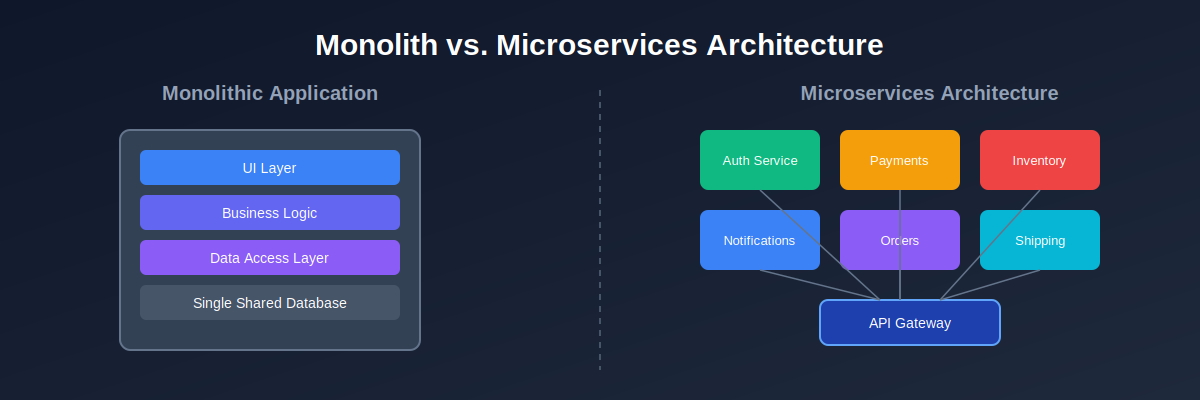
Neither approach is universally “better” — the right choice depends on the size of the organization, the complexity of the application, and how fast the business needs to move.
Why Organizations Adopt Microservices
IT leaders typically move toward microservices for a handful of practical reasons:
Faster development cycles. Small teams can build, test, and ship their service without waiting on other teams or a large release train.
Independent scaling. If the checkout service experiences a traffic spike during a sale, only that service needs additional resources — not the entire application.
Technology flexibility. Different services can be written in different languages or use different databases, letting teams pick the best tool for each job.
Resilience. When designed well, the failure of one microservice doesn’t necessarily crash the whole system — other services can continue operating.
Easier maintenance and updates. Smaller codebases are easier to understand, test, and refactor than one massive application.
These benefits explain why microservices have become the default architecture for cloud-native applications, especially those built on containers and orchestration platforms like Docker and Kubernetes.
Common Microservices Technologies
Most microservices environments rely on a supporting set of tools and patterns:
- Containers (like Docker) to package each service with its dependencies
- Orchestration platforms (like Kubernetes) to deploy, scale, and manage large numbers of containers
- API gateways to route requests and enforce policies at the edge of the system
- Service meshes (like Istio or Linkerd) to manage service-to-service communication, load balancing, and observability
- Message queues (like Kafka or RabbitMQ) for asynchronous communication between services
- CI/CD pipelines to automate the frequent, independent deployment of each service
Security Challenges of Microservices
This is where the “security leaders” part of this guide matters most. Microservices solve real engineering problems, but they also expand the attack surface in ways that traditional perimeter-based security wasn’t designed to handle.
More network communication to secure. Every call between services is a potential interception point. Instead of a handful of well-understood internal calls, a microservices environment might have thousands of service-to-service connections that all need encryption and authentication.
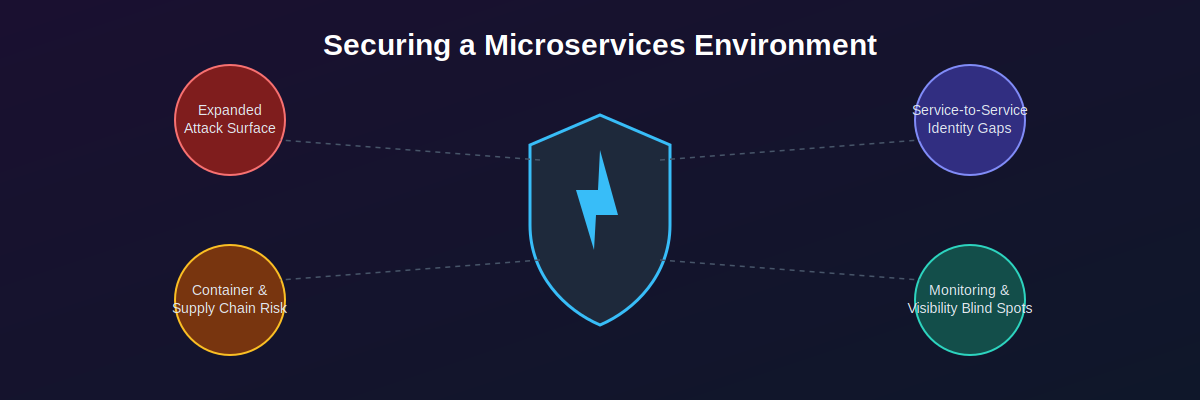
Expanded attack surface. Each microservice is its own deployable unit with its own dependencies, container image, and configuration — meaning each one is a potential entry point for attackers if left unpatched or misconfigured.
Complex identity and access management. Traditional network-based trust models don’t map well to microservices. Organizations need service-to-service authentication (often via mutual TLS or short-lived tokens) rather than relying on the old assumption that “anything inside the network is trusted.”
Harder-to-track data flows. With data moving across many services and often multiple databases, understanding where sensitive data lives and how it flows becomes significantly more complex — which complicates compliance efforts like GDPR, HIPAA, or PCI-DSS.
Visibility and monitoring gaps. Traditional monitoring tools built for monolithic applications often can’t keep up with the volume and speed of communication between dozens of independently deployed services. Without proper observability, a compromised service can go undetected for a long time.
Container and orchestration risk. Kubernetes clusters, container registries, and orchestration configurations introduce their own vulnerabilities — misconfigured permissions, exposed dashboards, or unpatched container images are common entry points.
Supply chain risk. Microservices often pull in numerous third-party libraries and open-source dependencies. A vulnerability in even one shared library can potentially be exploited across many services at once.
Best Practices for Securing Microservices
For IT and security leaders overseeing a microservices environment, a few practices consistently reduce risk:
- Adopt zero trust principles. Assume no service or network segment is automatically trusted; authenticate and authorize every request, service-to-service included.
- Encrypt all communication. Use mutual TLS or equivalent encryption for traffic between services, not just at the perimeter.
- Implement strong identity management. Use short-lived credentials, service accounts, and API tokens rather than static, long-lived secrets.
- Scan container images and dependencies continuously. Vulnerabilities in base images or open-source libraries should be caught before deployment, not after.
- Centralize logging and monitoring. Aggregate logs and metrics across all services so unusual behavior can be detected quickly, even across a sprawling architecture.
- Apply the principle of least privilege. Each microservice should only have access to the data and resources it strictly needs to perform its function.
- Automate security in the CI/CD pipeline. Build security checks — static analysis, dependency scanning, configuration checks — directly into the deployment pipeline rather than treating security as a final gate.
- Segment and isolate workloads. Use network policies and container isolation to limit how far an attacker can move if one service is compromised.
Microservices: A Powerful Architecture That Demands Strong Security
Microservices give organizations real advantages in speed, scalability, and flexibility. But that same distributed, fast-moving nature makes them harder to secure using traditional methods. Every new service is a new potential entry point, and every new API call is a new potential interception risk.
For IT and security leaders, the takeaway isn’t to avoid microservices — it’s to pair them with a security strategy built for distributed, cloud-native environments: strong identity controls, encrypted communication, continuous monitoring, and endpoint protection that can keep pace with a constantly changing architecture.
If your organization is running (or planning to run) a microservices environment, having the right visibility and protection in place from the start makes all the difference between a resilient system and a vulnerable one.
See how Xcitium can help protect your distributed applications and endpoints from modern threats.
Please give us a star rating based on your experience.


 (21 votes, average: 2.33 out of 5, rated)