Every day, businesses around the world send millions of purchase orders, invoices, and shipping notices to their partners. But what if that entire exchange happened instantly, automatically, and without a single sheet of paper? That’s exactly what EDI makes possible — so what is EDI, and why should security teams care about it just as much as supply chain managers do? In simple terms, EDI (Electronic Data Interchange) is the computer-to-computer exchange of standard business documents between organizations, replacing paper, fax, and email with a fast, structured digital format. For businesses that move sensitive data every day, understanding what EDI is — and how to keep it secure — is now a core part of any cybersecurity strategy.
In this guide, we’ll break down what EDI is, how it works, its business benefits, and the cybersecurity risks every organization should manage before adopting it.
What Is EDI (Electronic Data Interchange)?
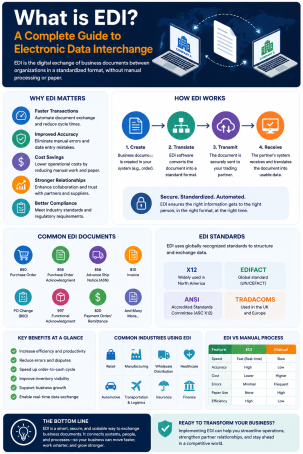
EDI stands for Electronic Data Interchange, a technology that allows two computer systems to exchange business documents — like purchase orders, invoices, and shipping notices — in a standardized electronic format, without any manual re-entry of data. Instead of a person typing an order into a spreadsheet or emailing a PDF invoice, EDI lets one company’s system talk directly to another’s, transmitting structured data that both systems can read and process automatically.
This is different from simply sending a scanned document or a PDF by email. Email still requires a person to open the attachment and manually key the information into an internal system, which introduces delays and typing errors. EDI eliminates that human step entirely: data moves directly from application to application, following an agreed-upon format so nothing gets lost, misread, or duplicated in translation.
EDI has been used since the 1960s in industries like logistics, retail, and manufacturing, and it remains the backbone of modern B2B (business-to-business) data exchange today — powering everything from global supply chains to healthcare claims processing.
How Does EDI Work?
To fully answer “what is EDI,” it helps to understand the mechanics behind it. EDI relies on three main components working together: a shared data standard, a translation process, and a secure transmission method.
EDI Standards and Formats
For two different computer systems to understand each other, they need a common language. That’s where EDI standards come in. The most widely used formats include:
- ANSI X12 – common in North America, especially retail and healthcare
- EDIFACT – an international standard developed by the United Nations, widely used in global trade
- RosettaNet – an XML-based standard used mainly in high-tech and semiconductor industries
These standards define exactly where each piece of information — like a product code, quantity, or price — should appear in the document, so the receiving system knows precisely how to read it.
The EDI Transaction Process, Step by Step
- Document creation – A business generates a document (e.g., a purchase order) in its internal system.
- Translation – EDI software converts the document into a standardized EDI format (like ANSI X12 or EDIFACT).
- Secure transmission – The formatted document is sent to the trading partner over a secure connection, such as AS2, SFTP, or a VPN.
- Receipt and translation – The receiving system translates the EDI file back into a format its own software can process.
- Automated processing – The data flows directly into the partner’s system — no manual entry required.
This entire cycle, which once took days by mail or hours by fax, now happens in seconds or minutes.
Key Benefits of EDI for Businesses
Understanding what EDI is naturally leads to the question: why do organizations use it? The advantages go far beyond convenience.
- Speed: Transactions that once took days over postal mail or back-and-forth email now complete in minutes.
- Accuracy: Removing manual data entry sharply reduces typos, duplicate orders, and mismatched records.
- Cost savings: Less paper, less manual labor, and fewer processing errors mean lower operational costs.
- Stronger partner relationships: Faster, more reliable order and invoice cycles improve trust with suppliers and customers.
- Scalability: Once set up, EDI can handle a growing volume of transactions without adding staff.
- Sustainability: Cutting paper-based processes supports greener, more eco-friendly operations.
Is EDI Secure? Understanding the Cybersecurity Risks
Because EDI carries sensitive business data — pricing, payment details, customer records, and proprietary supply chain information — it’s a natural target for cybercriminals. For any organization focused on online security, treating EDI as a purely operational tool is a mistake; it also needs to be treated as a data security priority.
Common EDI Security Risks
- Unencrypted data in transit or at rest, which can expose sensitive documents to interception
- Weak authentication, allowing unauthorized users to access trading partner connections
- Outdated EDI standards or software that lack modern encryption and patching support
- Third-party and vendor risk, since EDI networks often depend on external providers whose security posture may vary
- Human error, such as misconfigured settings or documents sent to the wrong recipient
EDI Security Best Practices
- Encrypt everything — both data in transit (using protocols like AS2, HTTPS, or SFTP) and data at rest.
- Enforce multi-factor authentication (MFA) for anyone accessing EDI systems.
- Vet your trading partners and vendors for their own security practices before connecting systems.
- Run regular security audits to catch misconfigurations and vulnerabilities early.
- Train employees to recognize phishing attempts and handle EDI data responsibly.
- Monitor continuously with endpoint and network protection to detect unusual activity in real time.
- Stay compliant with relevant regulations, such as HIPAA, GDPR, or PCI DSS, depending on your industry.
A well-secured EDI setup doesn’t just protect a single transaction — it protects the entire chain of trading partners connected to it, which is why layered cybersecurity matters as much as the EDI technology itself.
EDI vs. API: What’s the Difference?
Many businesses now ask whether APIs are replacing EDI. The truth is they often work together. EDI is built around standardized document formats exchanged in batches, making it ideal for high-volume, structured transactions like purchase orders and invoices. APIs, on the other hand, enable real-time, on-demand data exchange and are more flexible for smaller or more dynamic integrations. Many modern supply chains use both: EDI for core, high-volume transactions, and APIs to fill in the gaps for real-time visibility.
Common EDI Use Cases
- Retail: Purchase orders, invoices, and advance shipping notices (ASNs) between retailers and suppliers
- Healthcare: Claims processing and eligibility verification between providers and insurers
- Manufacturing: Just-in-time inventory coordination across global supply chains
- Logistics: Shipment tracking, customs documentation, and freight invoicing
- Finance: Automated invoicing and payment confirmations between B2B partners
Getting Started with EDI Securely
If your organization is adopting or already running EDI, the goal isn’t just automation — it’s automation you can trust. Before rolling out or scaling an EDI system, take stock of your endpoint security, network monitoring, and access controls, since these are the layers that actually stop a breach from spreading through your trading partner network. Pairing EDI with strong cybersecurity fundamentals — encryption, monitoring, and zero-trust access — turns a powerful efficiency tool into one your security team can stand behind.
Frequently Asked Questions About EDI
1. What is EDI in simple terms?
EDI (Electronic Data Interchange) is the automated exchange of business documents, like invoices or purchase orders, directly between two computer systems, without emails, faxes, or manual data entry.
2. What is EDI used for?
EDI is used to exchange common business documents such as purchase orders, invoices, shipping notices, payment confirmations, and healthcare claims between trading partners in industries like retail, manufacturing, logistics, and healthcare.
3. Is EDI the same as email?
No. While email is electronic, it still requires a person to open, read, and manually enter the data into a system. EDI removes that manual step entirely by transmitting structured data directly between systems.
4. Is EDI secure?
EDI can be highly secure when implemented with encryption, strong authentication, vetted trading partners, and continuous monitoring. Without those safeguards, EDI systems can be vulnerable to interception, unauthorized access, and data breaches.
5. What industries use EDI the most?
Retail, healthcare, manufacturing, logistics, and finance are among the heaviest users of EDI, largely because they process high volumes of repetitive, structured transactions between trading partners.
Protect Your EDI Transactions with Xcitium
Now that you know what EDI is and why it plays such a critical role in modern business, the next step is making sure every transaction is protected. Cyber threats targeting B2B data exchanges are growing more sophisticated, and a single unprotected endpoint can put your entire trading network at risk.
Xcitium helps organizations secure their systems, endpoints, and data with proactive, zero-trust protection built for today’s threat landscape.
Request a Free Demo to see how Xcitium can help safeguard your EDI transactions and overall business data.
Please give us a star rating based on your experience.


 (26 votes, average: 2.35 out of 5, rated)