If you’ve asked yourself “how fast is 5G internet, really?” you’re not alone. Carrier ads throw around numbers like “up to 10 Gbps,” but the speed your business actually experiences on a Tuesday afternoon in a downtown office is a very different story. For IT leaders evaluating network upgrades, remote-work infrastructure, or IoT deployments, understanding the real range of 5G speeds — and what drives the difference between marketing claims and daily performance — is essential before you commit budget to it.
This guide breaks down 5G speed in plain terms: what the technology can theoretically do, what it typically delivers, how it compares to 4G LTE, and what business and tech leaders should actually plan around — including the security implications that come with a faster, more connected network.
What Is 5G, and What Speed Does It Actually Deliver?
5G (fifth-generation wireless) is the successor to 4G LTE, built to deliver higher throughput, lower latency, and support for far more connected devices per square mile. The headline numbers are impressive: peak theoretical speeds of up to 10 Gbps and latency as low as 1 millisecond.
In practice, real-world 5G speeds vary enormously depending on the type of 5G spectrum in use, network congestion, distance from the cell tower, and the device itself. Here’s a realistic breakdown:
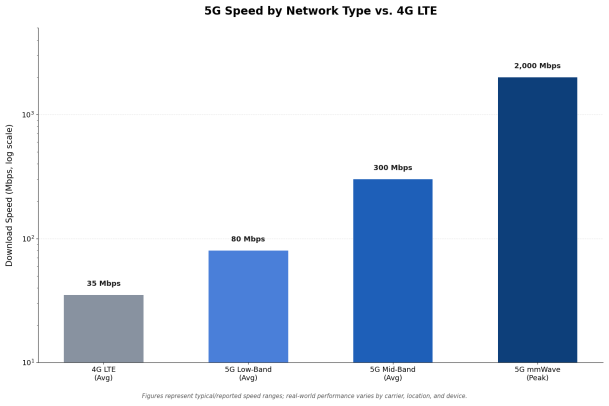
- Low-band 5G: 30–250 Mbps, with wide coverage similar to 4G
- Mid-band 5G: 100–900 Mbps, the “sweet spot” most carriers are expanding
- mmWave (high-band) 5G: 1–3 Gbps in ideal conditions, but with very limited range and poor building penetration
For comparison, average 4G LTE speeds typically land between 15–50 Mbps download. So even conservative mid-band 5G can be 5–10x faster than the 4G connection most businesses rely on today.
5G vs. 4G LTE: The Real Difference
Speed alone doesn’t tell the whole story. Three factors matter more for business use cases:
- Latency — 5G can bring round-trip latency down from the 30–50ms typical of 4G to under 10ms, sometimes near 1ms on standalone 5G networks. This matters enormously for real-time applications: video conferencing, VoIP, remote equipment control, and AR/VR.
- Network capacity — 5G supports roughly 1 million connected devices per square kilometer, compared to about 100,000 on 4G. For businesses deploying IoT sensors, smart building systems, or fleets of connected devices, this is often more valuable than raw speed.
- Consistency under load — 4G networks slow down significantly when many users share a cell tower. 5G’s architecture is designed to maintain more consistent throughput even as device density increases, which matters for offices, warehouses, retail floors, and manufacturing sites.
The Three Types of 5G Explained
Understanding which “flavor” of 5G is available in your area is the single biggest factor in how fast your connection will actually be.
Low-band 5G runs on the same frequencies as older cellular technology. It travels far and penetrates walls well, but the speed gains over 4G are modest — often just 20–50% faster.
Mid-band 5G is where most carriers have focused their rollout. It strikes a balance between coverage and speed, typically delivering 100 Mbps to nearly 1 Gbps, and is now available in most major metro areas.
mmWave 5G uses very high frequencies capable of multi-gigabit speeds, but the signal barely penetrates walls or windows and loses strength within a few hundred meters of a small cell. It’s mostly deployed in dense urban cores, stadiums, and airports — not something most offices should plan around as a primary connection.
The chart below illustrates the typical speed gap across these categories compared to 4G LTE.
Factors That Actually Determine Your 5G Speed
Two businesses on the same carrier, in the same city, can see wildly different 5G performance. The variables that matter most:
- Distance from the cell site — especially critical for mmWave, where speed drops off sharply after a few hundred meters
- Network congestion — speeds dip during peak business hours when many devices share the same tower
- Device and router capability — older 5G modems or routers may not support the frequency bands your carrier uses for its fastest tiers
- Building materials — concrete, low-E glass, and metal framing can significantly attenuate signal, particularly at higher frequencies
- Carrier network investment — coverage maps look similar on paper, but actual mid-band density varies a lot by carrier and region
For any serious business deployment, it’s worth requesting a site survey or trial period rather than relying on a coverage map alone.
Why Faster Networks Mean Bigger Security Stakes
Here’s the part that often gets overlooked in speed-focused conversations: as 5G increases bandwidth and connects exponentially more devices — laptops, sensors, cameras, point-of-sale systems, and industrial equipment — it also expands the attack surface your business has to defend.
A few reasons this matters for tech leaders specifically:
- More endpoints, more entry points. 5G’s ability to support massive device density means IoT and edge devices multiply fast, often faster than security policies can keep up.
- Faster networks mean faster-moving threats. Malware and lateral movement across a network happen quicker when bandwidth and latency are no longer the bottleneck.
- Network slicing introduces new complexity. 5G’s ability to create virtual, isolated network segments is powerful for performance, but each slice needs its own security posture to avoid becoming a weak link.
- Remote and hybrid work rides on 5G. As more employees connect over 5G hotspots and private 5G networks rather than managed office Wi-Fi, endpoint visibility becomes harder to maintain centrally.
In short: upgrading your speed without upgrading your endpoint security strategy just means threats move faster too.
How Businesses Should Prepare for 5G
If your organization is planning a 5G transition — whether for office connectivity, IoT, or private 5G deployment — a few practical steps go a long way:
- Map your actual coverage, not just the carrier’s advertised coverage, using a site survey or pilot device.
- Audit connected devices before scaling up IoT or edge deployments, since higher device density means more to secure.
- Right-size your investment — mid-band 5G is usually the better ROI for most offices and campuses; mmWave is rarely necessary outside dense, high-traffic venues.
- Update your endpoint security strategy in parallel with any network upgrade, so faster speeds don’t outpace your ability to monitor and contain threats.
- Plan for network segmentation, particularly if you’re using network slicing or private 5G, so critical systems aren’t exposed to the same risk profile as general-purpose devices.
Frequently Asked Questions
1. Is 5G always faster than 4G? Not automatically. Low-band 5G in a congested area can sometimes perform close to a strong 4G LTE connection. The speed advantage becomes dramatic mainly on mid-band and mmWave deployments, so it’s worth checking which type of 5G your carrier actually runs in your specific location rather than assuming 5G is a guaranteed upgrade everywhere.
2. What internet speed does a typical business need? It depends on headcount and use case. A small office running cloud apps, video calls, and standard browsing can often run comfortably on 100–200 Mbps. Organizations with heavy file transfers, video production, large-scale IoT, or many simultaneous users should look at 500 Mbps and above, which is where mid-band 5G and fiber both become attractive options.
3. Can 5G replace wired broadband for a business? For some organizations, yes — fixed wireless access (FWA) over mid-band 5G has become a legitimate primary connection for branch offices, retail locations, and temporary sites. For latency-sensitive, high-uptime operations, many IT leaders still prefer wired connections as the primary link and 5G as a fast, reliable failover.
4. Does private 5G make sense for warehouses and factories? Private 5G networks are increasingly popular for manufacturing floors, warehouses, and campuses that need dense device connectivity, predictable latency, and more control over network security than public carrier infrastructure allows. The tradeoff is higher setup complexity and cost, so it’s typically justified for larger-scale IoT or automation deployments rather than a standard office.
Looking Ahead: What Comes After 5G Speed Gains
Carriers are already rolling out 5G-Advanced and laying groundwork for 6G research, which promises even lower latency and higher device density. But for the vast majority of businesses over the next several years, the practical opportunity isn’t chasing the theoretical ceiling — it’s making full use of the mid-band 5G that’s already available: faster cloud access, more reliable video collaboration, scalable IoT, and better failover options for critical operations.
The organizations that benefit most from 5G won’t necessarily be the ones with the fastest peak speeds on paper. They’ll be the ones that matched their network upgrade with a security strategy built for a world with more devices, more bandwidth, and more potential entry points.
The Bottom Line
So, how fast is 5G internet? The honest answer is: it depends heavily on the type of 5G, your location, and your carrier’s infrastructure — ranging from a modest step up over 4G on low-band, to multi-gigabit bursts on mmWave. For most businesses, mid-band 5G offers the most realistic and valuable combination of speed, latency, and coverage today.
But speed is only half the equation. A faster, more connected network is also a bigger target. As your business scales its bandwidth and device count, your endpoint protection strategy needs to scale right alongside it.
Ready to secure your network as you scale up speed?
Request a Demo with Xcitium and see how comprehensive endpoint security can keep pace with your 5G-powered infrastructure.
Please give us a star rating based on your experience.

 (20 votes, average: 2.10 out of 5, rated)