Have you ever wondered how thousands of devices on the same network manage to communicate without chaos, or how cybersecurity teams isolate a breach before it spreads across an entire company? The answer often comes down to one small but powerful concept: the subnet mask. If you’ve ever asked yourself what is a subnet mask, you’re asking a foundational question in networking — one that directly impacts how secure and organized your network really is. A subnet mask is a 32-bit number that divides an IP address into a network portion and a host portion, helping devices determine which part of an address identifies the network and which part identifies the individual device. Understanding what is a subnet mask isn’t just for network engineers — it’s essential knowledge for anyone serious about internet security, since poorly configured subnets can expose entire networks to unnecessary risk. In this guide, we’ll explain how subnet masks work, the different types, and practical tips to keep your network segmented and secure.
What is a Subnet Mask? (The Simple Definition)
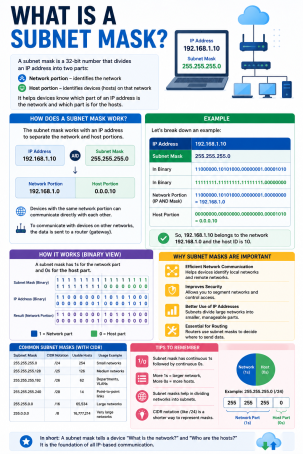
At its core, a subnet mask is a numerical value used in networking to split an IP address into two parts: the network ID and the host ID. It works alongside an IP address to tell devices, routers, and firewalls which portion of the address belongs to the network and which portion identifies a specific device on that network.
Subnet masks are written in the same dotted-decimal format as IP addresses — for example, 255.255.255.0. Each “255” represents a fully “masked” section reserved for the network, while any 0s indicate the portion available for individual host addresses. So when someone asks what is a subnet mask, the simplest explanation is this: it’s the tool that tells your network where one group of devices ends and another begins.
How Does a Subnet Mask Work?
A subnet mask works by performing a bitwise operation with an IP address to determine the network and host portions. Every IP address consists of 32 bits (in IPv4), and the subnet mask uses its own 32-bit pattern to “mask” part of that address as the network segment.
Binary Representation of a Subnet Mask
In binary, a subnet mask like 255.255.255.0 translates to 11111111.11111111.11111111.00000000. The 1s represent the network bits, and the 0s represent the host bits. Devices use this binary pattern to instantly determine whether a destination address is on the local network or needs to be routed elsewhere — a process that plays a direct role in both network performance and cybersecurity.
CIDR Notation Explained
Modern networks often express subnet masks using CIDR (Classless Inter-Domain Routing) notation, such as /24 instead of 255.255.255.0. The number after the slash represents how many bits are used for the network portion. CIDR notation simplifies subnetting and is widely used in firewall rules, routing tables, and cloud network configurations.
Why Subnetting Matters for Network Security
Subnetting — the process of dividing a larger network into smaller, manageable segments — is one of the most effective ways to strengthen internet security. By using subnet masks to create separate subnets, organizations can:
- Contain security breaches by isolating compromised devices within a single subnet instead of exposing the entire network.
- Reduce network congestion by limiting broadcast traffic to smaller segments.
- Apply targeted access controls, giving sensitive systems (like servers holding customer data) stricter firewall rules than general user devices.
- Simplify monitoring, since smaller subnets make it easier for cybersecurity teams to spot unusual traffic patterns.
Without proper subnetting, a single infected device could potentially communicate with every other device on a flat network, dramatically increasing the blast radius of a cyberattack.
Common Types of Subnet Masks
Not every network requires the same subnet size. Understanding common subnet mask classes helps in choosing the right structure for your environment.
Class A, B, and C Subnet Masks
- Class A (255.0.0.0): Supports a massive number of hosts, typically used by very large organizations or internet service providers.
- Class B (255.255.0.0): Balances network and host capacity, often used by medium to large enterprises.
- Class C (255.255.255.0): The most common subnet mask for small businesses and home networks, supporting up to 254 usable host addresses.
Custom Subnetting (VLSM)
Variable Length Subnet Masking (VLSM) allows network administrators to create subnets of different sizes within the same network, rather than being locked into fixed class boundaries. This flexibility helps allocate IP addresses more efficiently and supports better network segmentation for security purposes.
Actionable Tips for Secure Subnet Configuration
Configuring subnet masks correctly isn’t just a networking best practice — it’s a cybersecurity necessity. Here are practical steps to strengthen your network through smart subnetting:
- Segment sensitive systems (like databases or payment servers) into their own dedicated subnets with restricted access.
- Use VLANs alongside subnetting to add an additional layer of logical separation between departments or device types.
- Regularly audit your IP address plan to catch overlapping subnets or unused address ranges that could create security gaps.
- Apply firewall rules between subnets, not just at the network perimeter, to prevent lateral movement during a breach.
- Document your subnet structure clearly so your security team can quickly identify and isolate affected segments during an incident.
- Monitor inter-subnet traffic for unusual patterns that could indicate a compromised device attempting to spread across the network.
Taking these steps helps ensure that even if one part of your network is compromised, the damage stays contained rather than spreading unchecked.
Frequently Asked Questions (FAQs)
1. What is a subnet mask, in one sentence?
A subnet mask is a 32-bit number that works with an IP address to divide a network into a network portion and a host portion, helping devices identify which segment of the network they belong to.
2. Why is subnetting important for cybersecurity?
Subnetting limits how far an attacker or malware can spread within a network by isolating devices into smaller, controlled segments, making breaches easier to contain and monitor.
3. What’s the difference between a subnet mask and an IP address?
An IP address identifies a specific device on a network, while a subnet mask defines which portion of that address represents the network and which portion represents the host.
4. What does 255.255.255.0 mean?
255.255.255.0 is a common subnet mask (Class C) that reserves the first three sections of an IP address for the network and leaves the last section for individual host devices, supporting up to 254 hosts.
5. Do home networks need subnetting?
Most home networks use a single default subnet, but creating separate subnets for smart home devices, guest Wi-Fi, and personal devices can significantly improve home network security.
Strengthen Your Network Security Today
Understanding what is a subnet mask is just the beginning of building a secure, well-organized network. Poorly segmented networks remain one of the most overlooked vulnerabilities that cybercriminals exploit to move freely once inside.
Ready to see how proactive network protection works in practice?
Request a free demo with Xcitium today and discover how to keep every segment of your network secure.
Please give us a star rating based on your experience.

 (17 votes, average: 2.24 out of 5, rated)