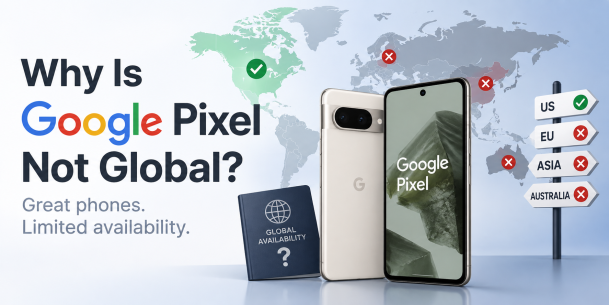
Why Is Google Pixel Not Available in Every Country?
Google Pixel phones are sold internationally, but they are not officially available in every country. Expanding a smartphone into a new market requires more than shipping devices—it can involve regulatory approvals, carrier and network compatibility, retail distribution, localized services, warranty and repair support, marketing, and sufficient customer demand.
Google has gradually expanded Pixel availability, but its geographic footprint remains more selective than that of some major smartphone brands.
Is Google Pixel a Global Phone?
Yes, Google Pixel is an international smartphone brand, but Pixel phones do not have official sales and support in every country.
Current Pixel models are officially sold across markets in:
- North America
- Europe
- Asia
- Australia
Availability varies by model.
That means it is more accurate to say Google Pixel has limited global availability rather than saying Pixel is not global.
Why Isn’t Google Pixel Available Everywhere?
There is no single publicly stated reason that explains every unsupported Pixel market.
Instead, entering a new smartphone market can depend on several factors.
| Factor | Why It Matters |
|---|---|
| Market demand | Google needs enough potential buyers to justify a launch |
| Carrier compatibility | Mobile technologies and carrier certification vary |
| Regulatory approval | Devices must satisfy local technical requirements |
| Distribution | Google needs reliable retail and delivery channels |
| Repair and support | Customers require warranty and after-sales service |
| Localization | Language, software, services, and documentation may need adaptation |
| Marketing costs | Launching and supporting a smartphone brand requires investment |
| Competition | Established smartphone brands may dominate some markets |
| Pricing | Taxes, duties, currency, and distribution affect local pricing |
These factors can make a selective rollout more practical than launching Pixel simultaneously in every country.
1. Google Uses a Selective Market Strategy
Google does not sell every hardware product in every Google Store region.
Instead, availability varies by:
- Product
- Model
- Country
- Store region
- Local services
This approach allows Google to concentrate sales, marketing, support, and distribution resources in selected markets.
Pixel availability has expanded over time, but expansion does not necessarily mean every country will receive every Pixel model.
2. Carrier and Network Compatibility Matters
Smartphones must work correctly with local mobile networks.
Depending on the country and carrier, this can involve support or certification for:
- 4G LTE
- 5G
- VoLTE
- Wi-Fi calling
- eSIM
- Frequency bands
- Emergency calling
- Carrier-specific network features
A Pixel imported from another country may support some local frequencies but still lack certain carrier-dependent features.
For this reason, hardware compatibility and official carrier support are not always the same thing.
3. Regulatory Requirements Differ by Country
Smartphones are radio-transmitting electronic devices.
Before a device can be officially sold in a market, manufacturers may need to meet local requirements involving areas such as:
- Radio-frequency operation
- Electrical safety
- Telecommunications
- Battery standards
- Product labeling
- Environmental requirements
- Consumer protection
Requirements vary by jurisdiction.
Entering additional markets therefore requires country-specific operational and compliance work.
4. Google Needs Distribution and Retail Partners
Selling a smartphone globally requires a reliable supply chain.
Google may need:
- Warehousing
- Shipping
- Retail partners
- Online sales infrastructure
- Carrier relationships
- Inventory management
- Returns processing
- Replacement-device logistics
Apple and Samsung have spent years building large global retail and distribution networks.
Pixel’s smaller hardware footprint means Google can be more selective about where it invests in these capabilities.
5. Warranty and Repair Support Must Be Available
Selling a phone is only the beginning of the customer relationship.
Users also need access to:
- Warranty claims
- Repairs
- Replacement devices
- Spare parts
- Technical support
- Returns
Launching in another country can therefore require an after-sales support network.
An imported Pixel may not receive the same warranty or repair experience as a phone purchased through an officially supported local sales channel.
6. Market Demand Influences Expansion
Google must also consider whether a market can support sufficient Pixel sales.
Important factors can include:
- Smartphone market size
- Premium-phone demand
- Android competition
- Brand awareness
- Expected sales
- Distribution costs
- Customer acquisition costs
A large population alone does not automatically make a country attractive for a hardware launch.
Google must determine whether expected demand justifies the cost of establishing and supporting local operations.
7. Pixel Faces Strong Smartphone Competition
The global smartphone market contains several well-established manufacturers.
Depending on the country, Google may compete against brands with:
- Larger retail networks
- Long-standing carrier relationships
- More physical stores
- Wider device portfolios
- Aggressive pricing
- Larger marketing budgets
- Strong local brand recognition
Pixel’s strengths in Android software, photography, AI, and Google integration do not automatically guarantee enough market share to justify entering every country.
8. Local Pricing Can Affect Pixel Expansion
A Pixel phone does not necessarily cost the same everywhere.
Local prices can be influenced by:
- Import duties
- Taxes
- Exchange rates
- Shipping
- Distribution
- Retail margins
- Regulatory costs
A device positioned competitively in one country could become substantially more expensive in another.
That can make expansion less attractive if the resulting price is difficult to compete with locally.
9. Software Features Can Vary by Country
Buying a Pixel does not guarantee that every advertised feature will work identically in every country.
Some features may depend on:
- Language
- Carrier
- Local regulations
- Google service availability
- Regional rollout
- Hardware model
- Software configuration
This is particularly important when importing a Pixel into a country where that model is not officially sold.
Always verify the specific feature rather than assuming global availability.
Where Are Google Pixel Phones Available?
Google officially sells current Pixel phones in selected markets across North America, Europe, Asia, and Australia.
Examples include:
- Australia
- Austria
- Belgium
- Canada
- Czechia
- Denmark
- Finland
- France
- Germany
- India
- Ireland
- Italy
- Japan
- Netherlands
- Norway
- Poland
- Portugal
- Singapore
- Spain
- Sweden
- Switzerland
- Taiwan
- United Kingdom
- United States
Availability differs between models, so users should check Google’s current regional availability page before purchasing.
Is Google Pixel Available in India?
Yes. Google Pixel phones are officially available in India.
Current Pixel models can be purchased through Google’s supported Indian sales channels, and Google operates an India-specific Google Store.
Availability, prices, promotions, and supported models can change, so buyers should verify the current Google Store listing.
Can You Use a Google Pixel in an Unsupported Country?
Possibly, but importing a Pixel into an unsupported market can create limitations.
Before importing, check:
- Network bands
- 5G compatibility
- VoLTE support
- Wi-Fi calling support
- eSIM compatibility
- Warranty coverage
- Repair availability
- Regional software features
- Local charger requirements
- Return options
A phone being technically capable of connecting to a network does not guarantee that every carrier feature will be supported.
Will an Imported Pixel Work?
An imported Pixel may work if its hardware supports the frequencies and technologies used by the local network.
However, users should not assume complete compatibility.
Potential issues include:
- Missing 5G support on a particular carrier
- VoLTE limitations
- Wi-Fi calling limitations
- Unsupported eSIM activation
- Limited warranty service
- Difficulty obtaining repairs
- Missing regional features
Check both Google’s specifications and the intended mobile carrier before importing.
Does Google Region-Lock Pixel Phones?
Pixel availability restrictions should not automatically be confused with SIM locking or region locking.
An unlocked Pixel is not tied to a particular carrier.
However, an unlocked device can still have network or feature limitations when used with an unsupported carrier or in a market where the device was not officially released.
In other words:
Unlocked does not mean universally supported.
Why Does Google Sell Pixel in Fewer Countries Than Some Competitors?
Companies such as Apple and Samsung have extensive global hardware operations built over many years.
A broader international smartphone operation requires:
- Carrier relationships
- Retail partnerships
- Distribution
- Advertising
- Repair networks
- Customer support
- Regulatory certification
- Local inventory
Google can choose to expand Pixel incrementally instead of matching the geographic footprint of larger smartphone vendors immediately.
The difference is therefore not simply about whether Google can sell Pixel globally. It is also about where Google chooses to invest in the infrastructure required to sell and support it officially.
Why Doesn’t Google Just Sell Pixel Online Everywhere?
Online sales solve only one part of international smartphone distribution.
Even if Google could ship a device to another country, customers would still need:
- Network compatibility
- Local regulatory compliance
- Warranty coverage
- Returns
- Repairs
- Customer service
- Replacement devices
- Supported payment methods
This helps explain why smartphone expansion involves much more than enabling international shipping on a website.
Why Are Some Pixel Features Region-Limited?
Certain Pixel features may depend on regional factors.
These can include:
- Local laws
- Language support
- Carrier support
- Network infrastructure
- Service availability
- Regulatory approval
As a result, two people using the same Pixel model in different countries may not necessarily have access to exactly the same network or software functionality.
Should You Import a Pixel From Another Country?
Importing may make sense when the phone is unavailable locally, but buyers should investigate compatibility before purchasing.
Check Before Importing a Pixel
| Check | Why It Matters |
|---|---|
| Network bands | Determines basic carrier compatibility |
| 5G support | 5G support can vary by carrier/model |
| VoLTE | Important for voice calling on modern networks |
| Wi-Fi calling | May require carrier support |
| eSIM | Availability varies |
| Warranty | International coverage may be limited |
| Repairs | Parts/service may not be locally available |
| Regional features | Some functions may vary |
| Taxes/duties | Can increase total cost |
| Return policy | International returns may be difficult |
Do not purchase solely because the device is advertised as “unlocked.”
Will Google Pixel Become Available in More Countries?
Google has expanded Pixel into additional markets over time, so further expansion is possible.
However, consumers should rely on Google’s official availability announcements rather than assuming a particular country will be added.
Market expansion can depend on commercial, technical, regulatory, and support considerations.
Google Pixel Global Availability FAQs
Is Google Pixel available worldwide?
No. Pixel is sold internationally but is not officially available in every country.
Why is Google Pixel not available everywhere?
Market demand, distribution, network support, regulations, pricing, and after-sales support can all affect expansion.
Is Pixel available in India?
Yes. Google officially sells Pixel phones in India.
Is Pixel available in Europe?
Yes, Pixel is officially sold in numerous European countries.
Is Pixel available in Australia?
Yes. Australia is an official Pixel market.
Can I import a Google Pixel?
Yes, but check network compatibility, warranty, repairs, and regional features first.
Will an imported Pixel support 5G?
It may, but 5G compatibility depends on the Pixel model and carrier network.
Does an unlocked Pixel work everywhere?
Not necessarily. Unlocked means it is not tied to one carrier, not that every network feature works worldwide.
Why doesn’t Google sell Pixel in every country?
Official expansion requires local sales, support, compliance, distribution, and network considerations.
Will Pixel expand to more countries?
Possibly, but Google should be treated as the authoritative source for future market announcements.
Please give us a star rating based on your experience.

 (13 votes, average: 2.23 out of 5, rated)