Every modern business runs on its IT infrastructure. Servers, networks, cloud platforms, storage, and thousands of endpoints all have to work together, around the clock, without a hiccup. When one piece fails, sales stop, employees sit idle, and attackers look for an opening.
The problem is that keeping all of this running has become a full-time job for a team most companies simply don’t have. Hybrid work has scattered devices across homes and cafes. Cloud adoption has added new layers to secure. Skilled engineers are expensive and hard to retain. That is exactly why IT Infrastructure Managed Services have moved from a nice-to-have to a core business strategy.
In this guide, we explain what IT infrastructure managed services are, what they cover, how the model works, the benefits they bring, and how to choose the right provider for your organization.
What are IT Infrastructure Managed Services
IT infrastructure managed services are an outsourcing model in which a business hands day-to-day management, monitoring, maintenance, and security of its IT environment to a specialized third party, known as a managed service provider (MSP).
Instead of waiting for something to break and then calling for help, the provider takes ongoing responsibility for keeping systems healthy. It watches the environment 24/7, applies patches and updates, fixes problems before users notice them, and reports on performance against agreed service levels.
Think of it as the difference between a mechanic you call after a breakdown and a pit crew that keeps the car race-ready at all times. Traditional “break-fix” support is reactive and billed per incident. Managed services are proactive, predictable, and billed as a recurring subscription, so the provider is rewarded for preventing problems rather than for fixing them.
Core Components of IT Infrastructure Managed Services
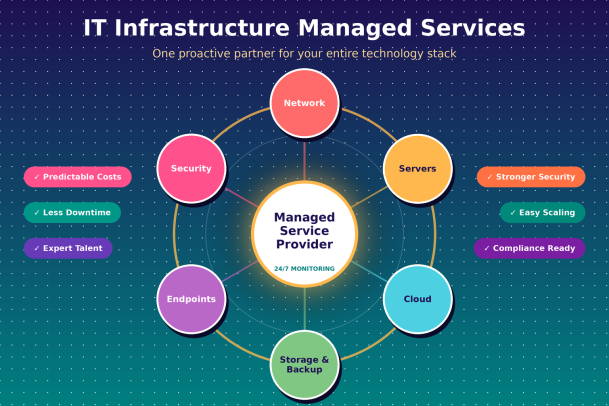
The exact scope varies by provider and contract, but most IT infrastructure managed services cover these building blocks:
- Network management: Monitoring and maintaining routers, switches, firewalls, Wi-Fi, VPNs, and SD-WAN links to keep connectivity fast and reliable.
- Server management: Provisioning, patching, and tuning physical and virtual servers, whether they sit on-premises or in a data center.
- Cloud infrastructure management: Managing workloads across AWS, Microsoft Azure, Google Cloud, and private clouds, including cost optimization and configuration control.
- Storage, backup, and disaster recovery: Running backups, testing restores, and keeping recovery plans ready so data loss never becomes business loss.
- Endpoint management: Keeping laptops, desktops, mobile devices, and IoT equipment updated, configured, and compliant with policy.
- Security management: Threat detection, endpoint protection, vulnerability management, and incident response to defend the entire environment.
- Monitoring and help desk: 24/7 performance monitoring, alerting, and a support desk that resolves user issues quickly.
Together, these services give a business one accountable partner for the health of its entire technology stack, rather than a patchwork of vendors and in-house heroes.
How IT Infrastructure Managed Services Work
Most engagements follow a clear lifecycle that moves from discovery to continuous improvement.
- Assessment and onboarding: The provider audits your current environment, documents every asset, identifies gaps and risks, and agrees on priorities with your team.
- Service level agreement (SLA): Both sides define what is covered, expected uptime, response and resolution times, reporting cadence, and escalation paths. The SLA is the backbone of accountability.
- Proactive monitoring and management: Remote monitoring and management (RMM) tools track the health of servers, networks, and endpoints 24/7. Automated alerts trigger action long before a small issue becomes an outage.
- Maintenance and security operations: Patching, updates, backups, and threat response happen on a defined schedule, often outside business hours to avoid disruption.
- Reporting and optimization: Regular reports show performance, incidents, and security posture. Quarterly reviews turn that data into a roadmap for upgrades and cost savings.
On pricing, providers usually offer per-device, per-user, or tiered all-inclusive plans. Each converts unpredictable repair bills into a fixed monthly operating expense that is far easier to budget.
Key Benefits of IT Infrastructure Managed Services
Predictable costs. A fixed monthly fee replaces surprise repair bills and large capital purchases. Businesses also avoid the full cost of hiring, training, and retaining specialist engineers.
Less downtime. Proactive monitoring catches failing disks, overloaded servers, and network bottlenecks early. Fewer outages mean more productive employees and happier customers.
Stronger security. Providers bring enterprise-grade tools and security expertise that smaller teams rarely have. Consistent patching alone closes many of the doors attackers use most often.
Access to expert talent. You gain a whole team of network engineers, cloud architects, and security analysts for less than the cost of a few full-time hires.
Scalability. Opening a new office, onboarding 50 employees, or migrating to the cloud no longer requires a hiring spree. The provider scales services up or down with your business.
Focus on core work. When infrastructure is handled, your internal IT staff can work on projects that drive revenue and innovation instead of chasing password resets and printer errors.
Easier compliance. Documented processes, audit trails, and regular reporting help organizations meet standards such as ISO 27001, HIPAA, PCI DSS, and GDPR.
Managed Services vs. Traditional In-House IT
The table below summarizes how the two approaches differ in practice.
| Factor | Traditional in-house / break-fix IT | IT infrastructure managed services |
|---|---|---|
| Approach | Reactive: fix after failure | Proactive: prevent failure |
| Cost model | Salaries plus unpredictable repair bills | Fixed, predictable monthly fee |
| Coverage | Business hours, limited by headcount | 24/7 monitoring and support |
| Expertise | Limited to the skills of a few staff | Broad team of specialists |
| Security | Often stretched thin | Dedicated tools and continuous oversight |
| Scalability | Slow; requires hiring | Fast; adjusts with contract |
Many organizations choose a co-managed model. Internal IT keeps strategic ownership and business-specific systems, while the provider handles routine monitoring, maintenance, and after-hours coverage. This hybrid often delivers the best of both worlds.
How to Choose the Right IT Infrastructure Managed Services Provider
Not all providers are equal. Use these criteria to separate true partners from simple resellers:
- Clear, measurable SLAs: Look for specific uptime guarantees and response times, plus penalties if they are missed.
- Security-first approach: Ask how they prevent breaches, not just how they respond. Prevention-focused technologies such as Zero Trust architecture and auto-containment add a crucial layer of protection.
- True 24/7 coverage: Confirm that monitoring and response are staffed around the clock, not just automated alerts sent to an inbox.
- Relevant experience: Choose a provider that has worked with businesses of your size, industry, and compliance requirements.
- Transparent pricing: Every service, exclusion, and potential extra charge should be spelled out before you sign.
- Unified tooling and visibility: A single platform for monitoring, patching, endpoint protection, and reporting reduces gaps and gives you a clear view of your environment.
- Scalability and flexibility: Your provider should grow with you and support both on-premises and cloud workloads.
Ask for references, review sample reports, and request a live demonstration of the platform before you commit.
Why Security Must Be at the Heart of Managed Infrastructure
Infrastructure and security can no longer be managed separately. Every unpatched server, misconfigured firewall, or unmanaged laptop is a potential entry point for ransomware and data theft. A provider that only keeps systems running, without hardening them against attack, leaves the most expensive risk on the table.
The strongest IT infrastructure managed services combine remote monitoring and management, patch automation, endpoint protection, and managed detection and response in one platform. This unified approach shrinks the attack surface, speeds up response, and gives leadership a single source of truth about both performance and risk.
Conclusion
IT infrastructure managed services give organizations what in-house teams increasingly struggle to provide on their own: 24/7 vigilance, deep expertise, predictable costs, and security built into every layer. Whether you are a growing business without a dedicated IT department or an enterprise looking to free up your internal team, the right managed services partner turns infrastructure from a constant headache into a competitive advantage.
Xcitium helps businesses unify infrastructure management and cybersecurity with a prevention-first, Zero Trust approach that stops threats before they cause damage. See how it can simplify your operations and protect your environment.
Ready to take control of your IT infrastructure? Request a Demo with Xcitium
Please give us a star rating based on your experience.

 (21 votes, average: 2.00 out of 5, rated)