What Is WiFi 7? A Complete Guide to the Next Generation of Wireless Technology
Updated on January 13, 2026, by Xcitium
Have you noticed that even the fastest WiFi networks struggle with congestion, lag, and dropped connections? If you’re asking what is WiFi 7, you’re already looking toward the future of wireless connectivity. As homes and businesses rely on more connected devices than ever, older WiFi standards are reaching their limits.
What is WiFi 7 isn’t just a question for tech enthusiasts—it matters to IT managers, cybersecurity teams, and business leaders planning for scalability, performance, and security. WiFi 7 promises dramatic improvements in speed, latency, and reliability, making it ideal for cloud computing, remote work, smart homes, and high-performance enterprise environments.
In this guide, we’ll explain what WiFi 7 is, how it works, why it matters, and whether it’s worth upgrading.
What Is WiFi 7?
What is WiFi 7? WiFi 7, also known as IEEE 802.11be, is the next-generation wireless standard designed to deliver ultra-fast speeds, lower latency, and improved efficiency compared to WiFi 6 and WiFi 6E.
WiFi 7 builds on previous standards by expanding bandwidth, improving modulation, and allowing devices to use multiple frequency bands simultaneously. The result is a more stable and responsive wireless experience—even in crowded environments.
Key Goals of WiFi 7
-
Increase wireless speed dramatically
-
Reduce latency for real-time applications
-
Improve performance in dense device environments
-
Support next-gen applications like AR, VR, and AI
Understanding what is WiFi 7 helps organizations prepare for future connectivity demands.
How WiFi 7 Works
To fully understand what is WiFi 7, it’s important to look at the technology behind it.
WiFi 7 introduces advanced features that allow routers and devices to communicate more efficiently across multiple frequency bands.
Core Technologies Powering WiFi 7
-
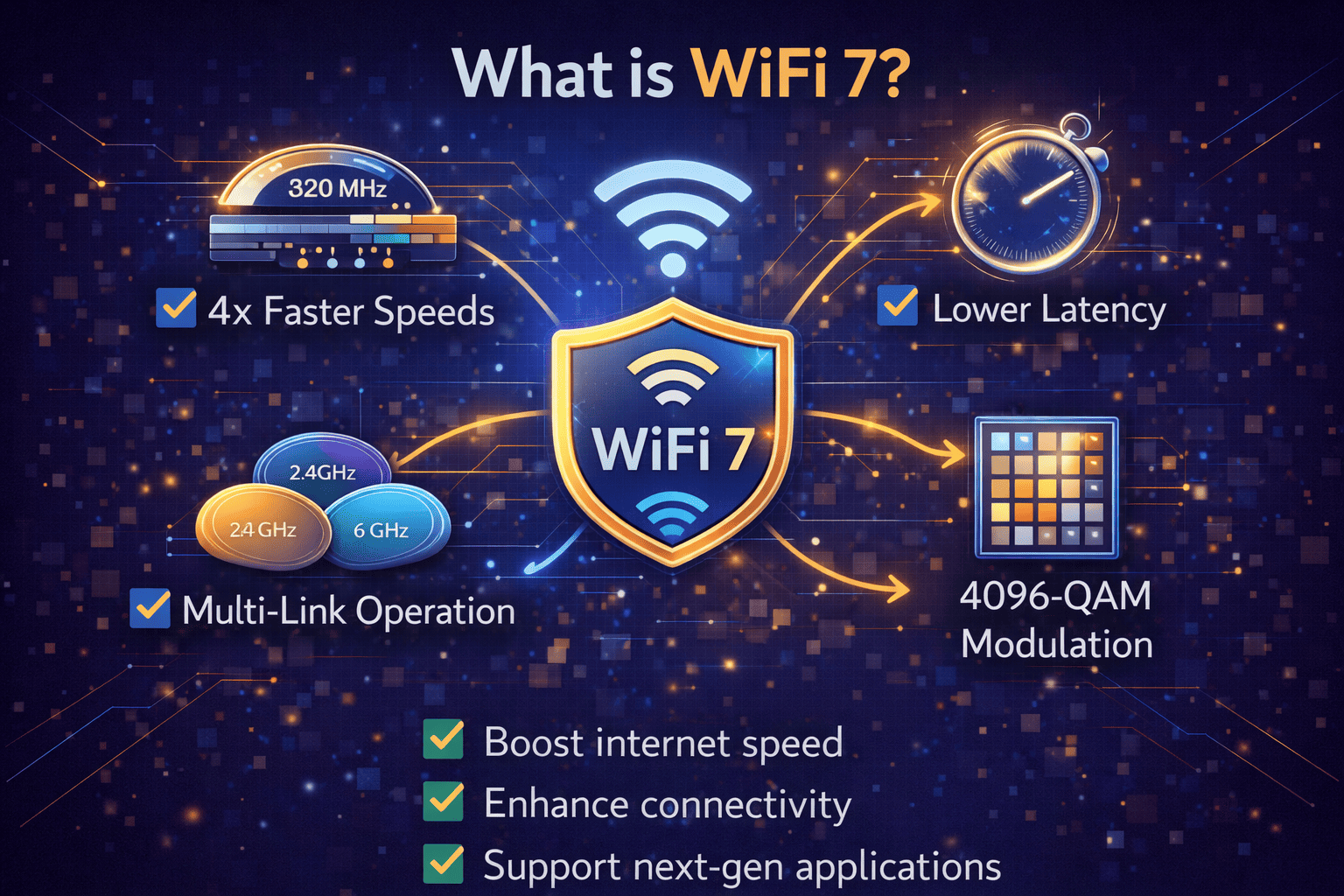
320 MHz channel bandwidth
-
4096-QAM modulation
-
Multi-Link Operation (MLO)
-
Improved scheduling and coordination
These enhancements allow WiFi 7 to deliver faster speeds and more reliable connections than previous standards.
WiFi 7 vs WiFi 6 and WiFi 6E
One of the most common questions related to what is WiFi 7 is how it compares to existing standards.
| Feature | WiFi 6 | WiFi 6E | WiFi 7 |
|---|---|---|---|
| Max Channel Width | 160 MHz | 160 MHz | 320 MHz |
| Modulation | 1024-QAM | 1024-QAM | 4096-QAM |
| Frequency Bands | 2.4 / 5 GHz | 2.4 / 5 / 6 GHz | 2.4 / 5 / 6 GHz |
| Multi-Link | ❌ | ❌ | ✅ |
| Latency | Low | Lower | Ultra-low |
WiFi 7 delivers up to 4x faster speeds than WiFi 6 under ideal conditions.
Key Features That Define What WiFi 7 Is
1. Multi-Link Operation (MLO)
One of the most important answers to what is WiFi 7 lies in Multi-Link Operation.
MLO allows devices to connect across multiple bands (2.4 GHz, 5 GHz, and 6 GHz) at the same time. This reduces latency and prevents congestion by dynamically switching traffic.
2. Ultra-Wide 320 MHz Channels
WiFi 7 doubles the channel width of WiFi 6, enabling higher throughput and faster data transfer—ideal for high-bandwidth applications.
3. 4096-QAM Modulation
This higher modulation scheme packs more data into each signal, increasing speeds without using additional spectrum.
4. Lower Latency for Real-Time Apps
WiFi 7 is optimized for real-time use cases such as:
-
Video conferencing
-
Online gaming
-
AR and VR
-
Industrial automation
Why WiFi 7 Matters for Businesses
Understanding what is WiFi 7 is especially important for business and enterprise environments.
Business Benefits of WiFi 7
-
Faster cloud access and file transfers
-
Improved performance for hybrid workforces
-
Better support for high-density offices
-
Reduced network congestion
-
More reliable VoIP and video calls
For IT managers, WiFi 7 means fewer complaints, less troubleshooting, and improved productivity.
What Is WiFi 7’s Role in Cybersecurity?
Network performance and security are closely linked. WiFi 7 introduces features that indirectly support stronger security postures.
Security Advantages
-
More stable connections reduce attack surface
-
Faster encryption handshakes
-
Better segmentation support
-
Improved handling of Zero Trust architectures
While WiFi 7 doesn’t replace security tools, it enhances the infrastructure that modern cybersecurity solutions depend on.
Who Should Upgrade to WiFi 7?
Not everyone needs WiFi 7 immediately. Knowing what is WiFi 7 helps determine if it’s right for you.
Ideal Candidates for WiFi 7
-
Enterprises with high device density
-
Organizations using cloud-heavy applications
-
Smart homes with dozens of connected devices
-
Media, gaming, and content creation industries
-
Healthcare and manufacturing environments
For small offices and basic home use, WiFi 6 may still be sufficient for now.
WiFi 7 and Smart Homes
Smart homes are one of the biggest drivers behind what is WiFi 7 adoption.
Smart Home Benefits
-
Reliable connectivity for IoT devices
-
Reduced interference between devices
-
Faster response times
-
Support for future smart technologies
As smart homes grow more complex, WiFi 7 ensures seamless operation.
Is WiFi 7 Backward Compatible?
Yes. One important detail when learning what is WiFi 7 is compatibility.
WiFi 7 routers are backward compatible with older WiFi devices, including WiFi 6, WiFi 5, and earlier standards. Older devices simply won’t benefit from the new features.
What Hardware Is Needed for WiFi 7?
To take full advantage of WiFi 7:
-
WiFi 7–enabled router
-
WiFi 7–compatible devices
-
Updated operating systems and drivers
Without compatible hardware, users won’t experience the full benefits.
Potential Challenges with WiFi 7 Adoption
Despite its advantages, WiFi 7 comes with challenges.
Considerations
-
Higher initial hardware cost
-
Limited device availability (early stages)
-
Overkill for low-bandwidth environments
Understanding these factors is key when evaluating what is WiFi 7 for your organization.
The Future of Wireless Networking with WiFi 7
WiFi 7 is designed to support the next decade of wireless innovation.
Future Use Cases
-
AI-driven workloads
-
Immersive AR/VR experiences
-
Smart cities and industrial IoT
-
Advanced telemedicine
WiFi 7 sets the foundation for future digital transformation.
Frequently Asked Questions (FAQ)
1. What is WiFi 7 in simple terms?
WiFi 7 is the latest wireless standard designed to deliver faster speeds, lower latency, and more reliable connections.
2. How fast is WiFi 7 compared to WiFi 6?
WiFi 7 can be up to four times faster than WiFi 6 under ideal conditions.
3. Do I need new devices for WiFi 7?
Yes. Both the router and connected devices must support WiFi 7 to gain full benefits.
4. Is WiFi 7 more secure?
WiFi 7 supports modern security frameworks and improves network stability, which enhances overall security.
5. When will WiFi 7 become mainstream?
Adoption is increasing, with wider availability expected over the next few years.
Final Thoughts: Why Understanding What Is WiFi 7 Matters
As connectivity demands continue to grow, understanding what is WiFi 7 helps businesses and individuals prepare for the future. With unmatched speed, ultra-low latency, and improved reliability, WiFi 7 is built for next-generation applications and digital experiences.
If your organization depends on fast, secure, and scalable networking, now is the time to start planning.
👉 See how advanced security solutions complement next-gen networks—request a demo today:
https://www.xcitium.com/request-demo/