Ask most IT leaders whether AI is running unchecked inside their organization and the answer comes back confident: we’d know. We control provisioning. We review vendors. We’d see it in the logs.
The uncomfortable part is that AI adoption didn’t arrive through procurement. It arrived through a browser tab, a free trial, a colleague’s recommendation in a team channel, and a Copilot license someone expensed to a department card. Employees adopted AI faster than IT could build a process to track it, and the gap between what’s actually in use and what IT can name has been widening for two years.
Shadow AI is any AI tool, assistant, or agent being used for company work without IT’s knowledge, approval, or oversight — the AI equivalent of shadow IT, except it moves faster and touches data more directly.
This piece isn’t a warning about something that might happen. It’s a checklist you can run against your own organization today.
What Counts as Shadow AI
Shadow AI isn’t limited to someone using a chatbot on the sly. It covers the full range of unsanctioned AI activity, including:
- Public AI tools used for internal work — an analyst pasting a customer list into a free chatbot to clean up formatting, or a manager summarizing a confidential performance review.
- Departmental AI tools bought outside procurement — marketing subscribes to an AI copywriting platform, support deploys a chatbot vendor, neither passes through security review.
- Homegrown agents and automations — a scripted workflow wired into an AI API by a technically capable employee, quietly running against production data with credentials nobody audited.
The common thread isn’t the tool. It’s the absence of anyone in a position to answer basic questions about it: what data does it see, who can use it, and what happens when it’s wrong.
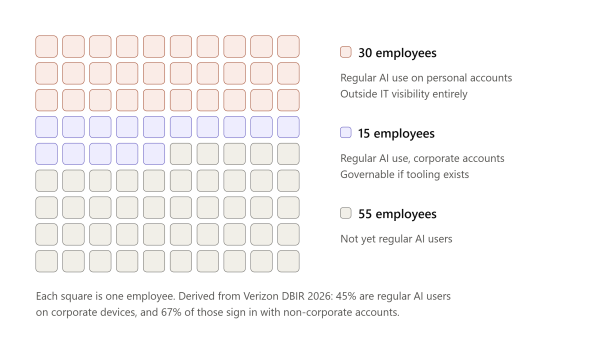
10 Signs Shadow AI Is Already in Your Organization
1. Employees are pasting company data into public AI tools
This is the most common form of shadow AI and the hardest to see. Contracts, code, customer records, and financial figures get dropped into consumer AI interfaces because it’s the fastest way to get a task done. Unless you’ve deployed monitoring at the browser or network layer, you have no record of what left the building.
2. More than one department is running its own chatbot or assistant
Sales has a lead-qualification bot. Support has a deflection assistant. HR is piloting something for onboarding questions. Each was a reasonable local decision, and none of them share a security baseline, a data-handling standard, or a shutdown procedure.
3. Nobody in IT can list every AI tool currently in use
Try it as an exercise: ask your team to produce a complete inventory from memory, then compare it against expense reports and SSO logs. The delta is your shadow AI footprint. If the answer requires an investigation rather than a lookup, you don’t have visibility — you have an estimate.
4. Staff are signing up for AI subscriptions on personal or department cards
AI tools are cheap enough to slip under approval thresholds, which is exactly why they bypass procurement. A twenty-dollar monthly charge on a department card never triggers a vendor review, a DPA, or a security questionnaire — but the tool it pays for may be processing regulated data.
5. AI-generated content is going out without a review step
Marketing copy, customer emails, support responses, and internal documentation are increasingly drafted by AI, which is fine. What’s not fine is when no human is accountable for accuracy before it ships. If you can’t name who reviewed a published claim, you can’t defend it either.
6. There’s no audit trail for decisions an AI tool influenced
A candidate gets screened out. A discount gets approved. A support ticket gets prioritized. If an AI tool shaped that outcome and nothing recorded which tool, which version, and which inputs, you cannot reconstruct the decision — for a regulator, a customer, or your own postmortem.
7. IT finds out about a new AI tool after it’s already in daily use
The tell isn’t that someone tried a new tool. It’s the direction of information flow: IT learns about it because it broke, because a user filed a ticket, or because it appeared in a renewal invoice. By then it’s embedded in a workflow and removing it costs political capital.
8. An AI tool has access to customer or financial data nobody approved
Connected AI assistants request broad permissions — inbox, calendar, CRM, file storage, ticketing — and users grant them in a single click. That’s a data-processing relationship established without a review, and in many cases without anyone in IT knowing the connection exists.
9. Two teams are independently building the same automation
Duplicate effort is a symptom, not just a waste. When two teams build the same AI-driven report or triage workflow without discovering each other, it means there’s no shared registry of what exists. If they can’t see each other’s work, neither can you.
10. There’s no written policy on which AI tools are approved for work use
Absent a policy, every employee writes their own — and most default to whatever is convenient. “Use good judgment” is not a control. If you can’t point to a document that names approved tools, prohibited data types, and an approval path for new requests, your governance posture is unofficial by definition.
If you recognized three or more of these, shadow AI isn’t a future risk in your organization. It’s current-state operations.
Why This Is a Bigger Risk Than It Looks
The instinct is to treat this as a productivity-tools problem. It isn’t. It’s a data problem wearing a productivity-tools costume.
Compliance exposure. GDPR, HIPAA, PCI DSS, and the EU AI Act all assume you can document where personal or regulated data goes and who processes it. Every unsanctioned AI tool is an undocumented processor. Auditors don’t grade on intent, and “we didn’t know that tool was in use” is a finding, not a defense.
Data leakage. Data entered into a consumer AI service may be retained, used to improve models, or accessible to that vendor’s staff, depending on terms your employees never read. Unlike a breach, this leakage generates no alert and no incident — it looks like normal work, right up until proprietary information surfaces somewhere it shouldn’t.
Brand and legal risk. Unreviewed AI output goes out under your company name. Fabricated statistics in a customer proposal, a hallucinated policy in a support reply, an infringing image in a campaign, or a biased screening decision in hiring — each becomes your liability, and each is harder to remediate once you can’t trace how it was produced.
Operational fragility. Undocumented AI workflows built by individuals become single points of failure. When that person leaves, nobody knows what the automation does, what it connects to, or how to fix it when it breaks.
Bringing Shadow AI Under Control
The reflex response is to ban unapproved tools. It doesn’t work. Blanket bans push usage further underground, onto personal devices and personal accounts where you have zero telemetry — trading a visible problem for an invisible one, while handing your competitors a productivity advantage.
The goal is governed adoption, not prohibition. That means:
- Discover what’s actually running. Inventory AI usage across expense data, SSO and OAuth grants, network traffic, and — most usefully — a candid amnesty-style survey of teams. You cannot govern an unknown population.
- Publish a real policy. Name approved tools, define which data classes may never be entered into external AI systems, and specify a fast approval path for new requests. Speed matters: if approval takes six weeks, employees will route around it.
- Give people sanctioned tools that are genuinely good. Most shadow AI is a symptom of unmet need. Provide capable, enterprise-grade alternatives and the incentive to freelance mostly disappears.
- Centralize visibility and control. Consolidate AI agents under one console where IT can see every deployment, enforce permissions and data boundaries, and log activity for audit.
- Require human accountability for AI output. Define review steps for anything customer-facing, regulated, or consequential, and keep records of what the AI contributed.
- Monitor continuously. AI tooling changes monthly. A one-time inventory is stale within a quarter, so treat discovery as an ongoing process rather than a project.
Shadow AI is fundamentally a visibility failure, and visibility is a solvable problem — which is why a growing category of platforms now exists specifically to address it. Xcitium Managed AI gives IT a single console to deploy, monitor, and govern every AI agent across the organization, applying the same discipline to AI that you already apply to endpoints, servers, and applications.
The AI in your company isn’t going away. The only real question is whether you can see it.
Please give us a star rating based on your experience.
 (1 votes, average: 5.00 out of 5, rated)