Xcitium AI Strategy Team — drawing on patterns we see across IT-led AI rollouts
Walk into almost any IT department in 2026 and you’ll find an AI initiative somewhere on the roadmap. Walk out a few months later, and there’s a good chance it’s still there approved, budgeted, discussed in every leadership meeting, and not yet live.
That gap between ambition and adoption is now well documented. Gartner projects that at least 30% of generative AI projects will be abandoned after proof-of-concept by the end of 2025, and forecasts that more than 40% of agentic AI projects will be canceled outright by the end of 2027 in both cases pointing to escalating costs, unclear business value, and inadequate risk controls as the leading causes. McKinsey’s 2025 State of AI research tells the same story from the other direction: 88% of organizations already use AI in at least one business function, yet nearly two-thirds haven’t begun scaling it past a pilot, and only about 6% of companies report the kind of AI-driven value that shows up in their bottom line.
None of that points to a lack of enthusiasm. Leadership wants AI. Departments are asking for it. Budget usually isn’t the blocker either. Most AI projects don’t fail because no one cared enough to push them forward they fail somewhere in the build, in the space between “let’s do this” and something an employee can actually use. If your own rollout feels like it’s lost momentum, the reason is probably on this list.
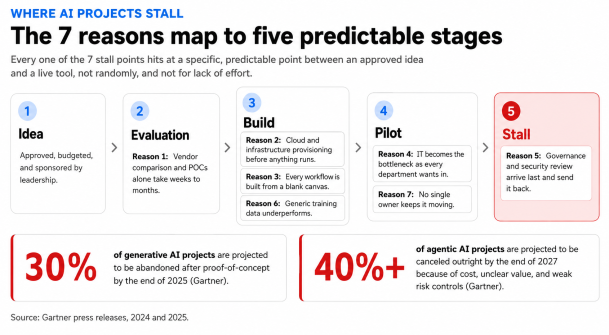
Where the 7 reasons hit: idea, evaluation, build, pilot, and stall.
7 Reasons AI Projects Stall
1. Platform evaluation alone takes months. Before a single agent gets built, most IT teams spend weeks often months comparing vendors, running proof-of-concepts, and negotiating contracts. That process is harder than it should be because the market is flooded with lookalike claims: Gartner estimates that of the thousands of vendors now marketing “agentic AI,” only around 130 offer genuine agentic capabilities, with the rest largely “agent-washing” rebranding existing automation as something more advanced. Sorting real capability from marketing takes real time, and industry build-versus-buy research puts even a production-grade custom build at four to twelve weeks for an experienced team a clock that doesn’t start until evaluation ends.
2. Cloud subscriptions and infrastructure setup are required before anything runs. Even after a platform is chosen, there’s provisioning: cloud environments, compute allocation, API access, integration groundwork. None of it is visible to the business, and none of it produces a working tool. Gartner puts the all-in cost of enterprise generative AI deployments at roughly $5 million to $20 million depending on the approach spend that starts accruing before the first workflow is even sketched out.
3. Every workflow gets built from scratch, with no starting template. Most platforms hand IT a blank canvas and call it flexibility. In practice, that means every use case customer support, sales outreach, internal helpdesk gets designed, prompted, and tested from zero, with no proven starting point to work from. It shows up in the satisfaction data: G2’s 2025 AI Agents survey of more than 1,000 B2B decision-makers found in-house, custom-built agents ranked last among deployment approaches on satisfaction, time-to-value, and ease of use behind every flavor of packaged platform.
4. IT becomes the bottleneck as every department wants in. Once word gets out that AI is being piloted, requests pour in from marketing, sales, HR, and support simultaneously. A small IT team that was scoped to support one pilot is suddenly fielding five, and the honest answer to most of those requests is “not yet” which quietly kills enthusiasm across the business.
5. Governance gets designed after the pilot, not before, and security review stalls it. It’s common for a team to build something that works technically, only to have security and compliance step in at the last minute with questions about data handling, access control, and audit trails. This isn’t a fringe risk Gartner names “inadequate risk controls” as one of the top reasons generative and agentic AI projects get abandoned or canceled outright. Retrofitting governance onto a finished pilot is slower and more painful than building it in from the start, and it’s often where projects quietly die.
6. Agents trained on generic data underperform on real company use cases. A chatbot trained on the open internet doesn’t know your product catalog, your support policies, or how your sales team actually talks to prospects. The result is an agent that technically works but produces generic, sometimes wrong answers and “poor data quality” is, again, one of the specific causes Gartner cites for why organizations pull the plug on GenAI projects after the proof-of-concept stage.
7. No single owner, so momentum dies after the kickoff meeting. AI initiatives frequently launch with broad sponsorship and no specific owner accountable for getting them live. Everyone agrees it matters; no one’s calendar has time blocked to drive it forward. Without a name attached to the outcome, the project drifts to the bottom of every list it’s on.
What the Companies That Succeed Do Differently
The organizations that actually get AI into production tend to do three things differently, and none of them are exotic they also happen to be the inverse of the reasons above, which is a large part of why they work.
They start with governance, not after it. Access controls, data handling rules, and approval workflows are decided before a single agent goes live, not bolted on when security asks hard questions during review. That single sequencing change removes the most common reason pilots stall late.
They pick one narrow use case instead of trying to solve everything at once. Rather than an enterprise-wide AI transformation, successful teams choose a specific, well-bounded job routing tier-one support tickets, drafting first-pass sales outreach and get that one thing genuinely working before expanding.
And they measure fast. Instead of a six-month evaluation followed by a six-month build, they get something live in weeks, watch how it performs against real usage, and adjust. Speed to a measurable result matters more than getting the first version perfect. G2’s research reflects this split in the market: 57% of surveyed companies already have some AI agent in production, and it’s platform-based deployments not custom builds that account for most of the fast movers.
The Faster Path: Pre-Built Instead of Custom-Built
Underneath most of these seven stalls is the same root cause: everything is being built from zero. The evaluation, the infrastructure, the workflow design, the training data, the governance model all of it treated as a custom project with a custom timeline, for every single use case, in every department that wants one.
Here’s how that plays out in practice. Picture a mid-size logistics company call it Meridian Freight, a composite drawn from the pattern we see repeatedly at 300- to 500-person distribution and logistics firms, not a specific customer. In Q1, Meridian’s IT team sets out to deploy an AI agent to handle tier-one customer support tickets. They spend six weeks evaluating four vendors, another three weeks on cloud provisioning and API access, and five weeks building and prompting the workflow from scratch. In week fifteen, security asks how the agent handles customer PII a question no one had answered yet and the project goes back into review. By the end of Q2, the pilot is technically running but still hasn’t launched company-wide, and two other departments who asked to be “next” are still waiting.
Now picture the alternative. Instead of designing an agent from a blank canvas, IT chooses a pre-built, role-based support agent from a catalog already configured for tier-one ticket routing, with data handling and access controls built into the platform rather than left for IT to design. Evaluation is a fit check, not a months-long bake-off. Infrastructure is already provisioned by the platform. Governance questions get answered by pointing to controls that were already built in, not retrofitted under deadline. The same use case that took Meridian most of two quarters in the first scenario is live inside a week in the second and IT has bandwidth left over for the next department in line.
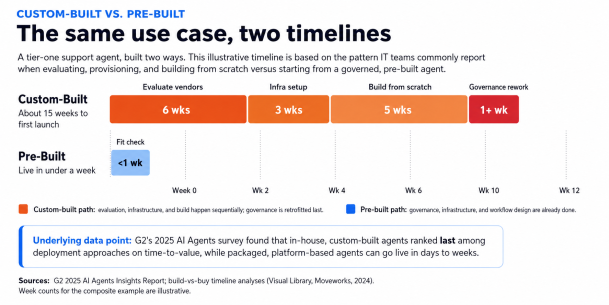
The same use case, two timelines: ~15 weeks custom-built vs. under a week pre-built.
This doesn’t remove the need for judgment someone still has to pick the right use case and stay involved after launch. But it removes almost everything on the list above that has nothing to do with judgment and everything to do with reinventing infrastructure that already exists elsewhere.
The Bottom Line
None of the seven reasons projects stall are really about AI itself. They’re about treating every rollout as a from-scratch engineering project when a role-based, governed starting point already exists. Xcitium Managed AI is built around exactly that model: pre-built, role-based agents with governance built in from the start, so a department can go from approval to a working agent in under an hour instead of months of custom build.
Please give us a star rating based on your experience.
 (1 votes, average: 5.00 out of 5, rated)