What if you could predict whether a login attempt is safe—or a cyberattack in progress—within seconds? That’s exactly what modern security systems aim to do using identity risk scoring.
Identity Risk Scoring Explained: With cyber threats growing rapidly, traditional security methods like passwords are no longer enough. Attackers use stolen credentials, phishing, and automated bots to bypass basic defenses. This is where identity risk scoring becomes a powerful tool in cybersecurity.
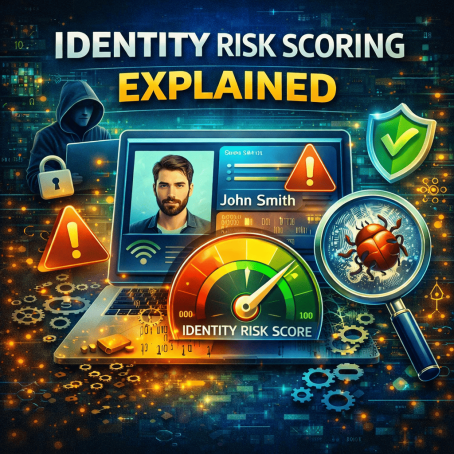
Identity risk scoring evaluates user behavior, device information, and contextual data to determine whether an access request is legitimate or suspicious. It assigns a risk level to each interaction, helping organizations make smarter security decisions in real time.
For IT managers, cybersecurity professionals, and business leaders, understanding identity risk scoring is essential for building secure, adaptive, and intelligent access control systems. In this guide, we’ll break down how identity risk scoring works, its benefits, key components, and best practices for implementation.
What Is Identity Risk Scoring?
Identity risk scoring is a cybersecurity method used to evaluate the likelihood that a user or login attempt poses a security risk. It assigns a score based on various factors such as behavior, device, location, and historical patterns.
Instead of treating every login equally, identity risk scoring helps systems adapt security controls dynamically.
Why Identity Risk Scoring Matters
Traditional authentication methods rely heavily on passwords. However, passwords can be:
-
Stolen through phishing
-
Cracked using brute force attacks
-
Reused across multiple accounts
Identity risk scoring adds an extra layer of intelligence by analyzing context and behavior rather than just credentials.
How Identity Risk Scoring Works
Identity risk scoring systems analyze multiple data points to calculate a risk score.
Step-by-Step Process
-
User attempts to log in
-
System collects contextual data
-
Risk factors are evaluated
-
A risk score is assigned
-
Security action is triggered
Based on the score, the system may:
-
Allow access
-
Require multi-factor authentication (MFA)
-
Block the request
Key Factors in Identity Risk Scoring
Several elements influence how risk scores are calculated.
1. User Behavior Analysis
Behavioral patterns play a major role in identity risk scoring.
Examples of Behavioral Data
-
Typing speed
-
Login frequency
-
Navigation patterns
-
Time of access
If a user behaves differently than usual, the system may assign a higher risk score.
2. Device Information
The device used for login provides important context.
Device-Based Risk Indicators
-
Unknown devices
-
Unrecognized browsers
-
Outdated operating systems
-
Suspicious configurations
A login from a new or untrusted device may trigger additional security checks.
3. Location and Geolocation
Location data helps identify unusual login attempts.
Examples
-
Login from a different country
-
Impossible travel (logging in from two locations within minutes)
-
High-risk geographic regions
Such anomalies increase the risk score.
4. Network and IP Address
The network used during login is another critical factor.
Risk Indicators
-
Use of public Wi-Fi
-
Suspicious IP addresses
-
VPN or proxy usage
-
Known malicious networks
These signals help identify potentially unsafe connections.
5. Threat Intelligence Integration
Modern identity risk scoring systems use threat intelligence to identify known risks.
Examples
-
Compromised credentials
-
Known attacker IP addresses
-
Malware-infected devices
This data improves the accuracy of risk assessments.
Types of Identity Risk Scores
Different systems may use various scoring models.
Low Risk
-
Known user
-
Trusted device
-
Normal behavior
Action: Access granted without additional verification.
Medium Risk
-
Minor anomalies detected
-
Slight behavior changes
Action: Require MFA or additional verification.
High Risk
-
Suspicious activity detected
-
Unknown device or location
Action: Block access or trigger security alerts.
Benefits of Identity Risk Scoring
Implementing identity risk scoring provides significant advantages.
Enhanced Security
By analyzing multiple factors, identity risk scoring detects threats that traditional methods miss.
Reduced False Positives
Instead of blocking all unusual activity, systems evaluate risk intelligently.
Improved User Experience
Low-risk users can access systems without unnecessary friction.
Real-Time Threat Detection
Identity risk scoring enables immediate response to suspicious behavior.
Support for Zero Trust Security
Identity risk scoring aligns with zero trust principles, where every access request is verified.
Identity Risk Scoring in Zero Trust Architecture
Zero trust security assumes that no user or device is inherently trusted.
Identity risk scoring plays a key role in this model.
How It Supports Zero Trust
-
Continuously evaluates user identity
-
Verifies every access request
-
Adapts security controls dynamically
This approach ensures that access decisions are based on real-time risk assessment.
Use Cases of Identity Risk Scoring
Organizations across industries use identity risk scoring for various purposes.
Fraud Prevention
Financial institutions use identity risk scoring to detect fraudulent transactions.
Secure Remote Access
With remote work increasing, identity risk scoring helps secure employee access from different locations.
Cloud Security
Cloud platforms use risk scoring to protect sensitive data and applications.
Customer Identity Protection
E-commerce platforms use identity risk scoring to prevent account takeover attacks.
Challenges in Identity Risk Scoring
Despite its benefits, identity risk scoring comes with challenges.
Data Privacy Concerns
Collecting user behavior data must comply with privacy regulations.
Complex Implementation
Integrating identity risk scoring into existing systems can be challenging.
False Negatives
In some cases, attackers may mimic legitimate behavior to avoid detection.
Continuous Updates Required
Threat landscapes evolve, requiring constant updates to scoring models.
Best Practices for Implementing Identity Risk Scoring
Organizations can maximize the effectiveness of identity risk scoring by following best practices.
1. Combine Multiple Data Sources
Use behavioral, device, and network data for accurate risk assessment.
2. Integrate with MFA
Trigger MFA for medium-risk scenarios to enhance security.
3. Use AI and Machine Learning
Advanced algorithms improve detection accuracy.
4. Regularly Update Risk Models
Keep systems updated with the latest threat intelligence.
5. Balance Security and User Experience
Avoid excessive friction for legitimate users.
The Future of Identity Risk Scoring
Identity risk scoring is evolving rapidly as cybersecurity technologies advance.
Future trends may include:
-
AI-driven behavioral analytics
-
Continuous authentication systems
-
Integration with biometric security
-
Automated risk-based access control
These advancements will make identity security more intelligent and adaptive.
Frequently Asked Questions (FAQ)
What is identity risk scoring?
Identity risk scoring is a method used to evaluate the likelihood that a user or login attempt poses a security risk based on behavior, device, and contextual data.
Why is identity risk scoring important?
It helps organizations detect suspicious activity, prevent unauthorized access, and improve overall cybersecurity.
How does identity risk scoring work?
It analyzes various factors such as user behavior, location, and device information to assign a risk score and determine access decisions.
What is a high-risk login attempt?
A high-risk login involves suspicious activity, such as unknown devices, unusual locations, or compromised credentials.
Can identity risk scoring replace passwords?
No. It complements traditional authentication methods by adding an extra layer of security.
Strengthen Your Identity Security Strategy
As cyber threats grow more advanced, traditional security methods are no longer enough. Identity risk scoring provides a smarter, more adaptive way to protect systems and data.
Organizations that adopt identity-based security strategies can reduce risk, improve user experience, and strengthen their cybersecurity posture.
👉 Request a demo today:
https://www.xcitium.com/request-demo/
Discover how advanced identity protection and threat detection solutions can help secure your organization and prevent modern cyber attacks.
Please give us a star rating based on your experience.
 (1 votes, average: 5.00 out of 5, rated)