With cyberattacks making headlines almost weekly and enterprise security budgets climbing every year, it’s no surprise that investors are increasingly searching for the right EDR stock to add to their portfolio. Endpoint Detection and Response has become one of the fastest-growing categories within cybersecurity, and the publicly traded companies building these tools have drawn significant attention from both retail and institutional investors.
This guide breaks down what EDR stock actually refers to, which major companies operate in this space, and what factors are worth researching before you consider adding cybersecurity exposure to your portfolio. As with any investment topic, this article is for informational purposes only and isn’t financial advice — always do your own research or consult a licensed financial advisor before making investment decisions.
What Does “EDR Stock” Mean?
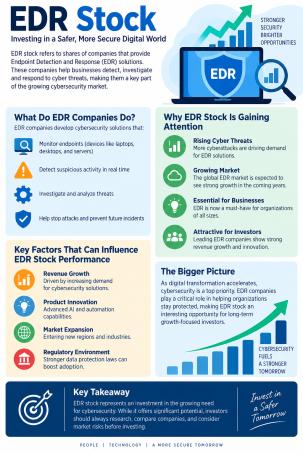
EDR stands for Endpoint Detection and Response — a category of cybersecurity software that continuously monitors laptops, servers, and mobile devices for suspicious activity, then automatically investigates and contains threats before they spread. When investors search for “EDR stock,” they’re typically looking for publicly traded companies whose revenue is built substantially around this technology, or major cybersecurity vendors that offer EDR as part of a broader security platform.
Unlike traditional antivirus software, EDR platforms use behavioral analysis, machine learning, and real-time telemetry to catch threats that signature-based tools miss — which is a major reason the category has become a core budget line item for enterprise security teams and, in turn, a closely watched investment theme.
Why the EDR and Cybersecurity Market Is Attracting Investor Attention
Cybersecurity stocks broadly — and endpoint-focused names specifically — have remained a consistent area of investor interest, with companies like Palo Alto Networks, Fortinet, CrowdStrike, and SentinelOne are regularly highlighted for having some of the highest dollar trading volume among cybersecurity stocks, reflecting sustained market attention to the sector. Analysts frequently point to rising cyberattacks, tightening regulatory requirements, and organizations’ growing dependence on digital infrastructure as core demand drivers behind the sector.
Several of the leading names are also leaning heavily into artificial intelligence, incorporating AI-driven workflows and autonomous threat response into their endpoint platforms — a trend that’s reshaping how investors evaluate growth potential in the space.
Major Publicly Traded Companies in the EDR Space
Several companies dominate conversations around EDR stock, though each takes a slightly different approach to the endpoint security market.
CrowdStrike (CRWD)
CrowdStrike is widely regarded as a category leader in cloud-native EDR and XDR (Extended Detection and Response), built around its Falcon platform. The company has become one of the most closely watched names in the broader cybersecurity sector.
SentinelOne (S)
SentinelOne differentiates itself with an AI-driven, autonomous approach to endpoint protection, aiming to detect and remediate threats without relying on constant human intervention or cloud connectivity.
Palo Alto Networks (PANW)
While best known for firewalls and network security, Palo Alto Networks has expanded aggressively into endpoint and cloud security through its Cortex platform, making it a major diversified player relevant to EDR-focused investors.
Microsoft (MSFT)
Microsoft Defender for Endpoint has grown into one of the most widely deployed EDR solutions globally, largely due to its deep integration with Windows and the Microsoft 365 ecosystem — giving Microsoft significant, if less headline-grabbing, exposure to the EDR category.
Fortinet (FTNT)
Fortinet offers endpoint protection as part of its broader security fabric, combining network, cloud, and endpoint defenses into a unified platform — a strategy that appeals to investors looking for diversified cybersecurity exposure rather than a pure-play endpoint bet.
What to Evaluate Before Investing in an EDR Stock
Cybersecurity is a compelling growth narrative, but not every company in the space performs the same way. Consider researching these factors before making any investment decision:
- Revenue growth and retention rates: Look at annual recurring revenue (ARR) growth and net revenue retention, which indicate how well a company is expanding within its existing customer base.
- Profitability path: Many high-growth cybersecurity companies still operate at a loss. Understand whether a company has a credible path to profitability or is already generating positive free cash flow.
- Competitive positioning: The EDR market is crowded and consolidating. Evaluate whether a company holds a defensible niche or risks being commoditized by larger, diversified vendors.
- Customer concentration and churn: High customer retention and low churn suggest a “sticky” product that’s difficult for competitors to displace.
- Platform breadth: Companies expanding beyond pure EDR into XDR, cloud security, and identity protection may have stronger long-term growth prospects than single-product vendors.
Risks to Consider With Cybersecurity Stocks
Cybersecurity stocks can carry meaningful volatility, and their performance can be influenced by technology trends, corporate IT spending, competitive pressure, and regulatory developments. Additional risks specific to the EDR category include:
- Intense competition from both pure-play vendors and diversified platforms bundling EDR into broader suites
- High valuations relative to earnings, common among fast-growing SaaS security companies
- Economic sensitivity, since enterprise security budgets can be delayed or trimmed during downturns
- Rapid technology shifts, as AI-driven detection methods continue to reshape competitive advantages within the sector
FAQ: EDR Stock
1. What is the best EDR stock to buy?
There’s no single “best” EDR stock — the right choice depends on your investment goals, risk tolerance, and research into each company’s financials and competitive position. This article is educational and not a recommendation to buy or sell any specific security.
2. Is CrowdStrike considered a pure EDR stock?
CrowdStrike began as an EDR-focused company but has since expanded into a broader XDR and cloud security platform, so while endpoint protection remains core to its business, it’s no longer a single-product pure play.
3. What’s the difference between EDR and XDR when evaluating stocks?
EDR focuses specifically on endpoint devices like laptops and servers, while XDR (Extended Detection and Response) expands that visibility across networks, cloud environments, and email. Many EDR-focused companies are expanding into XDR to broaden their addressable market.
4. Are EDR stocks a good long-term investment?
Endpoint security remains a critical, non-discretionary budget item for most organizations, which supports long-term demand. However, like any sector investment, returns depend on individual company execution, valuation, and broader market conditions — always assess risk carefully.
5. How is the EDR market different from traditional antivirus companies?
EDR platforms use continuous monitoring, behavioral analytics, and automated response rather than relying solely on signature-based detection, which is why many legacy antivirus vendors have had to rebuild or acquire EDR capabilities to stay competitive.
See Enterprise-Grade EDR in Action
Understanding the EDR market from an investment angle is one thing — experiencing what modern endpoint detection and response actually does for an organization’s security posture is another. Xcitium’s advanced EDR platform is built to detect, contain, and neutralize threats before they cause damage.
Request a demo today and see firsthand what sets next-generation endpoint protection apart.
Please give us a star rating based on your experience.

 (18 votes, average: 2.00 out of 5, rated)