Every organization today is drowning in data — log files, sensor readings, customer records, network traffic, application telemetry, and more. The challenge isn’t just collecting this data; it’s storing it in a way that’s flexible, scalable, and secure enough to actually use. That’s where the concept of a data lake comes in.
If you’re an IT leader trying to modernize your data infrastructure, or a cybersecurity professional trying to understand where threat data lives and how it’s protected, this guide breaks down exactly what a data lake is, how it works, and why it matters for your security posture.
What is a Data Lake?
A data lake is a centralized storage repository that holds vast amounts of raw data in its native format — structured, semi-structured, and unstructured — until it’s needed. Unlike traditional databases that require data to be cleaned and organized before it’s stored, a data lake accepts data as-is: JSON files, log lines, images, videos, CSVs, sensor streams, and more, all in one place.
Think of it like an actual lake that different rivers and streams flow into. Water from various sources arrives, and it’s stored in its natural form. You don’t have to purify it before it enters the lake — you only treat it when you’re ready to draw it out and use it.
In technical terms, a data lake typically sits on scalable object storage (like Amazon S3, Azure Data Lake Storage, or on-premises equivalents) and uses a “schema-on-read” approach. This means data is stored without a predefined structure, and the schema — the way it’s interpreted — is applied only when the data is queried or analyzed.
Data Lake vs. Data Warehouse: What’s the Difference?
This is one of the most common points of confusion, especially for IT leaders evaluating architecture decisions.
| Feature | Data Lake | Data Warehouse |
|---|---|---|
| Data type | Raw, unstructured, semi-structured, structured | Structured, processed |
| Schema | Schema-on-read (applied when queried) | Schema-on-write (applied before storage) |
| Cost | Generally lower, uses cheap object storage | Higher, optimized compute/storage |
| Users | Data scientists, engineers, ML models | Business analysts, reporting teams |
| Agility | Highly flexible, supports exploratory analysis | Rigid, optimized for known queries |
A data warehouse is built for fast, reliable business intelligence on data that’s already been cleaned and modeled. A data lake, by contrast, is built for flexibility — capturing everything now and deciding how to use it later. Many modern organizations run both, often connected through a data lakehouse architecture that blends the flexibility of a lake with the performance and governance of a warehouse.
Why Data Lakes Matter for IT Leaders
For IT leadership, data lakes solve a very practical problem: the explosion of data volume and variety across the enterprise. Here’s why they matter strategically.
1. Centralized Visibility Across the Organization
Rather than data living in dozens of disconnected silos — one system for HR, another for finance, another for operations — a data lake consolidates it all. This gives IT teams a single source of truth and simplifies infrastructure management.
2. Cost-Effective Scalability
Object storage that underpins most data lakes is significantly cheaper than traditional relational database storage. Organizations can retain years of historical data without the cost burden of scaling a data warehouse to match.
3. Support for Advanced Analytics and AI
Machine learning and AI models need large volumes of raw, diverse data to train effectively. Data lakes provide exactly that — a flexible reservoir that data science teams can draw from without waiting for IT to model and structure every dataset first.
4. Faster Time-to-Insight
Because data doesn’t need to be transformed before it’s stored, teams can ingest new data sources quickly and start extracting value sooner, rather than waiting weeks for a formal ETL (extract, transform, load) pipeline to be built.
Why Data Lakes Matter for Cybersecurity Professionals
Data lakes aren’t just a data engineering concern — they’re increasingly central to security operations. Here’s why.
1. A Single Repository for Security Telemetry
Modern security operations centers (SOCs) generate enormous volumes of data: firewall logs, endpoint detection and response (EDR) events, DNS queries, authentication logs, cloud audit trails, and more. A data lake gives security teams a consolidated place to store all of this telemetry at scale, which is essential for effective SIEM (Security Information and Event Management) and XDR (Extended Detection and Response) platforms.
2. Long-Term Retention for Threat Hunting and Forensics
Many compliance frameworks and incident response processes require retaining log data for months or years. Traditional log management tools become prohibitively expensive at that scale. Data lakes make long-term retention economically feasible, which is critical when a breach isn’t discovered until months after it occurred — a common scenario in advanced persistent threat (APT) investigations.
3. A Larger Attack Surface to Defend
Here’s the flip side: a data lake that aggregates sensitive data from across the enterprise becomes an extremely high-value target. If attackers compromise a poorly secured data lake, they could gain access to everything from customer PII to intellectual property to security logs themselves — potentially blinding your detection capabilities in the process.
This is why cybersecurity professionals need to treat data lake security as a first-class priority, not an afterthought.
4. Enabling Behavioral Analytics and Anomaly Detection
Security teams increasingly rely on machine learning models to detect anomalous behavior — unusual login patterns, lateral movement, data exfiltration attempts. These models need historical, high-volume data to train on, and a data lake is often the foundation that makes this kind of proactive threat detection possible.
Key Components of a Data Lake Architecture
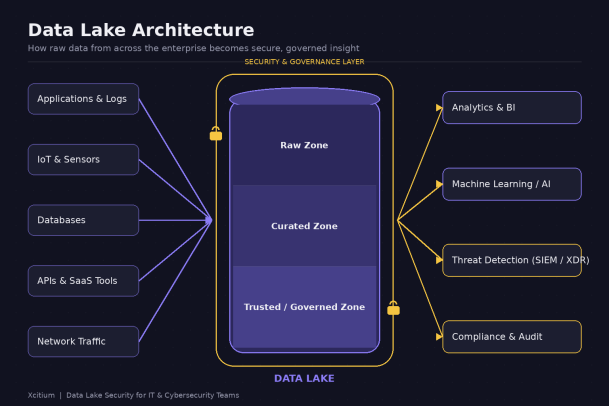
A well-designed data lake generally includes the following layers:
- Ingestion layer – Collects data from various sources (applications, IoT devices, APIs, network sensors) in batch or real-time streams.
- Storage layer – The core repository, usually built on scalable object storage, organized into zones (raw, curated, trusted).
- Processing layer – Tools like Apache Spark or cloud-native processing engines that transform, clean, and enrich data as needed.
- Governance and security layer – Access controls, encryption, data classification, and audit logging that determine who can see and use what data.
- Consumption layer – The tools and teams that draw insights from the lake: BI dashboards, ML models, SOC analysts, and compliance auditors.
That governance and security layer deserves special attention, because it’s often where data lakes fail in practice.
Common Data Lake Security Risks
Because data lakes are designed for flexibility and scale, security is not automatic — it has to be architected deliberately. Common risks include:
- Overly broad access permissions. Without granular access controls, too many users or applications can query sensitive data they shouldn’t touch.
- Data swamps. Poor governance turns a data lake into a “data swamp” — an unmanaged mass of data with no clear ownership, classification, or lifecycle policy, making it nearly impossible to secure properly.
- Lack of encryption at rest and in transit. Given the sheer volume and sensitivity of aggregated data, unencrypted lakes are a significant liability.
- Insufficient monitoring of the lake itself. Ironically, many organizations use data lakes to power security monitoring while neglecting to monitor the lake’s own access patterns for signs of compromise.
- Shadow IT ingestion. Teams connecting new data sources without going through security review can introduce unvetted, unclassified data into the environment.
Best Practices for Securing a Data Lake
For IT and security teams building or maintaining a data lake, a few foundational practices go a long way:
- Classify data at ingestion so sensitive information is tagged and handled appropriately from day one.
- Apply role-based and attribute-based access controls to ensure users and applications only see what they need.
- Encrypt data both at rest and in transit, and manage encryption keys separately from the storage environment.
- Implement continuous monitoring and anomaly detection on the data lake itself, not just the data flowing out of it.
- Establish clear data lifecycle policies to prevent the lake from becoming an ungoverned data swamp.
- Integrate the data lake with endpoint and network security tools so security telemetry feeding into it is trustworthy and tamper-resistant at the source.
That last point is where the whole picture connects. A data lake is only as valuable — and as secure — as the endpoints, networks, and systems feeding data into it. If those sources are compromised, the data lake inherits that risk at scale.
The Bottom Line
A data lake is a powerful architectural pattern for storing and unlocking value from massive, diverse datasets — but for IT leaders and cybersecurity professionals alike, its power comes with responsibility. It centralizes not just opportunity, but risk. Getting the governance, access control, and endpoint security right isn’t optional; it’s what determines whether your data lake becomes a strategic asset or your organization’s biggest liability.
Strong endpoint and network security is the foundation that keeps the data flowing into your lake trustworthy in the first place. If threats are neutralized before they ever generate malicious activity, your data lake stays clean, your analytics stay accurate, and your security team stays ahead of attackers instead of chasing them.
Ready to strengthen the security foundation behind your data infrastructure?
Xcitium’s Zero Trust architecture helps IT and security teams stop threats before they ever touch your endpoints — protecting the integrity of the data flowing into your data lake and beyond.
Please give us a star rating based on your experience.

 (24 votes, average: 2.04 out of 5, rated)