Every time you unlock your phone, stream a video, pay with a card, or check the weather, computing is quietly doing the work behind the scenes. It powers hospitals, banks, factories, governments, and the apps that fill our daily routines. Yet many people never stop to ask a simple question: what is computing, exactly?
Understanding computing is no longer just for engineers. Business leaders, students, and everyday users all benefit from knowing how this technology works, why it matters, and where it is heading. In this guide, we break down what computing means, how it evolved, the core building blocks that make it work, and why it has become the true backbone of digital innovation. We will also look at the security challenges that come with a computing-driven world and how organizations can stay protected.
What is Computing
At its simplest, computing is the use of computers and computational processes to take in data, process it according to a set of instructions, and produce useful results. Those results might be a calculation, a decision, a stored record, an image on a screen, or a message sent across the world.
Computing follows a basic cycle that has stayed remarkably consistent for decades:
- Input: Data enters the system through a keyboard, sensor, camera, file, or network.
- Processing: The processor executes instructions (software) to transform that data.
- Storage: Information is saved in memory or on disks so it can be used again.
- Output: Results are delivered to a person, another device, or another program.
Computing is also a broad academic and professional field. It includes computer science, software engineering, information technology, data science, and cybersecurity. Together, these disciplines study how to design machines, write programs, manage information, and keep systems safe and reliable.
A Brief History of Computing
Computing did not begin with laptops. Humans have used tools to calculate for thousands of years, from the abacus to mechanical calculators. In the 1830s, Charles Babbage designed the Analytical Engine, and Ada Lovelace wrote what many consider the first computer program for it.
The modern era began in the 1940s with room-sized electronic machines such as ENIAC, which used vacuum tubes to perform calculations. The invention of the transistor in 1947 and the integrated circuit in the late 1950s made computers smaller, faster, and cheaper.
The 1970s and 1980s brought the personal computer into homes and offices. The 1990s connected those computers through the internet. The 2000s and 2010s introduced smartphones, cloud platforms, and social media. Today, artificial intelligence, edge devices, and early quantum machines are pushing computing into entirely new territory. Each wave built on the last, and each one reshaped how people work and live.
The Core Components of Computing
Every computing system, from a smartwatch to a global cloud platform, relies on four essential building blocks working together.
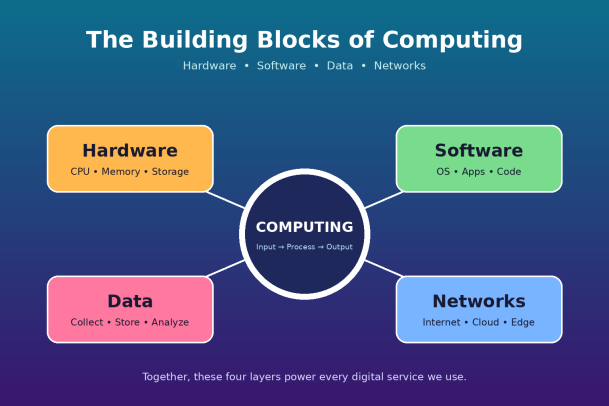
Hardware is the physical side of computing. It includes the central processing unit (CPU), memory (RAM), storage drives, graphics processors, and input and output devices. Hardware sets the limits on speed, capacity, and energy use.
Software is the set of instructions that tells hardware what to do. Operating systems like Windows, macOS, Linux, Android, and iOS manage resources, while applications handle specific tasks such as word processing, video editing, or online banking.
Data is the raw material of computing. Text, numbers, images, sensor readings, and transactions are collected, stored, and analyzed to create insights and drive decisions. In many organizations, data is now one of the most valuable assets they own.
Networks connect devices so they can share data and resources. Local networks link machines in a building, while the internet links billions of devices worldwide. Networks make cloud services, remote work, and real-time collaboration possible.
Key Types of Computing Today
Computing has branched into several models, each designed for different needs.
- Personal computing: Desktops, laptops, tablets, and smartphones that individuals use for work, study, and entertainment.
- Cloud computing: On-demand access to servers, storage, and software over the internet. Businesses can scale up or down without buying and maintaining their own hardware.
- Edge computing: Processing data close to where it is created, such as in factories, vehicles, or retail stores. This reduces delays and bandwidth costs.
- High-performance computing (HPC): Supercomputers and clusters that tackle massive problems like climate modeling, genome research, and engineering simulations.
- Artificial intelligence and machine learning: Systems that learn patterns from data to recognize speech, detect fraud, recommend products, or generate content.
- Quantum computing: An emerging approach that uses quantum bits (qubits) to solve certain problems, such as complex optimization and chemistry simulations, far faster than classical machines may ever manage.
Why Computing Is the Backbone of Digital Innovation
Innovation today almost always starts with computing. New products, services, and business models depend on the ability to collect data, process it quickly, and deliver results at scale. Here is how computing is transforming major industries:
- Healthcare: Electronic health records, AI-assisted diagnostics, telemedicine, and wearable monitors help doctors detect disease earlier and treat patients remotely.
- Finance: Real-time payment systems, algorithmic trading, mobile banking, and fraud detection all run on powerful computing infrastructure.
- Manufacturing: Smart factories use sensors, robotics, and predictive maintenance to reduce downtime and improve quality.
- Retail and e-commerce: Recommendation engines, inventory analytics, and personalized marketing help businesses understand and serve customers better.
- Education: Online learning platforms, virtual classrooms, and adaptive learning tools make education more accessible worldwide.
- Government and public services: Digital identity, online tax filing, and smart city systems improve efficiency and citizen experience.
The common thread is speed and scale. Computing lets organizations turn information into action faster than ever, which is why it is often called the engine of the digital economy.
The Security Challenge of a Computing-Driven World
As computing becomes more powerful and connected, it also becomes a bigger target. Every new device, cloud workload, and remote endpoint expands the attack surface that cybercriminals can exploit.
Some of the most pressing threats include:
- Ransomware that encrypts critical files and halts operations until a payment is made.
- Phishing and social engineering that trick users into revealing passwords or installing malware.
- Zero-day exploits that target unknown vulnerabilities before patches exist.
- Insider threats and misconfigurations that expose sensitive data unintentionally.
- Supply chain attacks that compromise trusted software or vendors.
Traditional security tools often rely on detecting known threats, which leaves gaps when attackers use new or disguised techniques. That is why modern organizations are moving toward a Zero Trust approach, where no file, user, or application is trusted by default. Endpoint protection, threat containment, and continuous monitoring are now essential parts of any computing strategy, not optional add-ons.
The Future of Computing
The next decade of computing will be shaped by several powerful trends. AI will become embedded in nearly every application, automating routine work and assisting with complex decisions. Edge and cloud computing will blend into seamless hybrid environments. Quantum computing will move from research labs toward practical use in areas like drug discovery and logistics.
At the same time, sustainability will matter more. Data centers consume large amounts of energy, so green computing practices, efficient chips, and renewable power will become priorities. Security will also evolve, with AI-driven defenses, stronger identity controls, and automated containment working to stay ahead of increasingly sophisticated attackers.
For businesses, the message is clear: understanding computing is not just a technical concern. It is a strategic one that affects competitiveness, resilience, and trust.
Conclusion
So, what is computing? It is the process of turning data into results through hardware, software, and networks, and it is the foundation on which nearly every modern innovation is built. From its humble beginnings with the abacus to today’s AI and quantum breakthroughs, computing has continuously redefined what is possible for people and businesses alike.
But every leap forward in computing also brings new risks. Protecting your endpoints, data, and users is essential to innovating with confidence. Xcitium helps organizations stop threats before they can cause damage, using Zero Trust architecture and patented containment technology that isolates unknown files so your business keeps running safely.
Ready to secure the computing environment that drives your business forward?
Please give us a star rating based on your experience.

 (17 votes, average: 2.24 out of 5, rated)