Artificial intelligence is no longer a side project. It now sits inside email filters, endpoint protection, fraud engines, help desks and the tools your developers use every day. It also sits in the hands of attackers, who use it to write convincing phishing emails, generate malware variants and probe defenses at machine speed.
For security and technology leaders, that creates a practical problem. You are asked to buy AI, govern AI and defend against AI, often without a clear picture of what is happening under the hood. Vendor slides promise “intelligent” and “autonomous” protection, but they rarely explain how the system reaches a decision or where it can fail.
So, how does AI work? This guide answers that question in plain language. You will learn the core building blocks, how models are trained and used, how AI is applied in cybersecurity, and which limits matter most when you evaluate tools. The goal is simple: help you make better decisions about AI, not turn you into a data scientist.
What AI Actually is
Artificial intelligence is a broad term for computer systems that perform tasks that normally require human judgment. Those tasks include recognizing patterns, classifying information, making predictions, understanding language and choosing actions.
The key difference from traditional software is how the logic is created. In classic programming, an engineer writes explicit rules: if a file hash matches this list, block it. In most modern AI, the engineer does not write the rules directly. Instead, the system learns them from examples. Show it enough labeled examples of malicious and benign files, and it learns the statistical patterns that separate the two.
It also helps to separate two ideas that often get blurred in the press:
- Narrow AI is built for a specific task, such as detecting spam, flagging anomalous logins or summarizing text. Every AI product on the market today is narrow AI, including large language models.
- General AI refers to a hypothetical system that could match human reasoning across any domain. It does not exist in production, and no security tool you buy is “thinking” the way a person does.
Keeping this distinction in mind is the first defense against overblown marketing claims.
How Does AI Work? The Four Core Building Blocks
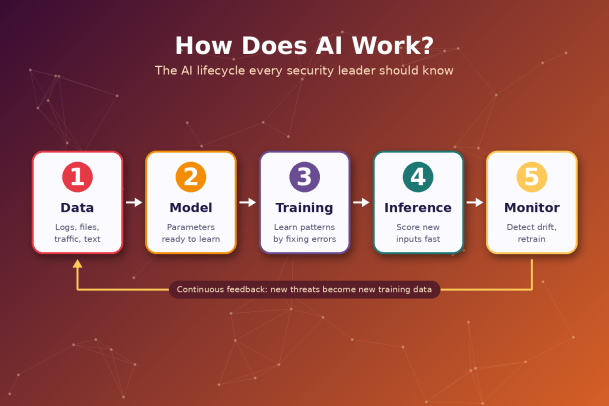
Almost every AI system, from a spam filter to a chatbot, follows the same lifecycle. Understanding these four stages tells you where value is created and where risk enters.
- Data. AI starts with data: logs, files, network traffic, emails, images or text. The quality, volume and relevance of that data set the ceiling on how good the system can be. Biased, outdated or poisoned data produces a flawed model, no matter how advanced the algorithm.
- The model. A model is a mathematical structure with adjustable internal settings called parameters. Before training, those parameters are essentially random, so the model’s outputs are meaningless.
- Training. During training, the model is fed examples and makes predictions. Each prediction is compared with the correct answer, and the error is used to nudge the parameters in a better direction. Repeated millions or billions of times, this process gradually encodes patterns from the data into the model.
- Inference. Once trained, the model is deployed and applied to new inputs it has never seen. This is the moment of value: a new file is scored, a login is flagged or a question is answered. Inference is fast, but it is also where adversaries try to fool the model.
A fifth stage is often forgotten: monitoring and retraining. Threats, users and environments change. A model trained on last year’s attacks will slowly lose accuracy, a problem known as model drift, unless it is regularly evaluated and updated.
Machine Learning, Neural Networks and Large Language Models
Machine learning is the engine behind most AI. It comes in three main flavors, and each shows up in security products differently.
| Approach | How it learns | Typical security use |
|---|---|---|
| Supervised learning | From labeled examples (“malicious” or “benign”) | Malware classification, phishing detection |
| Unsupervised learning | Finds structure in unlabeled data | Anomaly detection, user behavior analytics |
| Reinforcement learning | Learns by trial, reward and penalty | Automated response tuning, attack simulation |
Neural networks are a family of models loosely inspired by the brain. They are built from layers of simple connected units. Each layer transforms the data a little, and stacking many layers lets the network learn complex patterns. This is called deep learning, and it powers image recognition, speech recognition and modern language tools.
Large language models (LLMs) are deep neural networks trained on enormous amounts of text. At their core, they predict the next word, or more precisely the next token, given everything that came before. Because they learn from so much language, they can summarize incidents, explain code, draft reports and answer analyst questions.
That same design explains their weaknesses. An LLM produces the most plausible continuation, not a verified fact. It can “hallucinate” confident but wrong answers, and it can be manipulated through crafted inputs known as prompt injection.
How AI Works in Cybersecurity
In security, AI is mostly used to do one thing well: find the signal in an overwhelming amount of noise. Security teams face millions of events a day, and no human team can review them all. AI helps in several practical ways.
- Threat detection. Models trained on known malware and attack techniques score files, processes and emails for risk, catching new variants that signature-based tools miss.
- Behavioral analytics. Unsupervised models learn what “normal” looks like for users, devices and applications, then flag deviations such as unusual login times, odd data transfers or lateral movement.
- Alert triage and prioritization. AI correlates related alerts, filters out false positives and ranks incidents, so analysts spend time on what matters.
- Analyst assistance. LLM-based copilots summarize incidents, translate queries and explain suspicious scripts, shortening investigation time.
- Automated response. When confidence is high, AI-driven playbooks can isolate endpoints, revoke sessions or quarantine files in seconds.
There is an important catch. Detection-based AI is fundamentally a prediction. It assigns a probability that something is bad. That means there will always be a gray zone of unknown files and behaviors the model cannot classify with confidence. Attackers deliberately aim for that gray zone.
This is why mature security architectures do not rely on detection alone. Approaches built on Zero Trust principles, such as running unknown files in isolated containment until they are verified, protect the environment even when the AI is uncertain. AI makes the decision faster; containment makes a wrong decision harmless.
The Limits and Risks Leaders Must Understand
Knowing how AI works also means knowing how it breaks. These are the risks that matter most for security and technology leaders.
- Adversarial attacks. Attackers can make small, deliberate changes to a file or input that cause a model to misclassify it. A malware sample padded with benign code may slip past a classifier.
- Data poisoning. If attackers can influence training data, they can quietly teach a model to ignore certain threats.
- Prompt injection and data leakage. LLM tools can be tricked by hidden instructions in documents, emails or web pages, and they may expose sensitive data if access controls are weak.
- False positives and false negatives. Every model trades one against the other. Too sensitive, and analysts drown in alerts. Too lenient, and real attacks get through.
- Opacity. Many deep learning models cannot fully explain why they made a decision, which complicates audits, compliance and incident review.
- Model drift. Accuracy degrades as threats evolve, so yesterday’s strong model can become today’s blind spot.
None of these risks means you should avoid AI. They mean AI should be one layer in a defense-in-depth strategy, with human oversight and controls that hold up when the model is wrong.
Questions to Ask Before You Buy AI-Powered Security
With a clear picture of how AI works, you can cut through vendor claims quickly. Use these questions in your next evaluation:
- What data was the model trained on, and how often is it retrained?
- What are the measured false positive and false negative rates in environments like ours?
- What happens to a file or process the AI cannot confidently classify?
- How does the system defend against adversarial inputs and prompt injection?
- Can analysts see why a decision was made, and can they override it?
- Where does our data go, and is it used to train shared models?
The third question is often the most revealing. A strong answer describes a safe default, such as containment or isolation, rather than simply allowing unknowns to run.
Conclusion: Put AI to Work Without Betting the Business on It
So, how does AI work? It learns patterns from data, encodes them in a trained model and applies them to new inputs to make fast predictions. That makes it a powerful force multiplier for security teams, and an equally powerful tool for attackers.
The leaders who get the most from AI treat it as a capability, not magic. They ask hard questions about data and accuracy, keep humans in the loop and pair AI-driven detection with controls that stay safe when the model is uncertain.
Xcitium combines intelligent threat analysis with patented Zero Trust containment, so unknown files are isolated and harmless while they are verified, even when no model can tell yet whether they are malicious. You get the speed of AI without leaving gaps for attackers to exploit.
Ready to see how AI and Zero Trust work together to stop threats before they cause damage? Request a Demo with Xcitium today.
Please give us a star rating based on your experience.

 (19 votes, average: 2.16 out of 5, rated)