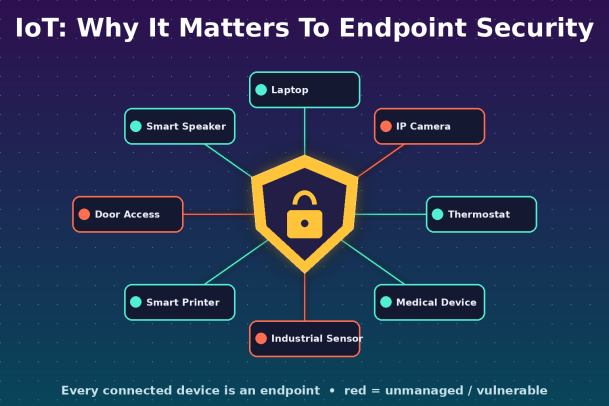
Every smart camera, badge reader, connected printer and sensor on your network is an endpoint, and most of them are unprotected. That is the simplest answer to the question of why IoT matters to endpoint security. The Internet of Things has quietly multiplied the number of devices that can be attacked, and it has done so faster than most security programs have adapted.
A decade ago, “endpoint” meant a laptop, a desktop or a server. Today it includes thermostats in the boardroom, infusion pumps in hospitals, programmable logic controllers on factory floors and voice assistants in home offices. Industry estimates put connected IoT devices in the tens of billions worldwide, and that number keeps climbing. Each one talks to your network, and each one can become a doorway for an attacker.
In this article, we explain what an IoT endpoint is, why these devices create unique security risks, how attackers exploit them, and the practical steps organizations can take to bring IoT under the same protection as the rest of their endpoints.
What counts as an IoT Endpoint
An IoT endpoint is any internet-connected physical device that collects, sends or acts on data, usually with little or no human interaction. Unlike a laptop, it rarely has a screen, a keyboard or room for a traditional security agent.
Common IoT endpoints in business environments include:
- Office and building systems: smart lighting, HVAC controllers, IP cameras, door access systems and connected printers.
- Healthcare devices: patient monitors, infusion pumps, imaging equipment and wearable trackers.
- Industrial and operational technology (OT): sensors, PLCs, SCADA components and robotics on production lines.
- Retail and logistics: point-of-sale terminals, RFID scanners, smart shelves and fleet trackers.
- Remote work gear: home routers, smart speakers and personal devices that share a network with corporate laptops.
The common thread is that these devices are built for function first and security second. Many ship with default passwords, run outdated firmware and cannot be patched easily, if at all.
Why IoT Matters to Endpoint Security
IoT changes endpoint security in five fundamental ways.
1. The attack surface has exploded
Every connected device adds a new entry point. A mid-sized organization may manage a few hundred laptops but thousands of IoT devices. Security teams that only protect traditional endpoints are guarding a fraction of the doors.
2. Visibility is poor
You cannot protect what you cannot see. Many IoT devices are installed by facilities, operations or individual departments without IT involvement. This “shadow IoT” leaves gaps in asset inventories and in monitoring coverage.
3. Built-in security is weak
Hard-coded credentials, unencrypted communication, open ports and no secure update mechanism are common. Many devices run stripped-down operating systems that cannot host antivirus or EDR agents, so conventional endpoint tools simply do not reach them.
4. IoT devices are ideal pivot points
Attackers rarely want the smart thermostat itself. They want what it connects to. A compromised IoT device on a flat network gives an attacker a foothold to move laterally toward servers, databases and user workstations, often without triggering alerts.
5. The consequences go beyond data
When a laptop is breached, data is at risk. When an IoT or OT device is breached, physical operations can be at risk too: halted production, disabled cameras, tampered medical equipment or unlocked doors. The stakes include safety, uptime and regulatory compliance.
How Attackers Exploit IoT Endpoints
The risks are not theoretical. The 2016 Mirai botnet hijacked hundreds of thousands of cameras, routers and DVRs simply by logging in with factory-default passwords. It then used them to launch some of the largest distributed denial-of-service attacks recorded at the time, knocking major websites offline. Variants of Mirai still circulate today.
Other well-documented scenarios show the same pattern:
- Lateral movement from a minor device. Security researchers and incident responders have repeatedly traced breaches to an overlooked device, such as an internet-connected sensor or camera, that gave attackers a route into the core network.
- Ransomware via unmanaged devices. Attackers increasingly use devices that cannot run security agents as staging points, because activity there goes unnoticed.
- Surveillance and espionage. Compromised cameras and microphones can quietly leak sensitive conversations, layouts and credentials.
- Botnet recruitment. Weakly secured devices are enlisted to attack others, damaging your reputation and consuming your bandwidth.
In almost every case, the root cause is the same: the device was connected to the network but not managed as a security-relevant endpoint.
Best Practices for Securing IoT Endpoints
Bringing IoT into your endpoint security strategy does not require starting from scratch. It requires extending proven principles to a new class of devices.
- Discover and inventory every device. Use network scanning and passive traffic analysis to identify all connected devices, including those added outside IT. Record the make, model, firmware version, owner and business purpose of each.
- Change default credentials immediately. Replace factory passwords with strong, unique ones, and disable unused accounts, services and ports.
- Segment the network. Place IoT devices on dedicated VLANs or micro-segments with strict rules about what they can reach. A compromised camera should never be able to talk to your finance servers.
- Patch and update firmware. Maintain a firmware update schedule and favor vendors that provide signed, regular updates. Replace devices that have reached end of support.
- Encrypt communications. Require TLS or equivalent encryption for device-to-cloud and device-to-server traffic to prevent interception and tampering.
- Monitor behavior continuously. IoT devices behave predictably. A thermostat that suddenly scans the network or contacts an unknown server is a red flag. Behavioral monitoring catches what signatures miss.
- Build IoT into procurement. Make security requirements, such as update support, credential management and logging, part of every purchasing decision.
- Plan for incidents. Include IoT devices in incident response playbooks so teams know how to isolate, investigate and restore them quickly.
The Role of Zero Trust, Containment and EDR/XDR
Best practices reduce risk, but modern IoT environments also need a security architecture designed for devices you cannot fully trust.
Zero Trust for devices. A Zero Trust approach assumes no device is safe simply because it sits inside the network. Every connection is verified, every device gets only the minimum access it needs, and trust is continuously re-evaluated based on behavior.
Containment by default. Since attackers will eventually get something through, the ability to isolate unknown or suspicious activity before it can do damage is critical. Containment technology runs untrusted files and processes in a secure environment, so even zero-day threats cannot reach the systems that matter.
EDR and XDR visibility. Endpoint Detection and Response (EDR) protects the laptops, servers and workstations that IoT devices connect to, catching lateral movement as soon as it reaches a managed endpoint. Extended Detection and Response (XDR) goes further by correlating signals across endpoints, networks and cloud workloads. That broader view is what turns a strange spike of traffic from a printer into a recognized attack chain.
Managed detection and response. Many organizations lack the staff to watch IoT traffic around the clock. A managed service with 24/7 analysts closes that gap and shortens the time between detection and response.
Together, these layers ensure that even when an IoT device is compromised, the attack is contained, detected and stopped before it becomes a breach.
Conclusion: Every Device Is an Endpoint
IoT matters to endpoint security because it redefines what an endpoint is. The smart camera in the lobby, the sensor on the production line and the printer down the hall all deserve the same scrutiny as a corporate laptop. Ignore them, and attackers will find the unlocked door you forgot existed.
The path forward is clear: discover every device, segment and harden them, monitor their behavior, and back it all with Zero Trust containment and unified detection and response. Organizations that make IoT a first-class part of their endpoint strategy will be the ones that stay ahead of the next Mirai.
Ready to secure every endpoint, including IoT?
Xcitium’s Zero Trust architecture combines patented containment, EDR and XDR to stop threats before they cause damage, wherever they enter your network. See how it protects your entire device ecosystem.
Please give us a star rating based on your experience.


 (24 votes, average: 2.42 out of 5, rated)