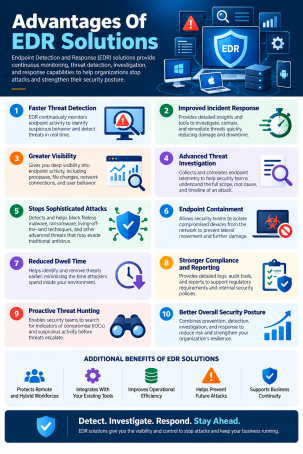
Would you know if an attacker had been hiding inside one of your laptops for the past three weeks? For many organizations, the honest answer is no. Traditional antivirus only stops threats it already recognizes, and today’s attackers count on that gap. This is where the advantages of EDR solutions become impossible to ignore. Endpoint detection and response (EDR) monitors every device around the clock, spots suspicious behavior, and helps you respond before one infected endpoint turns into a network-wide breach.
In this guide, we break down the key advantages of EDR solutions, show how EDR compares with antivirus, and share practical tips to get the most from your investment.
What Is an EDR Solution?
EDR is a cybersecurity technology that continuously collects and analyzes activity on endpoints such as laptops, desktops, servers, and mobile devices. Instead of only blocking known malware, EDR security looks at what is actually happening on a device: which processes start, which files change, and which network connections open.
How EDR Works
- Data collection: A lightweight agent records endpoint telemetry (process, file, registry, and network activity).
- Behavioral analysis: The platform compares that activity against threat intelligence and normal behavior to flag anomalies.
- Alerting and investigation: Analysts see the full attack timeline, not just an isolated alert.
- Response: You can isolate a device, kill a process, or remove malicious files, often in a few clicks or automatically.
Top 10 Advantages of EDR Solutions
Here are the most important benefits of EDR for security teams of any size.
1. Real-Time Visibility Across Every Endpoint
You can’t defend what you can’t see. EDR gives you a live view of device activity across your environment, including remote and hybrid workers. That visibility is the foundation for every other benefit below.
2. Detection of Unknown and Zero-Day Threats
Signature-based tools miss new malware and fileless attacks. EDR uses behavioral analysis to catch suspicious actions even when the threat has never been seen before. This is among the biggest advantages of EDR solutions in a landscape of constantly changing attacks.
3. Faster Incident Response
When an alert fires, every minute counts. EDR lets responders isolate a compromised endpoint, stop malicious processes, and roll back changes quickly, which limits the damage and shortens recovery time.
4. Stronger Ransomware Protection
Ransomware shows recognizable behavior, such as rapid file encryption and attempts to delete backups. EDR can detect these patterns early and contain the affected device before the infection spreads to shared drives and servers.
5. Proactive Threat Hunting
Security teams can search historical endpoint data for indicators of compromise, unusual logins, or suspicious scripts. Threat hunting turns EDR from a reactive tool into a proactive one.
6. Deep Forensic Investigation
Because EDR records what happened and when, you can reconstruct an attack from the first foothold to the last action. That answers the questions leadership and auditors ask: how did they get in, what did they touch, and is it over?
7. Containment of Lateral Movement
Attackers rarely stop at one device. EDR helps you spot credential theft and movement between systems, then isolate affected endpoints so the attacker can’t pivot deeper into your network.
8. Reduced Attacker Dwell Time
Dwell time is how long an attacker stays undetected. Continuous monitoring and automated alerts shrink that window, which reduces the chance of data theft or encryption.
9. Support for Compliance and Reporting
Detailed logs and incident records help you demonstrate due diligence for frameworks such as HIPAA, PCI DSS, and ISO 27001. Exact requirements vary, so confirm them against your own regulations.
10. Better Protection for Remote and Hybrid Work
EDR agents protect devices wherever they connect, from the office, home Wi-Fi, or a coffee shop. Security follows the endpoint instead of depending on the corporate perimeter.
EDR vs. Traditional Antivirus
| Capability | Traditional Antivirus | EDR |
|---|---|---|
| Detection method | Known signatures | Behavior, telemetry, threat intelligence |
| Unknown and zero-day threats | Limited | Strong |
| Visibility into endpoint activity | Minimal | Continuous and detailed |
| Investigation and forensics | Basic logs | Full attack timeline |
| Response actions | Quarantine a file | Isolate device, kill process, remediate |
| Threat hunting | Not supported | Supported |
The advantages of EDR solutions over antivirus come down to one idea: antivirus asks “is this file known to be bad?”, while EDR asks “is this behavior suspicious?”
Advantages of EDR Solutions for Small and Mid-Sized Businesses
Smaller teams often assume EDR is only for large enterprises. In reality, attackers target smaller companies precisely because defenses tend to be thinner. The advantages of EDR solutions matter even more when you have a lean IT team, because automation handles alert triage and containment while your staff focuses on other priorities.
If you don’t have round-the-clock security staff, a managed EDR service adds expert analysts who monitor and respond 24/7, so threats are handled even at 3 a.m. or on a holiday weekend.
How to Get the Most Out of Your EDR Solution
To realize the full advantages of EDR solutions, put these practices to work:
- Deploy to every endpoint, including servers and remote laptops. Unmonitored devices become the easiest way in.
- Tune your alerts so analysts focus on genuine threats instead of noise.
- Automate common responses, such as isolating a device on confirmed ransomware behavior.
- Combine EDR with patch management to close the vulnerabilities attackers exploit.
- Run regular threat hunts, even a short weekly search for unusual activity.
- Train your team on phishing and safe browsing, since people remain a common entry point.
- Test your incident response plan so everyone knows who acts when an alert fires.
What to Look for When Choosing an EDR Solution
- Strong behavioral detection for unknown threats
- Automated and one-click response actions
- Low impact on device performance
- Cloud-based management from a single console
- Integration with your wider security stack (SIEM, XDR, patch management)
- Option for 24/7 managed detection and response
How Xcitium EDR Delivers More
Xcitium combines EDR with its ZeroDwell Technology, which isolates unknown files so they can’t cause harm while a verdict is reached, and Verdict Cloud, which classifies files as safe or malicious. The result is prevention and detection working together, so you get the advantages of EDR solutions without relying on detection alone. Add patch management and Managed EDR with a 24/7 SOC, and your endpoints stay protected and monitored around the clock.
Frequently Asked Questions
What are the main advantages of EDR solutions?
The main advantages of EDR solutions are real-time endpoint visibility, detection of unknown and zero-day threats, faster incident response, ransomware containment, threat hunting, and detailed forensic data for investigations and compliance.
Is EDR better than antivirus?
EDR goes further than antivirus. Antivirus blocks known malware using signatures, while EDR monitors behavior, investigates incidents, and lets you respond. Many organizations use both, with EDR as the deeper layer.
Can small businesses benefit from EDR?
Yes. Small businesses are frequent targets and often have limited security staff. Automated response and managed EDR services give them enterprise-grade protection without a large in-house team.
How does EDR help stop ransomware?
EDR detects ransomware-like behavior, such as mass file encryption, and can isolate the device automatically. This stops the infection from spreading to other systems and shared storage.
What is the difference between EDR, MDR, and XDR?
EDR focuses on endpoints. Managed detection and response (MDR) adds a team of experts who monitor and respond for you. Extended detection and response (XDR) correlates data from endpoints, networks, and cloud for broader visibility.
Conclusion
The advantages of EDR solutions go well beyond what antivirus can offer: continuous visibility, early detection of unknown threats, rapid response, and the forensic detail to understand every incident. As attacks grow more evasive, relying on signatures alone leaves a gap that attackers will find. Layering EDR into your security program gives you the visibility and control to stop threats while they are still small.
Ready to see the advantages of EDR solutions in action? Request a demo with Xcitium today and find out how to protect every endpoint in your organization.
Please give us a star rating based on your experience.

 (22 votes, average: 2.18 out of 5, rated)