What Is Virtual Memory? A Complete Guide for Modern Computing
Updated on January 28, 2026, by Xcitium
Have you ever wondered how your computer continues running smoothly even when multiple heavy applications are open at once? The answer lies in a powerful operating system feature known as virtual memory. If you’re asking what is virtual memory, you’re not alone—it’s a fundamental concept that quietly enables modern computing performance.
For IT managers, cybersecurity professionals, CEOs, and founders, understanding what is virtual memory is more than a technical curiosity. It affects system performance, application stability, security posture, and infrastructure planning across desktops, servers, and cloud environments.
In this guide, we’ll explain what is virtual memory, how it works, why it matters, its benefits and limitations, security considerations, and best practices for using it effectively.
What Is Virtual Memory?
To start with the basics, what is virtual memory?
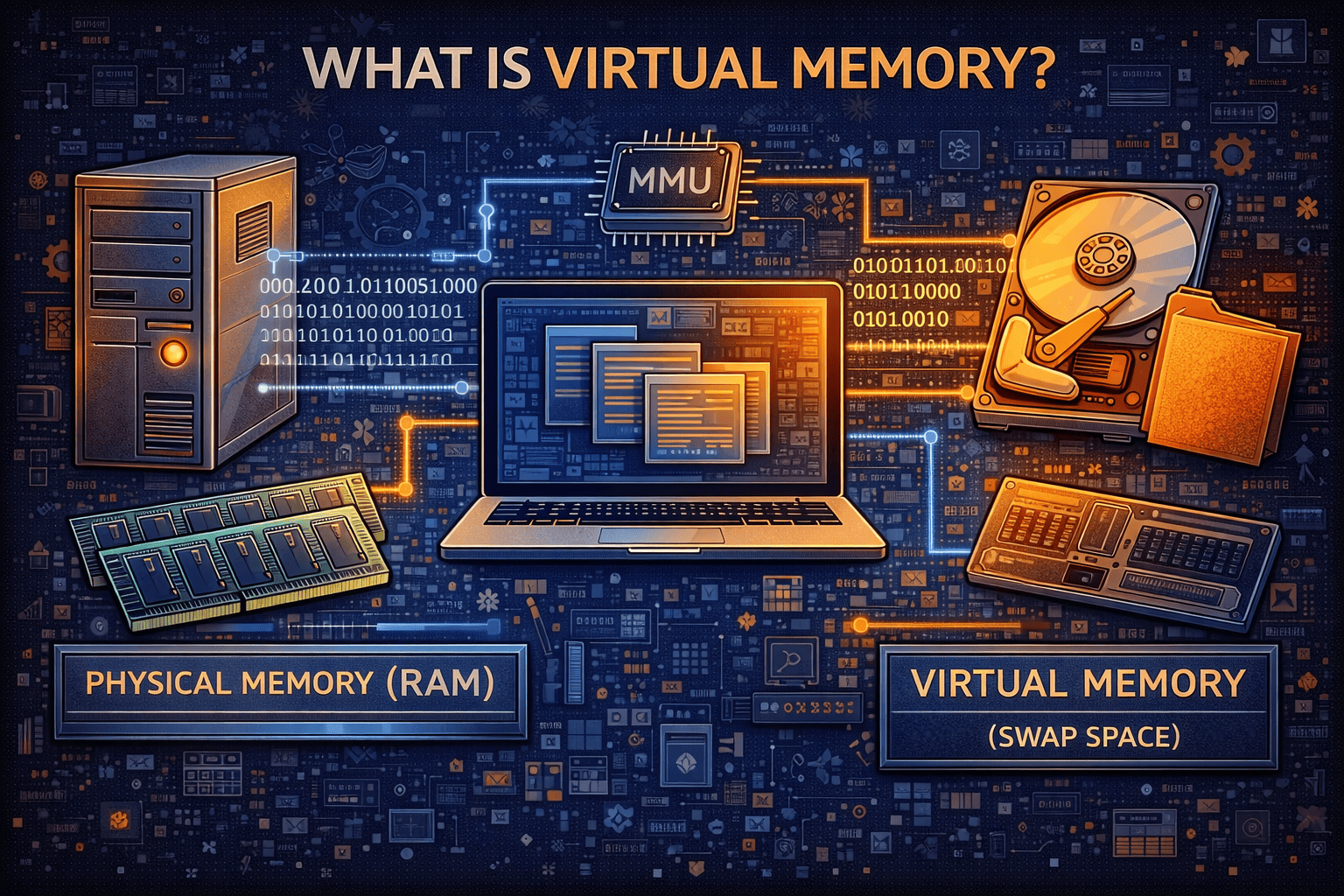
Virtual memory is a memory management technique used by operating systems to extend the available physical RAM by using a portion of secondary storage—such as a hard drive or SSD—as temporary memory. This allows systems to run larger applications and more processes than physical memory alone would permit.
In simple terms, virtual memory creates the illusion of more RAM, enabling smoother multitasking and better system stability.
Why Virtual Memory Exists
Understanding what is virtual memory also requires understanding the problem it solves.
The Core Challenge
Physical RAM is:
-
Limited
-
Expensive
-
Finite
Modern applications—especially browsers, databases, and development tools—consume large amounts of memory. Virtual memory ensures systems don’t crash or freeze when RAM runs out.
How Virtual Memory Works
To fully understand what is virtual memory, let’s break down how it functions behind the scenes.
Step-by-Step Virtual Memory Process
-
Applications request memory from the operating system
-
The OS assigns virtual addresses instead of physical ones
-
Frequently used data stays in RAM
-
Inactive data is moved to disk (swap space or page file)
-
The OS swaps data between RAM and disk as needed
This process is often called paging.
Key Components of Virtual Memory
Virtual memory relies on several core components working together.
1. Physical Memory (RAM)
RAM stores active processes and data for fast access.
2. Swap Space / Page File
A designated area on disk used when RAM is full.
3. Memory Management Unit (MMU)
A hardware component that maps virtual addresses to physical memory.
Together, these components enable seamless memory expansion.
Virtual Memory vs Physical Memory
A common question when learning what is virtual memory is how it differs from physical memory.
| Feature | Physical Memory (RAM) | Virtual Memory |
|---|---|---|
| Speed | Very fast | Slower |
| Location | Hardware | Disk-based |
| Capacity | Limited | Scalable |
| Cost | High | Low |
| Reliability | High | Depends on disk |
Virtual memory trades speed for capacity and stability.
Types of Virtual Memory Systems
Different operating systems implement virtual memory differently.
1. Paging-Based Virtual Memory
Paging divides memory into fixed-size blocks called pages.
Advantages
-
Efficient memory usage
-
Reduces fragmentation
-
Widely used in modern OSs
This is the most common implementation today.
2. Segmentation-Based Virtual Memory
Segmentation organizes memory into logical segments.
Use Cases
-
Older systems
-
Specialized environments
Most modern systems combine paging and segmentation concepts.
Benefits of Virtual Memory
Organizations rely on virtual memory because it provides critical advantages.
Key Benefits
-
Supports large applications
-
Improves system stability
-
Enables multitasking
-
Reduces hardware dependency
-
Optimizes memory utilization
Without virtual memory, modern operating systems would struggle under real-world workloads.
Virtual Memory and System Performance
Understanding what is virtual memory also means understanding its performance impact.
Performance Trade-Offs
-
RAM access is much faster than disk access
-
Excessive swapping can slow systems
-
Proper tuning minimizes performance loss
Virtual memory is a safety net—not a replacement for sufficient RAM.
Virtual Memory in Modern Operating Systems
Virtual memory is a core feature of all major OS platforms.
Common Implementations
-
Windows – Page File
-
Linux – Swap Space
-
macOS – Swap and compressed memory
Each OS optimizes virtual memory differently, but the core principles remain the same.
Virtual Memory in Servers and Cloud Environments
For IT leaders, what is virtual memory becomes especially important in servers and cloud workloads.
Server Use Cases
-
Running multiple virtual machines
-
Supporting containerized applications
-
Handling unpredictable workloads
Cloud platforms rely heavily on virtual memory to ensure elasticity and uptime.
Virtual Memory and Virtualization
Virtual memory plays a crucial role in virtualized environments.
In Virtual Machines
-
Each VM has its own virtual memory space
-
The hypervisor manages physical memory allocation
-
Overcommitment allows efficient resource use
This enables higher density and cost efficiency in data centers.
Security Implications of Virtual Memory
From a cybersecurity perspective, what is virtual memory also has security implications.
Potential Security Risks
-
Sensitive data written to disk
-
Swap files containing credentials or keys
-
Disk access by unauthorized users
Without proper safeguards, virtual memory can expose sensitive information.
Best Practices for Securing Virtual Memory
To mitigate risks:
-
Enable disk encryption
-
Restrict access to swap files
-
Use secure deletion policies
-
Monitor system behavior
Security must extend beyond RAM to disk-based memory.
Virtual Memory and Zero Trust Systems
Zero Trust assumes no system component is fully trusted.
Virtual Memory in Zero Trust
-
Encrypted memory storage
-
Continuous monitoring
-
Least-privilege access to system resources
Virtual memory management should align with Zero Trust principles.
Common Virtual Memory Problems
Despite its benefits, virtual memory can cause issues if mismanaged.
Common Problems
-
Thrashing (constant swapping)
-
Slow system performance
-
Application crashes
-
Disk wear on SSDs
These issues usually signal insufficient RAM or poor configuration.
How to Optimize Virtual Memory Performance
To get the most from virtual memory:
-
Ensure adequate physical RAM
-
Use fast SSD storage
-
Monitor swap usage
-
Avoid excessive overcommitment
-
Tune OS memory parameters
Optimization balances performance and stability.
Virtual Memory in High-Performance Systems
In high-performance computing, virtual memory is carefully managed.
HPC Considerations
-
Minimize swapping
-
Maximize RAM usage
-
Predictable workloads
Performance-critical systems often rely less on virtual memory.
Virtual Memory and Application Design
Developers also need to understand what is virtual memory.
Development Considerations
-
Memory leaks increase swap usage
-
Poor memory management degrades performance
-
Efficient code reduces reliance on virtual memory
Good software design complements OS memory management.
When Virtual Memory Is Not Enough
Virtual memory has limits.
Signs You Need More RAM
-
Persistent slowdowns
-
High swap usage
-
Frequent application crashes
-
Increased latency
Virtual memory should extend RAM—not replace it.
The Future of Virtual Memory
Virtual memory continues to evolve.
Emerging Trends
-
Faster NVMe-based swapping
-
Memory compression
-
AI-driven memory optimization
-
Cloud-native memory management
These advances improve efficiency while reducing performance penalties.
Actionable Tips for IT Managers and Leaders
If you manage systems using virtual memory:
-
Monitor memory and swap usage regularly
-
Encrypt disks to protect swap data
-
Right-size RAM for workloads
-
Avoid overcommitting critical systems
-
Align memory policies with security strategy
Proactive management prevents outages and data exposure.
Frequently Asked Questions (FAQ)
1. What is virtual memory in simple terms?
Virtual memory uses disk space to act like extra RAM when physical memory is full.
2. Does virtual memory slow down a computer?
It can if used excessively, because disk access is slower than RAM.
3. Is virtual memory secure?
Yes, when properly configured with encryption and access controls.
4. Should virtual memory be disabled?
No. Disabling it can cause crashes when RAM is exhausted.
5. How much virtual memory should I use?
It depends on workload, RAM size, and system design—there’s no one-size-fits-all rule.
Final Thoughts: Why Virtual Memory Still Matters
Understanding what is virtual memory is essential for anyone managing modern computing environments. From desktops to cloud infrastructure, virtual memory enables stability, scalability, and flexibility in a world where applications constantly demand more resources.
However, performance and security depend on proper configuration, monitoring, and complementary controls.
👉 See how advanced security solutions protect systems across memory, disk, and runtime layers.
Strengthen your infrastructure visibility and protection today.
🔗 Request a demo:
https://www.xcitium.com/request-demo/