SIEM vs XDR Comparison: Key Differences & Benefits
Updated on March 10, 2026, by Xcitium
Cyber threats are evolving faster than ever. Organizations now face sophisticated ransomware attacks, zero-day vulnerabilities, and advanced persistent threats (APTs) that traditional security tools often struggle to detect.
This raises an important question:
Should businesses rely on SIEM or adopt XDR for better security visibility and response?
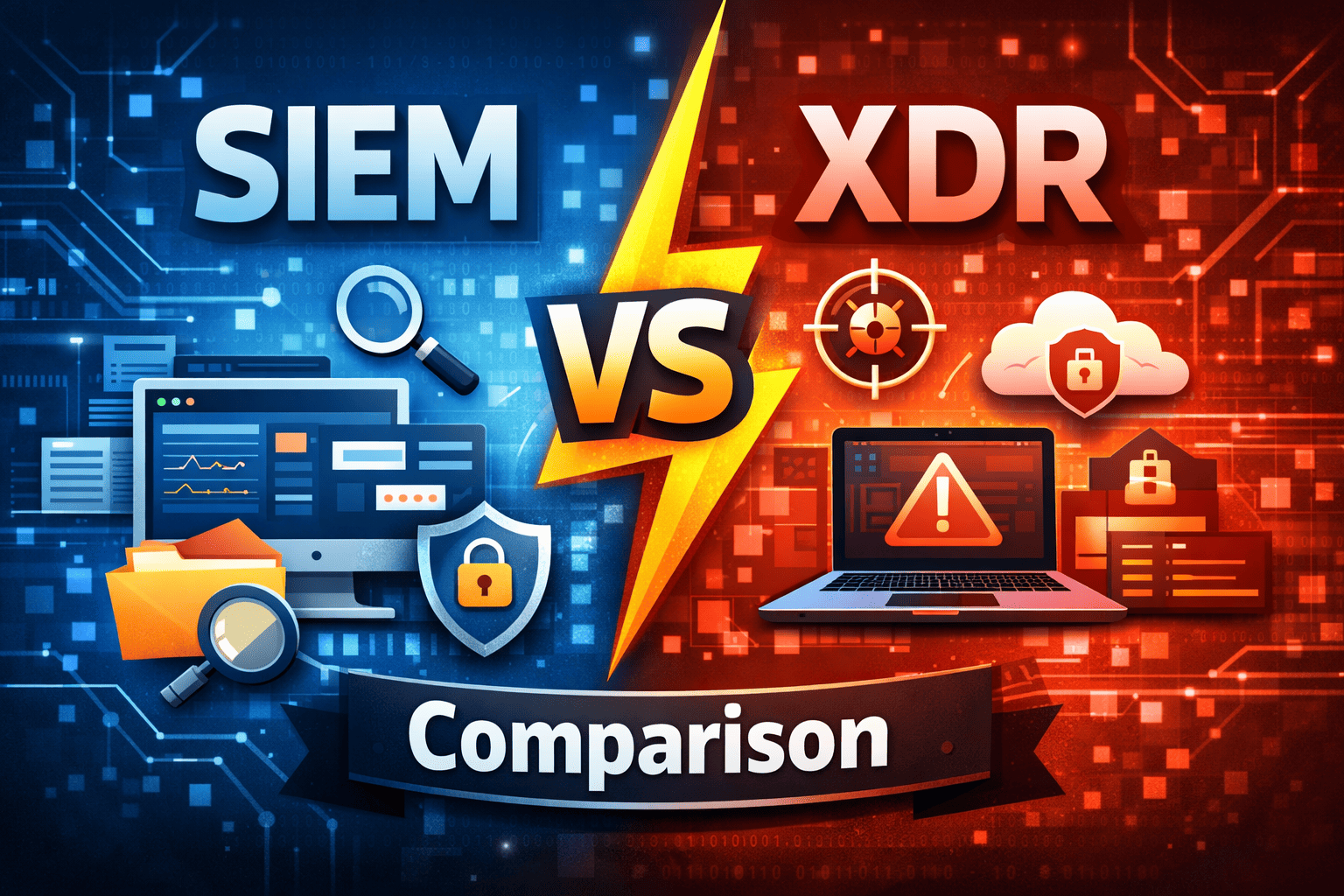
Security Information and Event Management (SIEM) has been a cornerstone of enterprise cybersecurity for years. However, Extended Detection and Response (XDR) is rapidly gaining popularity as a modern alternative.
In this guide, we’ll explore the SIEM vs XDR comparison, key differences, use cases, advantages, and how businesses can choose the right security solution.
What is SIEM?
Security Information and Event Management (SIEM) is a security platform that collects, analyzes, and correlates security logs from across an organization’s IT environment.
SIEM solutions aggregate logs from various sources such as:
-
Servers
-
Firewalls
-
Network devices
-
Applications
-
Endpoints
-
Identity systems
These logs are then analyzed to detect suspicious activities, generate alerts, and help security teams investigate incidents.
Key Capabilities of SIEM
Log Management
SIEM platforms collect and store logs from multiple sources, enabling organizations to maintain a centralized record of security events.
Security Event Correlation
By correlating events across systems, SIEM tools identify patterns that could indicate malicious activity.
Compliance Reporting
SIEM helps organizations meet regulatory requirements such as:
-
GDPR
-
HIPAA
-
PCI DSS
-
SOC 2
Threat Detection
SIEM systems use correlation rules and analytics to detect potential security incidents.
Common SIEM Use Cases
-
Compliance monitoring
-
Security event investigation
-
Insider threat detection
-
Log management and auditing
-
Incident response support
While SIEM remains valuable, many organizations find it complex to manage and difficult to scale without skilled security teams.
What is XDR?
Extended Detection and Response (XDR) is a modern cybersecurity platform designed to integrate multiple security layers and provide unified threat detection and response.
Unlike SIEM, which primarily focuses on logs, XDR analyzes telemetry across endpoints, networks, cloud workloads, identity systems, and applications.
This provides security teams with context-rich threat detection and automated response capabilities.
Key Capabilities of XDR
Cross-Layer Threat Detection
XDR correlates signals across multiple security tools, including:
-
Endpoint detection and response (EDR)
-
Network detection
-
Cloud security
-
Email security
-
Identity systems
Automated Threat Response
XDR platforms can automatically contain threats by:
-
Isolating endpoints
-
Blocking malicious IPs
-
Killing malicious processes
AI-Driven Threat Analytics
Advanced analytics and machine learning help identify suspicious behaviors and unknown threats.
Unified Security Visibility
XDR provides a single dashboard to monitor security events across the entire IT infrastructure.
Common XDR Use Cases
-
Advanced threat detection
-
Ransomware prevention
-
Automated incident response
-
Cross-environment security monitoring
-
Security operations center (SOC) optimization
SIEM vs XDR: Key Differences
Understanding the differences between SIEM and XDR is crucial for choosing the right cybersecurity solution.
Data Collection
SIEM
SIEM collects log data from multiple systems and analyzes it for suspicious patterns.
XDR
XDR collects real-time telemetry data across endpoints, networks, and cloud environments.
Threat Detection Approach
SIEM
SIEM primarily relies on:
-
Correlation rules
-
Log analysis
-
Security alerts
Detection effectiveness depends heavily on rule tuning and analyst expertise.
XDR
XDR uses:
-
Behavioral analytics
-
AI-driven detection
-
Cross-layer correlation
This enables faster and more accurate threat identification.
Incident Response
SIEM
SIEM typically provides alerts, but response actions often require manual investigation by security teams.
XDR
XDR platforms provide automated response capabilities, reducing the time required to contain threats.
Deployment Complexity
SIEM
SIEM systems can be complex to deploy and maintain. Organizations often require:
-
Dedicated SOC teams
-
Rule tuning
-
Integration management
XDR
XDR solutions are designed to simplify security operations by consolidating multiple security tools into a unified platform.
Security Visibility
SIEM
SIEM provides visibility mainly through log data.
XDR
XDR provides deep visibility across the entire attack surface, including endpoints, cloud systems, and networks.
SIEM vs XDR Comparison Table
| Feature | SIEM | XDR |
|---|---|---|
| Data Source | Log-based | Telemetry across multiple layers |
| Detection Method | Rule-based correlation | AI and behavioral analytics |
| Response | Mostly manual | Automated response capabilities |
| Visibility | Limited to logs | Full ecosystem visibility |
| Deployment | Complex | Simplified integration |
| SOC Efficiency | Requires skilled analysts | Reduces alert fatigue |
When Should Organizations Use SIEM?
Despite the rise of XDR, SIEM still plays an important role in cybersecurity.
Organizations may prefer SIEM when they need:
Compliance and Audit Reporting
SIEM is widely used to meet regulatory compliance requirements because it stores long-term log data.
Centralized Log Storage
Organizations that need detailed log retention for auditing purposes benefit from SIEM platforms.
Mature Security Operations Centers
Enterprises with well-established SOC teams may use SIEM for deep log analysis.
When Should Organizations Use XDR?
XDR is particularly beneficial for organizations seeking faster threat detection and simplified security operations.
Advanced Threat Protection
XDR excels at identifying sophisticated threats such as ransomware and multi-stage attacks.
Reduced Alert Fatigue
By correlating events automatically, XDR significantly reduces false positives.
Automated Security Response
XDR enables security teams to respond to threats faster through automation.
Modern Cloud Environments
Organizations using hybrid and cloud infrastructures benefit from XDR’s cross-platform visibility.
Can SIEM and XDR Work Together?
Yes. Many organizations deploy SIEM and XDR together to maximize security capabilities.
SIEM + XDR Security Strategy
SIEM handles
-
Compliance reporting
-
Log retention
-
Historical analysis
XDR handles
-
Threat detection
-
Incident response
-
Automated containment
Combining both solutions creates a strong security ecosystem capable of detecting and responding to modern cyber threats.
Challenges Organizations Face Without Modern Detection Tools
Without advanced threat detection platforms like SIEM or XDR, organizations may struggle with:
-
Slow incident detection
-
Lack of visibility across security systems
-
Alert fatigue
-
Delayed threat response
-
Increased ransomware risks
These challenges highlight why modern security architectures increasingly adopt XDR-driven security operations.
How XDR Improves Security Operations
Modern XDR platforms improve cybersecurity by:
Enhancing Threat Visibility
Security teams gain insight into attacks across endpoints, networks, and cloud workloads.
Accelerating Incident Response
Automated containment reduces the time required to stop threats.
Simplifying Security Management
XDR reduces the number of separate security tools organizations must manage.
Reducing Security Costs
Automation and unified visibility allow organizations to operate with smaller SOC teams.
Choosing the Right Security Solution
Selecting between SIEM and XDR depends on several factors:
-
Organization size
-
Security team maturity
-
Compliance requirements
-
Infrastructure complexity
-
Budget and resources
For many modern organizations, XDR offers a faster and more efficient approach to threat detection, while SIEM continues to support compliance and log management needs.
FAQ: SIEM vs XDR
What is the main difference between SIEM and XDR?
The primary difference is that SIEM focuses on log analysis, while XDR provides integrated threat detection and automated response across multiple security layers.
Is XDR replacing SIEM?
Not entirely. While XDR is becoming more popular for threat detection and response, SIEM still plays an important role in compliance reporting and log management.
Which is better for ransomware protection?
XDR is generally better for ransomware protection because it provides behavioral detection and automated response across endpoints and networks.
Do small businesses need SIEM or XDR?
Small businesses often benefit more from XDR solutions because they provide comprehensive protection without requiring large security teams.
Can SIEM integrate with XDR platforms?
Yes. Many organizations integrate SIEM with XDR to combine log management, compliance monitoring, and advanced threat detection.
Final Thoughts: SIEM vs XDR
Both SIEM and XDR play important roles in modern cybersecurity strategies. While SIEM provides centralized log management and compliance capabilities, XDR offers advanced threat detection, automation, and cross-layer visibility.
As cyber threats continue to evolve, many organizations are moving toward XDR-powered security operations to improve detection speed and response efficiency.
If you’re looking to strengthen your cybersecurity posture with advanced threat detection and response capabilities, it’s time to explore modern security platforms.
👉 Request a demo today to see how Xcitium can help protect your organization:
https://www.xcitium.com/request-demo/