Technology can block malware, filter suspicious emails, and detect unusual activity. But it cannot fully protect an organization when an employee clicks a phishing link, reuses a weak password, shares sensitive data with the wrong person, or approves a fake payment request under pressure.
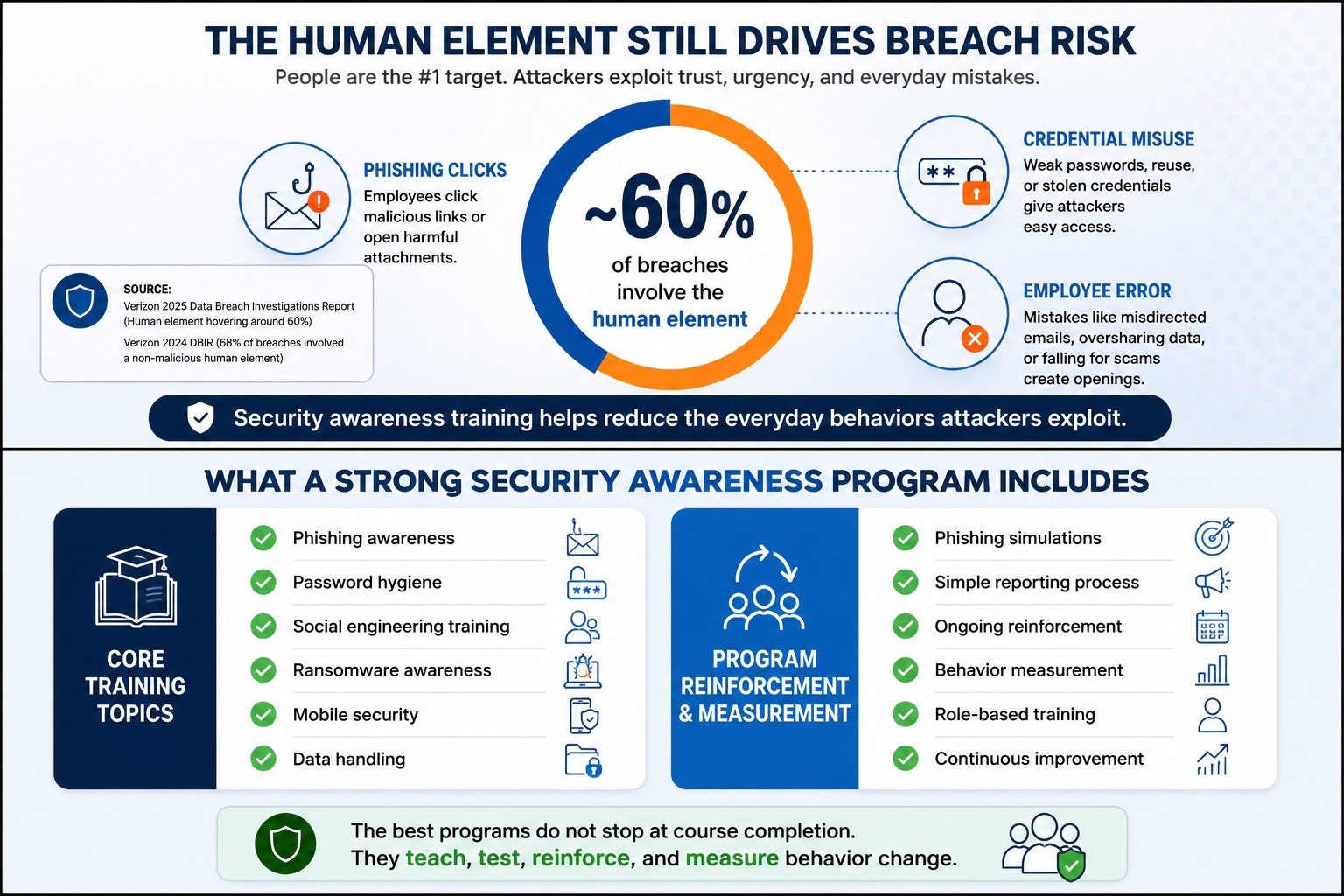
That is why security awareness training has become a core part of modern cybersecurity. Human behavior is still one of the most common paths attackers use to enter an organization. Verizon’s 2025 Data Breach Investigations Report reported that the human element hovered around 60% of breaches, while Verizon’s 2024 DBIR stated that 68% of breaches involved a non-malicious human element such as social engineering or error.
For IT managers, HR leaders, compliance teams, and business executives, this creates a clear message: cybersecurity is not only a technology issue. It is also a people, process, and culture issue.
Security awareness training helps employees understand cyber risks and respond safely in everyday work situations. It teaches people how to recognize phishing emails, protect passwords, report suspicious activity, handle sensitive data, and avoid common mistakes that lead to breaches.
This guide explains what security awareness training is, why it matters in 2026, what a strong program should include, the mistakes organizations should avoid, and how to measure whether your program is actually reducing risk.
What Is Security Awareness Training?
Security awareness training is an organized program that teaches employees how to recognize, avoid, and report cybersecurity threats. The goal is not to turn every employee into a security expert. The goal is to help every employee make safer decisions while using email, devices, applications, cloud tools, mobile phones, and company data.
In simple terms, security awareness training helps employees answer practical questions such as:
Can I trust this email?
Should I click this link?
Is this attachment safe?
How do I report a suspicious message?
What should I do if I accidentally shared information?
How do I protect customer, employee, or company data?
A good security awareness program focuses on real-world behavior. It goes beyond generic IT training or a one-time compliance video. Traditional IT training may teach employees how to use systems, software, or company tools. Security awareness training teaches them how attackers exploit those tools and how employees can avoid becoming the entry point for a cyberattack.
It is also different from a single annual presentation. Cyber threats change constantly. Phishing emails become more convincing. Attackers use AI-generated messages, fake login pages, deepfake audio, QR code scams, and social engineering tactics that feel urgent and personal. Because the threat landscape changes, employee training must be continuous, practical, and measurable.
The best programs combine education, phishing simulations, reporting workflows, reminders, policy reinforcement, and performance measurement. They help employees build habits, not just complete a course.
Why Security Awareness Training Matters
Security awareness training matters because employees interact with risk every day. They open emails, download files, approve invoices, manage credentials, use cloud applications, access customer data, and communicate with vendors. Every one of these actions can either reduce risk or create an opening for attackers.
The Human Element in Data Breaches
Many attacks succeed because they target people rather than systems. A phishing email may trick an employee into entering credentials. A fake vendor request may persuade finance teams to change payment details. A malicious attachment may install malware. A social engineering call may convince a help desk employee to reset access for the wrong person.
The human element remains a major factor in breaches. Verizon’s 2025 DBIR described the human element as remaining around 60% of breaches, and its 2024 report highlighted that more than two-thirds of breaches involved a non-malicious human element.
This does not mean employees are the problem. It means attackers understand how people work. They exploit urgency, trust, distraction, authority, and routine business processes. Security awareness training helps employees pause, verify, and report suspicious activity before a mistake becomes a breach.
Compliance and Insurance Requirements
Security awareness training is also important for compliance. Many cybersecurity frameworks and standards expect organizations to train their workforce on security responsibilities.
The NIST Cybersecurity Framework 2.0 includes awareness and training outcomes, including personnel being provided with awareness and training so they can perform general tasks with cybersecurity risks in mind. ISO/IEC 27001 is also widely used as a global standard for information security management systems, helping organizations manage risks related to the security of data they own or handle.
Cyber insurance has also made employee security behavior more important. Insurers increasingly look at security controls, incident history, phishing defenses, employee training, multi-factor authentication, and response readiness before approving coverage or pricing policies. While requirements vary by insurer and region, organizations that can show evidence of regular training and risk reduction are often in a stronger position than those that only run annual check-the-box training.
The Cost of a Breach vs. the Cost of Training
A data breach can be expensive. IBM’s 2025 Cost of a Data Breach Report placed the global average cost of a data breach at USD 4.44 million. Costs may include investigation, containment, legal fees, regulatory response, customer notification, downtime, lost business, reputational damage, and security improvements after the incident.
Security awareness training is not a replacement for technical controls such as endpoint protection, email security, identity management, backup, and monitoring. But it is usually far less expensive than recovering from a breach. More importantly, it addresses a risk area that technology alone cannot fully remove: employee decision-making.
The business case is simple. If training helps reduce phishing clicks, improve reporting rates, prevent credential theft, and stop even one serious incident, the return can be significant.
What a Good Security Awareness Program Includes
A strong security awareness program is not built around one video or one quiz. It is a structured, ongoing effort that teaches, tests, reinforces, and measures secure behavior.
Core Training Topics
Every organization has different risks, but most security awareness programs should cover several core topics.
Phishing awareness is usually one of the first priorities. Employees need to understand how phishing emails, fake login pages, malicious attachments, QR code scams, and impersonation attempts work.
Password hygiene is another essential topic. Training should explain why password reuse is dangerous, how password managers help, and why multi-factor authentication is important.
Social engineering should also be included. Employees should learn how attackers use urgency, authority, fear, curiosity, and trust to manipulate people into taking unsafe actions.
Ransomware awareness is especially important because many ransomware attacks begin with phishing, stolen credentials, or unsafe downloads. Employees should know how ransomware spreads and what warning signs to report.
Mobile security should be part of training because employees often access company email, messaging apps, and cloud tools from smartphones. They need to recognize smishing, unsafe Wi-Fi, malicious apps, and device loss risks.
Data handling is another key topic. Employees should understand how to classify, store, share, and dispose of sensitive information. This is especially important for teams handling customer data, financial records, healthcare information, legal documents, HR files, or intellectual property.
Other useful topics include safe browsing, removable media risks, remote work security, physical security, AI tool usage, business email compromise, and incident reporting.
Phishing Simulations
Phishing simulations help organizations test how employees respond to realistic attack scenarios. Instead of only teaching people what phishing looks like, simulations show whether employees can recognize and report suspicious messages in practice.
A good phishing simulation program should be educational, not punitive. The goal is not to shame employees who click. The goal is to understand risk patterns and improve behavior over time.
Simulations can test different scenarios, such as fake password reset emails, invoice requests, delivery notifications, HR messages, cloud document shares, QR codes, or executive impersonation attempts. Results can help security teams identify which departments, roles, or topics need more support.
Reporting and Measurement
Training is stronger when employees know exactly how to report suspicious activity. If an employee sees a suspicious email but does not know where to send it, the organization loses a valuable early warning signal.
A strong program should include a simple reporting process. This may include a phishing report button, a dedicated security email address, help desk workflow, or incident reporting portal.
Measurement is equally important. Security teams should track training completion, simulation results, reporting rates, repeat clickers, department-level trends, and time to report. These metrics help leaders understand whether training is creating real behavior change.
Ongoing Reinforcement
One-time training does not work well because people forget information and attackers constantly change tactics. Security awareness should be reinforced throughout the year.
Reinforcement can include short monthly lessons, internal newsletters, posters, quick videos, team-specific reminders, phishing simulation feedback, security tips during onboarding, and updates after real-world threats.
The goal is to keep cybersecurity visible without overwhelming employees. Short, relevant, repeated messages are often more effective than long annual sessions that employees rush through and forget.
Common Mistakes Organizations Make
Many organizations invest in security awareness training but fail to get meaningful results because the program is too generic, too infrequent, or too focused on completion instead of behavior.
One common mistake is relying only on annual check-the-box training. Annual training may satisfy a basic compliance requirement, but it is not enough to build lasting habits. Employees need regular reminders and practice.
Another mistake is not running phishing simulations. Without simulations, organizations may not know whether employees can apply what they learned. A quiz score does not always show how someone will respond to a convincing phishing email during a busy workday.
A third mistake is failing to measure behavior change. Completion rates are useful, but they do not tell the full story. If 98% of employees completed training but phishing click rates remain high and reporting rates remain low, the program is not reducing risk effectively.
Organizations also make the mistake of using generic content that does not match their industry or employee roles. A finance team may need training on invoice fraud and wire transfer scams. HR may need training on resume attachments and employee data. Executives may need training on impersonation and business email compromise. Developers may need secure coding and credential handling awareness.
Another common issue is creating a fear-based culture. Employees may avoid reporting mistakes if they believe they will be punished. A strong security culture encourages fast reporting, even when someone clicked a link or entered credentials. Early reporting can reduce damage.
How to Measure If Your Program Is Working
Security awareness training should be measured by outcomes, not just participation. The most effective programs track whether employee behavior improves over time.
Click-through rates are one useful metric. If phishing simulation click rates decrease over several months, it may show that employees are becoming better at identifying suspicious emails. However, this metric should not be viewed alone. A lower click rate is helpful, but it does not tell the full story.
Reporting rates are often more important. Employees who report suspicious emails help security teams detect threats faster. A strong program should aim to increase the percentage of employees who report simulated and real phishing attempts.
Completion rates still matter, especially for compliance. They show whether employees completed assigned training. But completion does not equal risk reduction. A person can complete a course and still click a phishing link the next day.
Behavior change is the real goal. Organizations should look at a combination of metrics, including fewer repeat clickers, faster reporting, better password practices, reduced policy violations, improved incident reporting, and stronger performance across high-risk departments.
Security leaders should also review trends by role and business unit. If one department consistently performs poorly in simulations, the answer may not be more generic training. It may require targeted coaching, better workflows, or changes to business processes that attackers are exploiting.
FAQs
How often should security awareness training happen?
Security awareness training should happen throughout the year. A full training session may be delivered annually or semi-annually, but employees should receive shorter reminders, phishing simulations, policy updates, and role-specific guidance on a regular basis. Monthly or quarterly reinforcement is usually more effective than one long annual session.
Is annual security awareness training enough?
Annual training alone is usually not enough. It may help meet a basic compliance requirement, but it does not provide enough repetition to change behavior. Cyber threats evolve quickly, and employees need ongoing practice to recognize phishing, social engineering, credential theft, ransomware risks, and unsafe data handling.
What is the difference between training and phishing simulation?
Security awareness training teaches employees what cyber threats look like and how to respond. Phishing simulation tests whether employees can apply that knowledge when they receive realistic suspicious emails. Training builds knowledge, while simulations measure behavior and identify areas that need improvement.
Who should receive security awareness training?
Every employee should receive security awareness training because every employee can be targeted. However, training should also be adapted by role. Finance, HR, executives, IT administrators, developers, customer support, and remote workers may face different types of attacks and should receive relevant examples.
What topics should be included in employee security training?
A strong employee security training program should include phishing, password hygiene, multi-factor authentication, social engineering, ransomware, mobile security, safe browsing, data handling, remote work security, incident reporting, and business email compromise.
How do you know if security awareness training is effective?
The best way to measure effectiveness is to track behavior over time. Useful metrics include phishing click rates, reporting rates, repeat clickers, training completion, time to report suspicious emails, and department-level risk trends. The goal is not only to prove that employees completed training, but to show that risky behavior is decreasing.
Build a Stronger Human Layer of Cyber Defense
Security awareness training is not about blaming employees. It is about giving them the knowledge, confidence, and process they need to make safer decisions every day.
In 2026, attackers are using more convincing phishing emails, social engineering tactics, fake login pages, malicious attachments, QR codes, and impersonation attempts. Organizations that rely only on technical defenses leave a major risk untreated. Organizations that train, test, reinforce, and measure employee behavior build a stronger human layer of defense.
The most effective security awareness programs are continuous, practical, role-based, and measurable. They help employees recognize threats, report suspicious activity, and protect sensitive data before a mistake becomes a breach.
To help your employees build safer cyber habits, explore Xcitium’s cyber awareness education resources here: https://www.xcitium.com/cyber-awareness-education/
Please give us a star rating based on your experience.
 (0 votes, average: 0.00 out of 5, rated)