What if a hacker were already inside your network right now, and nobody noticed? It happens more often than most businesses realize. Breaches often take months to identify and contain, giving attackers plenty of time to steal data and deploy ransomware. Managed detection and response (MDR) closes that gap by combining advanced security technology with a team of expert analysts who watch for threats, investigate them, and respond around the clock.
In this guide, you’ll learn what managed detection and response is, how it works, how it compares to other security services, and how to choose the right provider.
What Is Managed Detection and Response?
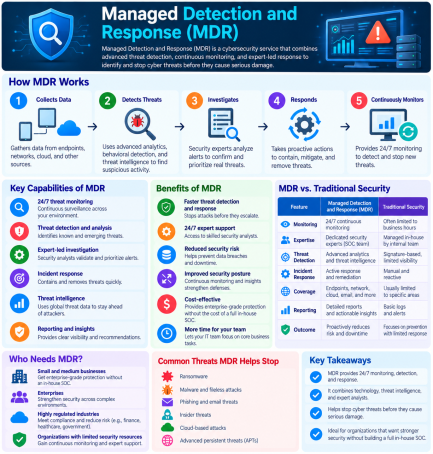
Managed detection and response is an outsourced cybersecurity service that provides 24/7 threat monitoring, detection, investigation, and response. Instead of relying only on automated tools, MDR pairs technology with human security experts who can spot subtle signs of compromise and take action immediately.
Most MDR services cover endpoints, networks, cloud workloads, and user identities. If your organization lacks a full in-house security operations center (SOC), MDR gives you enterprise-grade protection without the cost of building one.
Why Traditional Security Isn’t Enough
Antivirus software and firewalls stop known threats, but modern attackers use fileless malware, stolen credentials, and zero-day exploits to slip past them. Alerts also pile up faster than small IT teams can review. Managed detection and response fills this gap by adding expert human analysis and rapid response.
How Does Managed Detection and Response Work?
A typical MDR service follows a continuous cycle.
1. Continuous Monitoring
MDR tools collect data from endpoints, servers, networks, cloud platforms, and email. Analysts monitor this telemetry 24/7 for suspicious behavior.
2. Threat Detection
Machine learning, behavioral analytics, and threat intelligence identify unusual activity, such as odd login times, lateral movement, or unexpected data transfers.
3. Investigation and Triage
Analysts review alerts, remove false positives, and determine whether a real attack is underway. This saves your team from alert fatigue.
4. Response and Containment
When a threat is confirmed, the MDR team acts quickly. Actions can include isolating infected devices, blocking malicious IP addresses, disabling compromised accounts, and removing malware.
5. Remediation and Reporting
The provider helps restore systems, explains the root cause, and recommends improvements so the same attack doesn’t succeed twice.
Key Features of Managed Detection and Response Services
- 24/7/365 threat monitoring by security experts
- Proactive threat hunting to find hidden attackers
- Endpoint detection and response (EDR) capabilities
- Incident response and guided remediation
- Threat intelligence from global attack data
- Compliance support and detailed reporting
- Cloud and identity threat coverage
MDR vs. EDR vs. MSSP vs. SIEM
These terms are often confused. Here is how they differ.
| Solution | What It Does | Human Experts Included? |
|---|---|---|
| MDR | Monitors, detects, investigates, and responds to threats | Yes |
| EDR | Detects and records endpoint threats, usually needing your team to act | No (tool only) |
| MSSP | Manages security tools and sends alerts, often with limited response | Partly |
| SIEM | Collects and correlates log data | No (tool only) |
In short, managed detection and response goes beyond tools and alerts by delivering active investigation and response.
Benefits of Managed Detection and Response
Faster Threat Detection and Response
Shorter detection time means less damage. MDR teams can contain threats in minutes instead of days.
Access to Expert Talent
Cybersecurity professionals are hard to hire and expensive to keep. MDR gives you a skilled team without the recruiting burden.
Reduced Costs
Outsourcing is typically far cheaper than building a 24/7 SOC with staff, tools, and training.
Less Alert Fatigue
Analysts filter noise so your IT team focuses only on real incidents.
Stronger Compliance
Detailed logs and reports help meet requirements such as HIPAA, PCI DSS, and GDPR.
Who Needs Managed Detection and Response?
MDR is valuable for:
- Small and mid-sized businesses without a dedicated security team
- Healthcare, finance, and retail organizations handling sensitive data
- Remote and hybrid workforces with many endpoints to protect
- Enterprises that want to extend an existing security team
How to Choose the Right MDR Provider: Actionable Tips
Use this checklist when comparing managed detection and response vendors:
- Check coverage. Confirm it protects endpoints, cloud, network, and identities.
- Confirm 24/7 expert availability. Ask whether analysts are in-house or outsourced.
- Ask about response actions. Make sure the provider can contain threats, not just alert you.
- Review response times. Look for clear service-level agreements (SLAs).
- Look for Zero Trust technology. Preventing unknown threats from running reduces the number of incidents.
- Evaluate reporting and transparency. You should see what was found and what was done.
- Test integration. The service should work with your existing tools and systems.
- Compare pricing. Look for predictable pricing with no hidden fees.
Best Practices to Get the Most From MDR
- Keep software and endpoints patched
- Enforce multi-factor authentication (MFA)
- Train employees to recognize phishing
- Maintain an updated incident response plan
- Review your provider’s reports regularly and act on recommendations
Frequently Asked Questions (FAQs)
1. What is managed detection and response in simple terms?
Managed detection and response is a service where security experts monitor your systems around the clock, detect threats, and respond to them for you.
2. What is the difference between MDR and EDR?
EDR is a technology that detects threats on endpoints. MDR combines that technology with a managed team that investigates and responds on your behalf.
3. Is managed detection and response worth it for small businesses?
Yes. Small businesses are frequent targets but rarely have a 24/7 security team. MDR delivers expert protection at a fraction of the cost of building one.
4. How quickly can an MDR provider respond to a threat?
Response times vary, but strong providers act within minutes of confirming a threat. Check each vendor’s SLA.
5. Does MDR replace antivirus or firewalls?
No. MDR adds a layer of expert monitoring and response on top of your existing defenses.
Conclusion: Don’t Wait for a Breach to Find Out
Cyber threats are faster, quieter, and more sophisticated than ever. Managed detection and response gives your business the 24/7 expertise and rapid action needed to stop attacks before they become costly breaches. By choosing a provider that combines proactive threat hunting, quick incident response, and Zero Trust protection, you can focus on running your business while experts guard it.
Ready to see managed detection and response in action? Request a free demo of Xcitium today and discover how our experts and Zero Trust technology stop threats before they cause damage.
Please give us a star rating based on your experience.

 (153 votes, average: 1.18 out of 5, rated)