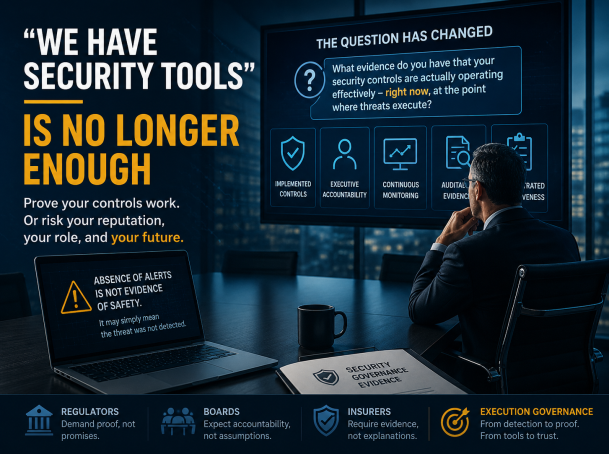
What evidence do you have that your security controls are actually operating effectively – right now, at the point where threats execute?
If your answer is ‘we have alerts from our EDR’ or ‘we passed our last audit,’ you are answering a question that is no longer being asked. And in 2026, the gap between what you can demonstrate and what regulators, boards, and insurers expect is becoming personal.
The Regulatory Shift Nobody Warned You About
For years, cybersecurity compliance worked on a simple model: document your controls, show your policies, and pass the annual audit. The implicit assumption was that documented controls were operating controls. If you had a policy saying you protected endpoints, that was evidence enough.
That era is over.
Every major regulatory framework has quietly converged on a fundamentally different standard:
- NIST SP 800-137 requires ‘maintaining ongoing awareness’ and assessing controls ‘at a frequency sufficient to support risk-based security decisions’ – not annual attestations.
- NIS2 Article 21 demands ‘policies and procedures to assess the effectiveness of cybersecurity risk-management measures’ – not just their existence.
- DORA Article 5 places ‘ultimate responsibility for managing ICT risk’ on the management body personally – not on the IT department.
- HIPAA’s 2026 update eliminates ‘addressable’ safeguards entirely. All controls become mandatory with annual testing requirements.
- The SEC now requires public companies to ‘describe processes for assessing, identifying, and managing material risks from cybersecurity threats’ – and investors read these disclosures.
Five frameworks. Five different jurisdictions. One converging message: the question is no longer whether controls exist. The question is whether you can demonstrate they are working.
The SolarWinds Precedent – Why This Is Personal
In October 2023, the SEC charged SolarWinds’ CISO personally. Not the company. The individual. For inadequate cybersecurity controls and misleading disclosures about the company’s security posture.
The case settled in November 2025, but the precedent was already set. CISOs, CFOs, General Counsel, and board members now carry personal exposure – personal fines, career consequences, and in extreme cases, criminal charges – for cybersecurity failures that were historically institutional problems.
The Personal Liability ShiftDirectors & Officers insurance premiums are now priced on cybersecurity governance quality. Your personal financial exposure is linked to the demonstrability of your security posture – not just its existence.
This is not abstract. Over 50% of SMBs were denied cyber insurance in 2025 due to inadequate controls. And ‘inadequate’ did not mean they had no tools. It meant they could not prove their tools were working. Underwriters now request screenshots, audit logs, and technical proof of control configuration – not verbal attestations.
What Your Current Stack Can Prove – and What It Cannot
Let’s be direct about what detection-based security tools actually produce as evidence.
Your EDR shows you what it detected. Every alert, every blocked threat, every detection event – this is valuable evidence that your detection system operates. But it answers only one question: ‘What did we see?’
It cannot answer: ‘What was allowed to run that we didn’t see?’
And here is the structural problem: by mathematical necessity, no classifier-based system achieves 100% detection accuracy. Alan Turing proved in 1936 that no algorithm can determine, for every possible program, whether it is malicious. This is not an engineering limitation. It is mathematically impossible. Every EDR has false negatives – threats it misclassifies as benign and allows it to execute.
When a false negative occurs, something genuinely harmful runs on your system. No alert is generated. No evidence is produced. Your board asks: ‘Did our controls work?’ Your answer, based on your EDR logs, is silence.
The absence of alerts is not evidence of safety. It may simply mean the threat was not detected.
— Xcitium Technical White Paper, 2026
The Category That Changes Everything
What we are describing has a name, and it is becoming the defining concept of modern endpoint security.
Execution Governance is the enforcement of policy-driven control over what code is permitted to interact with operating system kernel resources – at the moment of execution. It is distinguished from detection by one critical property: the enforcement decision does not depend on correctly classifying whether code is malicious.
Instead of asking, ‘is this code malicious?’ – a question that is provably unanswerable with certainty – an Execution Governance system asks: ‘is this code trusted?’ If not, execution is constrained, regardless of whether the code turns out to be benign or harmful.
The result is a different kind of evidence. Not ‘we detected threats.’ Instead: ‘we documented how every execution decision was handled.’
That second statement is what regulators, boards, and insurers are now asking for.
Five Pillars Already Required by Standards
The regulatory frameworks already define Execution Governance – they just haven’t called it that yet. The requirements are explicit:
| Implemented controls | Not just documented policies – controls technically enforced in real time (NIST SP 800-171, HIPAA §164.308) |
| Executive accountability | Leadership bears personal responsibility for cybersecurity outcomes (DORA Article 5, NIST CSF 2.0, SEC Item 106) |
| Continuous monitoring | Ongoing awareness and assessment – not periodic audits (NIST SP 800-137, DORA) |
| Auditable evidence | Documented proof that controls functioned (HIPAA §164.312, CMMC 2.0) |
| Demonstrated effectiveness | Verifiable evidence that controls work in practice (NIS2 Article 21, NIST CSF 2.0) |
These five pillars define what Execution Governance delivers – and what detection-only approaches leave unaddressed.
What This Series Covers
Over the next four blogs, we will build the complete picture of Execution Governance: what the evidence gap looks like in practice, why AI has made detection-only security structurally broken, how Xcitium’s Kernel API Virtualization technology fills the gap, and what it looks like when a real organization measures their execution gap in 30 days.
If you are a CISO preparing for a board conversation, a compliance renewal, or simply trying to understand whether your current stack can answer the question regulators are asking – this series is for you.
Please give us a star rating based on your experience.
 (1 votes, average: 5.00 out of 5, rated)