Industrial cyberattacks are rising rapidly. According to industry reports, cyber incidents targeting operational environments have increased dramatically in recent years. But many organizations still apply traditional IT security strategies to operational technology (OT) environments.
Is that approach effective?
Not really.
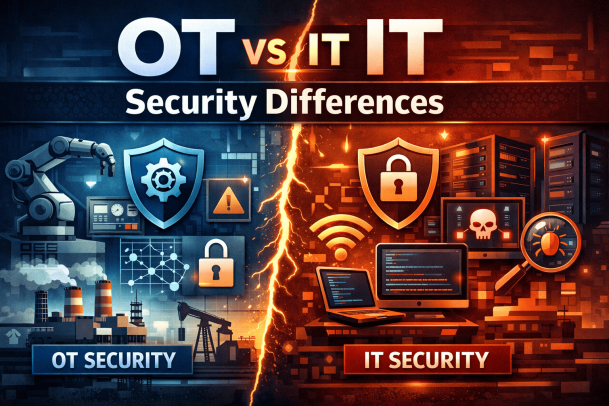
OT vs IT Security Differences – Know More
OT and IT systems have different priorities, architectures, and risks, which means they require distinct security strategies. Understanding the differences between OT vs IT security is critical for protecting industrial operations, enterprise networks, and critical infrastructure.
In this guide, we’ll explore the core differences between OT and IT security, why they matter, and how organizations can build a stronger cybersecurity strategy that protects both environments.
What is IT Security?
IT security (Information Technology security) focuses on protecting data, networks, and computing systems used for business operations.
Typical IT systems include:
-
Servers
-
Workstations
-
Cloud infrastructure
-
Corporate networks
-
Databases
-
Business applications
The primary goal of IT security is to protect the confidentiality, integrity, and availability (CIA) of data.
Key Objectives of IT Security
IT security strategies are designed to:
-
Protect sensitive data
-
Prevent unauthorized access
-
Detect malware and ransomware
-
Secure network communications
-
Ensure compliance with security standards
Common IT Security Technologies
Organizations typically use the following tools:
-
Antivirus and endpoint protection
-
Firewalls
-
SIEM platforms
-
Identity and access management (IAM)
-
Intrusion detection systems (IDS)
-
VPNs and encryption technologies
IT security is dynamic and constantly evolving, with frequent patching and updates required to stay protected.
What is OT Security?
OT security (Operational Technology security) protects systems that monitor and control industrial processes.
These systems are commonly found in:
-
Manufacturing plants
-
Energy and utilities
-
Transportation systems
-
Oil and gas facilities
-
Smart infrastructure
-
Healthcare equipment
OT environments include devices like:
-
Industrial Control Systems (ICS)
-
Supervisory Control and Data Acquisition (SCADA)
-
Programmable Logic Controllers (PLCs)
-
Distributed Control Systems (DCS)
Key Objectives of OT Security
Unlike IT systems, OT environments focus primarily on:
-
Operational continuity
-
Safety
-
Reliability of industrial processes
Even a small disruption in OT environments can cause:
-
Production shutdowns
-
Physical damage
-
Safety hazards
-
Supply chain disruptions
OT Security Technologies
Common OT security controls include:
-
Network segmentation
-
Industrial firewalls
-
Protocol monitoring
-
Asset discovery tools
-
OT intrusion detection systems
-
Secure remote access solutions
OT vs IT Security: Key Differences
Although OT and IT share some cybersecurity concepts, they differ significantly in purpose, architecture, and security priorities.
1. Security Priorities
| IT Security | OT Security |
|---|---|
| Protects data | Protects physical operations |
| Focus on confidentiality | Focus on availability and safety |
| Supports business operations | Supports industrial processes |
In IT environments, data protection is the priority.
In OT environments, system uptime and operational safety come first.
2. System Architecture
IT systems typically operate in standardized and frequently updated environments, while OT environments rely on legacy systems designed decades ago.
IT Infrastructure
-
Cloud platforms
-
Virtualized systems
-
Standard operating systems
-
Frequent software updates
OT Infrastructure
-
Legacy hardware
-
Proprietary industrial protocols
-
Specialized embedded systems
-
Long device lifecycles (10–20+ years)
These differences make OT environments much harder to patch or upgrade.
3. Patch Management
Patch management is routine in IT environments but far more complex in OT systems.
IT Systems
-
Regular patch cycles
-
Automated updates
-
Quick deployment
OT Systems
-
Updates may disrupt operations
-
Downtime is costly
-
Vendors often control patch availability
For OT, patches must be carefully tested before deployment.
4. Network Visibility
IT networks usually offer full monitoring and visibility.
OT networks, however, often lack modern monitoring capabilities.
IT Network Visibility
-
Centralized logging
-
SIEM integration
-
Endpoint monitoring
-
Automated threat detection
OT Network Visibility
-
Limited logging
-
Proprietary communication protocols
-
Legacy network infrastructure
This makes threat detection more challenging in OT environments.
5. Security Ownership
IT security is typically managed by enterprise IT teams.
OT security, however, often falls under engineering or operations teams.
IT Security Ownership
-
Managed by IT departments
-
Supported by cybersecurity teams
-
Governed by compliance frameworks
OT Security Ownership
-
Managed by plant operators
-
Overseen by engineering teams
-
Focused on operational reliability
This organizational separation often creates security gaps between IT and OT environments.
Why IT Security Strategies Don’t Work for OT
Many organizations mistakenly assume they can apply the same cybersecurity strategy to both IT and OT environments.
This assumption can create serious risks.
Operational Risks
Aggressive IT security tools can accidentally:
-
Shut down industrial systems
-
Interrupt production
-
Cause equipment malfunction
Compatibility Issues
Traditional IT tools may not support industrial communication protocols such as:
-
Modbus
-
DNP3
-
PROFINET
-
OPC
Safety Concerns
OT environments must prioritize human safety and physical infrastructure, which changes how security controls are implemented.
Best Practices for Securing OT and IT Environments
Organizations must adopt a unified but specialized cybersecurity strategy that protects both environments.
1. Build an IT-OT Security Strategy
Develop a security framework that integrates both environments while respecting their differences.
Key actions include:
-
Define IT-OT security policies
-
Establish governance between teams
-
Align risk management strategies
2. Implement Network Segmentation
Separating IT and OT networks reduces attack surfaces.
Best practices include:
-
Create security zones
-
Use industrial firewalls
-
Control traffic between networks
This prevents attackers from moving laterally between environments.
3. Improve Asset Visibility
Many organizations don’t know exactly which devices exist in their OT environment.
Asset discovery tools help:
-
Identify connected devices
-
Detect unauthorized equipment
-
Monitor network activity
4. Use Threat Detection for Industrial Networks
Modern security platforms can detect anomalies in industrial traffic.
These tools help identify:
-
Insider threats
-
Unauthorized commands
-
Suspicious network behavior
5. Implement Secure Remote Access
Remote access is often required for maintenance and troubleshooting.
Organizations should enforce:
-
Multi-factor authentication
-
Zero trust access policies
-
Secure VPN gateways
-
Privileged access management
The Future of IT-OT Security
As digital transformation accelerates, IT and OT environments are becoming more interconnected.
Technologies such as:
-
Industrial IoT (IIoT)
-
Smart manufacturing
-
AI-driven automation
-
Cloud-enabled industrial systems
are increasing the attack surface.
This convergence means organizations must modernize their cybersecurity strategy to protect both digital and physical systems.
Companies that fail to secure their OT environments risk:
-
Operational shutdowns
-
Safety incidents
-
Financial loss
-
Regulatory penalties
Frequently Asked Questions (FAQ)
What is the main difference between OT and IT security?
The main difference is their security priorities. IT security focuses on protecting data and information systems, while OT security prioritizes operational safety and system availability in industrial environments.
Why is OT security harder than IT security?
OT environments often rely on legacy systems, proprietary protocols, and long device lifecycles, making patching, monitoring, and upgrades much more difficult.
What industries require OT security?
OT security is critical in industries such as:
-
Manufacturing
-
Energy and utilities
-
Oil and gas
-
Transportation
-
Healthcare
-
Critical infrastructure
Can IT and OT networks be integrated safely?
Yes, but it requires strong segmentation, monitoring, and access control to prevent cyber threats from spreading between environments.
What are common OT cyber threats?
Common threats include:
-
Ransomware targeting industrial systems
-
Supply chain attacks
-
Insider threats
-
Unauthorized remote access
-
Malware designed for industrial control systems
Strengthen Your IT and OT Security Strategy
The growing convergence of IT and OT environments means organizations must rethink their cybersecurity approach. Protecting both enterprise networks and industrial systems requires specialized tools, visibility, and expertise.
Want to see how modern cybersecurity platforms protect both environments?
👉 Request a personalized demo today:
https://www.xcitium.com/request-demo/
Discover how advanced security solutions can help safeguard your infrastructure, improve threat detection, and strengthen your enterprise cybersecurity posture.
Please give us a star rating based on your experience.
 (1 votes, average: 5.00 out of 5, rated)