Cyber threats are growing more sophisticated every year. From ransomware attacks and data breaches to supply chain compromises, organizations across industries face increasing pressure to strengthen their security posture. But here’s the challenge: How do businesses measure the effectiveness of their cybersecurity efforts?
This is where cybersecurity maturity models come into play.
Cybersecurity maturity models help organizations evaluate their security capabilities, identify gaps, and build a roadmap for improvement. According to industry research, companies that adopt structured maturity frameworks are better equipped to prevent attacks and respond to incidents faster.
In this guide, we’ll explore cybersecurity maturity models compared, explain how they work, and examine the most widely used frameworks—including NIST, CMMC, ISO 27001, and CIS. By the end, you’ll understand how to choose the right model for your organization and improve your overall cybersecurity maturity.
What Is a Cybersecurity Maturity Model?
A cybersecurity maturity model is a framework used to assess and improve an organization’s cybersecurity practices. These models define levels of security maturity, helping organizations measure how well they manage risk, implement controls, and respond to cyber threats.
Most maturity models include several stages that represent increasing levels of cybersecurity capability.
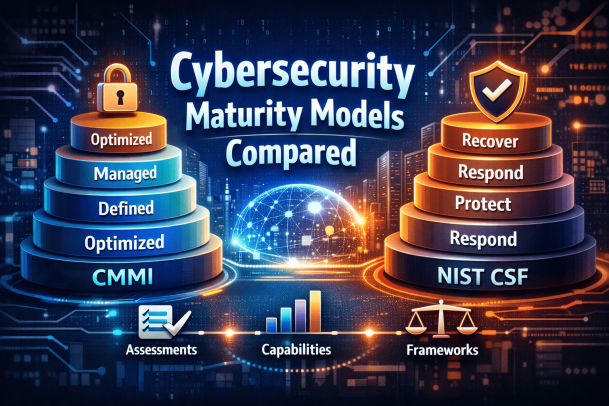
Typical Maturity Levels
Although models vary, many follow a similar structure:
-
Initial / Ad Hoc – Security practices are informal and reactive.
-
Developing – Basic security policies and processes exist.
-
Defined – Security procedures are documented and standardized.
-
Managed – Security activities are monitored and measured.
-
Optimized – Continuous improvement and proactive security practices.
By evaluating current maturity levels, organizations can build a roadmap to enhance cybersecurity defenses.
Why Cybersecurity Maturity Models Matter
Implementing cybersecurity maturity frameworks helps organizations move from reactive security to proactive risk management.
Key Benefits
-
Clear security improvement roadmap
-
Standardized cybersecurity practices
-
Better risk management
-
Improved regulatory compliance
-
Stronger defense against cyber threats
For security leaders and executives, maturity models also provide measurable metrics for cybersecurity investments.
Key Cybersecurity Maturity Models Explained
Several cybersecurity frameworks help organizations evaluate and improve their security maturity.
Let’s compare the most widely used models.
NIST Cybersecurity Framework (CSF)
The NIST Cybersecurity Framework is one of the most widely adopted cybersecurity standards globally.
Developed by the National Institute of Standards and Technology, it provides a flexible framework for managing cybersecurity risks.
Core Functions of NIST CSF
The framework is structured around five key functions:
-
Identify – Understand organizational risks and assets.
-
Protect – Implement safeguards to secure systems and data.
-
Detect – Identify cybersecurity events quickly.
-
Respond – Take action to contain and mitigate threats.
-
Recover – Restore operations after incidents.
Strengths of NIST CSF
-
Flexible and scalable
-
Suitable for organizations of all sizes
-
Widely recognized by regulators
Many companies use NIST as the foundation of their cybersecurity programs.
CMMC (Cybersecurity Maturity Model Certification)
The Cybersecurity Maturity Model Certification (CMMC) was developed by the U.S. Department of Defense to protect sensitive government information.
CMMC focuses heavily on defense contractors and supply chain security.
CMMC Maturity Levels
The model includes several maturity levels that measure cybersecurity capability.
These levels ensure organizations handling government data follow strict security practices.
Key Focus Areas
-
Access control
-
Incident response
-
Risk management
-
Security monitoring
Organizations working with the Department of Defense must comply with CMMC requirements.
ISO 27001 Security Framework
ISO/IEC 27001 is an international standard for information security management systems (ISMS).
It provides a structured approach to managing sensitive information and protecting data.
Key Components of ISO 27001
ISO 27001 focuses on:
-
Risk assessment
-
Security policies
-
Access control
-
Incident management
-
Continuous improvement
Benefits of ISO 27001
-
Globally recognized certification
-
Strong focus on governance and risk management
-
Suitable for organizations handling sensitive data
Many multinational organizations adopt ISO 27001 to demonstrate strong cybersecurity practices.
CIS Critical Security Controls
The Center for Internet Security (CIS) Critical Security Controls framework provides a practical set of cybersecurity best practices.
It focuses on actionable security controls rather than governance structures.
Key CIS Control Categories
The framework includes controls such as:
-
Inventory of assets
-
Secure configurations
-
Continuous vulnerability management
-
Access control management
-
Security monitoring
CIS controls are particularly useful for organizations seeking practical security implementation guidance.
Comparing Cybersecurity Maturity Models
Each cybersecurity maturity model has unique strengths and use cases.
| Framework | Primary Focus | Best For |
|---|---|---|
| NIST CSF | Risk management | Organizations of all sizes |
| CMMC | Defense supply chain security | Government contractors |
| ISO 27001 | Information security governance | Global enterprises |
| CIS Controls | Practical cybersecurity controls | IT teams and SMBs |
Choosing the right framework depends on industry requirements and organizational goals.
How to Choose the Right Cybersecurity Maturity Model
Selecting the right maturity model requires evaluating several factors.
Industry Requirements
Some industries require specific frameworks.
Examples include:
-
CMMC for defense contractors
-
HIPAA compliance for healthcare organizations
-
PCI-DSS for payment systems
Organizational Size and Complexity
Small businesses may benefit from simpler frameworks like CIS controls, while large enterprises often adopt NIST or ISO standards.
Compliance and Regulatory Needs
Organizations operating internationally often adopt ISO 27001 due to its global recognition.
Security Resources
Consider the expertise and resources available for implementing and maintaining cybersecurity programs.
Steps to Improve Cybersecurity Maturity
Organizations can follow a structured approach to improve cybersecurity maturity.
Step 1: Conduct a Security Assessment
Evaluate current security practices using a chosen framework.
Identify gaps and vulnerabilities.
Step 2: Develop a Cybersecurity Roadmap
Create a strategic plan to address security gaps.
Prioritize high-risk areas.
Step 3: Implement Security Controls
Deploy security technologies such as:
-
Endpoint protection platforms
-
Threat detection tools
-
Network monitoring systems
-
Identity and access management solutions
Step 4: Monitor and Measure Security Performance
Track key security metrics to ensure continuous improvement.
Step 5: Train Employees and Security Teams
Human error remains a leading cause of cyber incidents.
Security awareness training helps reduce risk.
Challenges in Implementing Cybersecurity Maturity Models
Organizations often face obstacles when implementing cybersecurity frameworks.
Complexity of Frameworks
Some models require extensive documentation and processes.
Resource Constraints
Small organizations may lack dedicated security teams.
Rapidly Evolving Threat Landscape
Cyber threats evolve faster than many security programs.
Continuous adaptation is necessary.
The Future of Cybersecurity Maturity
Cybersecurity maturity frameworks will continue evolving as technology advances.
Emerging trends include:
-
AI-powered threat detection
-
Automated security monitoring
-
Zero Trust architectures
-
Cloud security frameworks
Organizations adopting modern cybersecurity strategies will stay ahead of evolving threats.
Frequently Asked Questions (FAQ)
1. What is a cybersecurity maturity model?
A cybersecurity maturity model is a framework used to assess and improve an organization’s cybersecurity capabilities.
2. Which cybersecurity maturity model is best?
The best model depends on industry requirements. NIST, ISO 27001, CMMC, and CIS controls are widely used frameworks.
3. Why are maturity models important for cybersecurity?
They provide structured guidance for improving security practices and reducing cyber risk.
4. Can small businesses use cybersecurity maturity models?
Yes. Frameworks like CIS controls and NIST CSF are suitable for organizations of all sizes.
5. How often should organizations assess cybersecurity maturity?
Organizations should perform assessments annually or whenever significant infrastructure changes occur.
Final Thoughts: Strengthening Cybersecurity Maturity
Cybersecurity maturity models provide a powerful roadmap for organizations looking to improve their security posture. By adopting structured frameworks such as NIST, CMMC, ISO 27001, or CIS controls, businesses can build stronger defenses against modern cyber threats.
The key is continuous improvement. Cybersecurity maturity isn’t a one-time achievement—it’s an ongoing journey that evolves alongside emerging risks and technologies.
Organizations that invest in mature cybersecurity strategies are better equipped to prevent attacks, respond to incidents, and protect critical data.
👉 Request a demo today:
https://www.xcitium.com/request-demo/
Discover how advanced cybersecurity solutions can help strengthen your organization’s security posture and accelerate your cybersecurity maturity journey.
Please give us a star rating based on your experience.
 (1 votes, average: 5.00 out of 5, rated)