What Is a Data Warehouse? A Complete Guide for IT & Business Leaders
Updated on February 2, 2026, by Xcitium
Data is everywhere—but turning raw data into meaningful insights is still a major challenge. If you’ve ever struggled with scattered reports, slow analytics, or inconsistent business metrics, you’ve likely asked: what is a data warehouse, and why does my organization need one?
A data warehouse is more than just storage. It’s the foundation for smarter decision-making, stronger security controls, and scalable business intelligence. For IT managers, cybersecurity professionals, and CEOs alike, understanding data warehousing is no longer optional—it’s strategic.
In this guide, we’ll break down what a data warehouse is, how it works, why it matters for security-focused organizations, and how to choose the right approach for your business.
What Is a Data Warehouse? (Simple Definition)
A data warehouse is a centralized system designed to store, manage, and analyze large volumes of structured data from multiple sources. Unlike operational databases that support daily transactions, a data warehouse is built specifically for analytics, reporting, and decision-making.
In simple terms, when someone asks what is a data warehouse, the answer is:
A data warehouse collects data from different systems, cleans and organizes it, and makes it easy to analyze over time.
This enables organizations to answer complex questions such as:
-
How is the business performing month over month?
-
Where are security risks increasing?
-
Which customers or systems generate the most value—or risk?
Why Data Warehouses Matter in Cybersecurity and IT Operations
For organizations focused on online security and cybersecurity, data warehouses play a critical role beyond analytics.
Key benefits include:
-
Centralized visibility into security logs, alerts, and operational data
-
Faster threat detection through historical pattern analysis
-
Compliance reporting for regulations like GDPR, HIPAA, and ISO standards
-
Improved incident response using correlated data sources
When IT teams understand what a data warehouse is and how to leverage it, they gain a powerful tool for both operational efficiency and risk reduction.
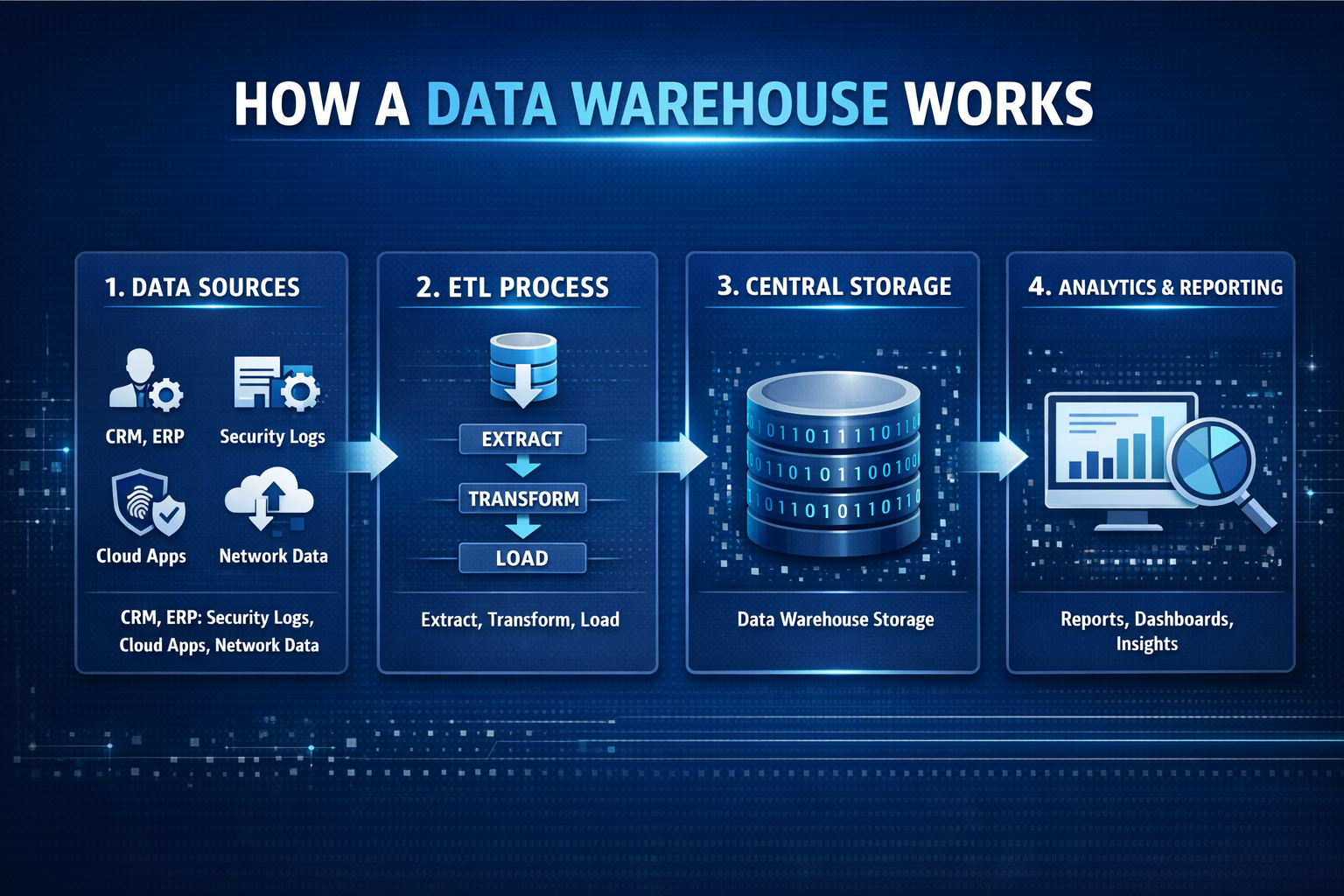
How a Data Warehouse Works
To truly understand what a data warehouse is, it helps to see how data flows through it.
1. Data Sources
Data is collected from multiple systems, such as:
-
CRM platforms
-
ERP systems
-
Security tools and SIEMs
-
Cloud applications
-
Network and endpoint logs
2. ETL (Extract, Transform, Load)
Data is:
-
Extracted from source systems
-
Transformed into a consistent format
-
Loaded into the data warehouse
This step ensures accuracy, consistency, and usability.
3. Centralized Storage
The data warehouse stores historical data optimized for queries—not transactions.
4. Analytics & Reporting
Business intelligence tools query the warehouse to generate dashboards, reports, and insights.
Data Warehouse vs Database: What’s the Difference?
One of the most common misconceptions when discussing what is a data warehouse is confusing it with a traditional database.
| Feature | Database | Data Warehouse |
|---|---|---|
| Purpose | Daily operations | Analytics & reporting |
| Data Type | Current data | Historical data |
| Performance | Optimized for transactions | Optimized for queries |
| Users | Applications | Analysts, executives, IT teams |
In short, databases run the business—data warehouses explain the business.
Types of Data Warehouses
Understanding different types helps leaders choose the right solution.
1. Enterprise Data Warehouse (EDW)
A centralized system serving the entire organization. Best for large enterprises with complex reporting needs.
2. Operational Data Store (ODS)
Holds near-real-time data for operational reporting but lacks long-term history.
3. Data Mart
A smaller, department-specific subset of a data warehouse (e.g., security or finance teams).
Each approach supports different business and security requirements.
Cloud vs On-Premise Data Warehouses
When evaluating what a data warehouse is today, cloud options dominate the conversation.
Cloud Data Warehouses
Examples: Snowflake, Amazon Redshift, Google BigQuery
Advantages:
-
Scalability on demand
-
Lower upfront costs
-
Built-in redundancy and disaster recovery
Security Consideration:
Requires strong access controls, encryption, and monitoring.
On-Premise Data Warehouses
Advantages:
-
Full control over infrastructure
-
Easier compliance for certain regulations
Challenges:
-
Higher maintenance costs
-
Limited scalability
Hybrid models are increasingly popular for security-conscious organizations.
Key Security Considerations for Data Warehouses
For cybersecurity and IT leaders, answering what is a data warehouse must include security implications.
Best Practices Include:
-
Role-based access control (RBAC)
-
Data encryption at rest and in transit
-
Continuous monitoring and auditing
-
Secure ETL pipelines
-
Integration with threat detection platforms
A poorly secured data warehouse becomes a single point of failure—making security design essential from day one.
How Data Warehouses Support Executive Decision-Making
CEOs and founders often ask what is a data warehouse’s business value.
Executive Benefits:
-
Unified performance metrics
-
Reliable forecasting and trend analysis
-
Faster strategic decisions
-
Reduced data silos across departments
When leadership trusts the data, confidence in decisions increases.
Common Challenges in Data Warehousing
Despite their benefits, data warehouses come with challenges.
Top Challenges:
-
Data quality and consistency
-
Integration complexity
-
Security and compliance risks
-
Performance optimization
-
Cost management
The right architecture, governance, and security tooling help mitigate these risks.
How to Choose the Right Data Warehouse for Your Organization
Before implementing, ask these questions:
-
What data sources need to be integrated?
-
What are the security and compliance requirements?
-
Who will access the data?
-
What analytics tools are required?
-
How fast will data volume grow?
Understanding what a data warehouse is in your specific context ensures long-term success.
Actionable Tips for IT & Security Teams
-
Start with a clear data governance policy
-
Classify sensitive data before ingestion
-
Automate monitoring and alerting
-
Regularly audit user access
-
Align warehouse security with your SOC strategy
FAQ: Data Warehouses Explained
1. What is a data warehouse used for?
A data warehouse is used for reporting, analytics, trend analysis, and informed decision-making using historical data.
2. How is a data warehouse different from a data lake?
A data warehouse stores structured, cleaned data, while a data lake holds raw data in various formats.
3. Is a data warehouse secure?
Yes—when designed correctly with encryption, access controls, and monitoring.
4. Do small businesses need a data warehouse?
Many small businesses benefit from lightweight or cloud-based data warehouses as they scale.
5. How long does it take to implement a data warehouse?
Implementation can range from weeks to months depending on complexity, data sources, and security requirements.
Final Thoughts: Why Data Warehousing Is a Strategic Advantage
Understanding what is a data warehouse is no longer just a technical concern—it’s a business imperative. For cybersecurity teams, it strengthens threat detection. For IT managers, it simplifies operations. For executives, it enables confident, data-driven leadership.
The organizations that win in today’s digital landscape are those that secure, centralize, and leverage their data intelligently.
Ready to Strengthen Your Data & Security Strategy?
See how intelligent security and visibility can transform the way you manage and protect your data.
👉 Request a demo today:
https://www.xcitium.com/request-demo/