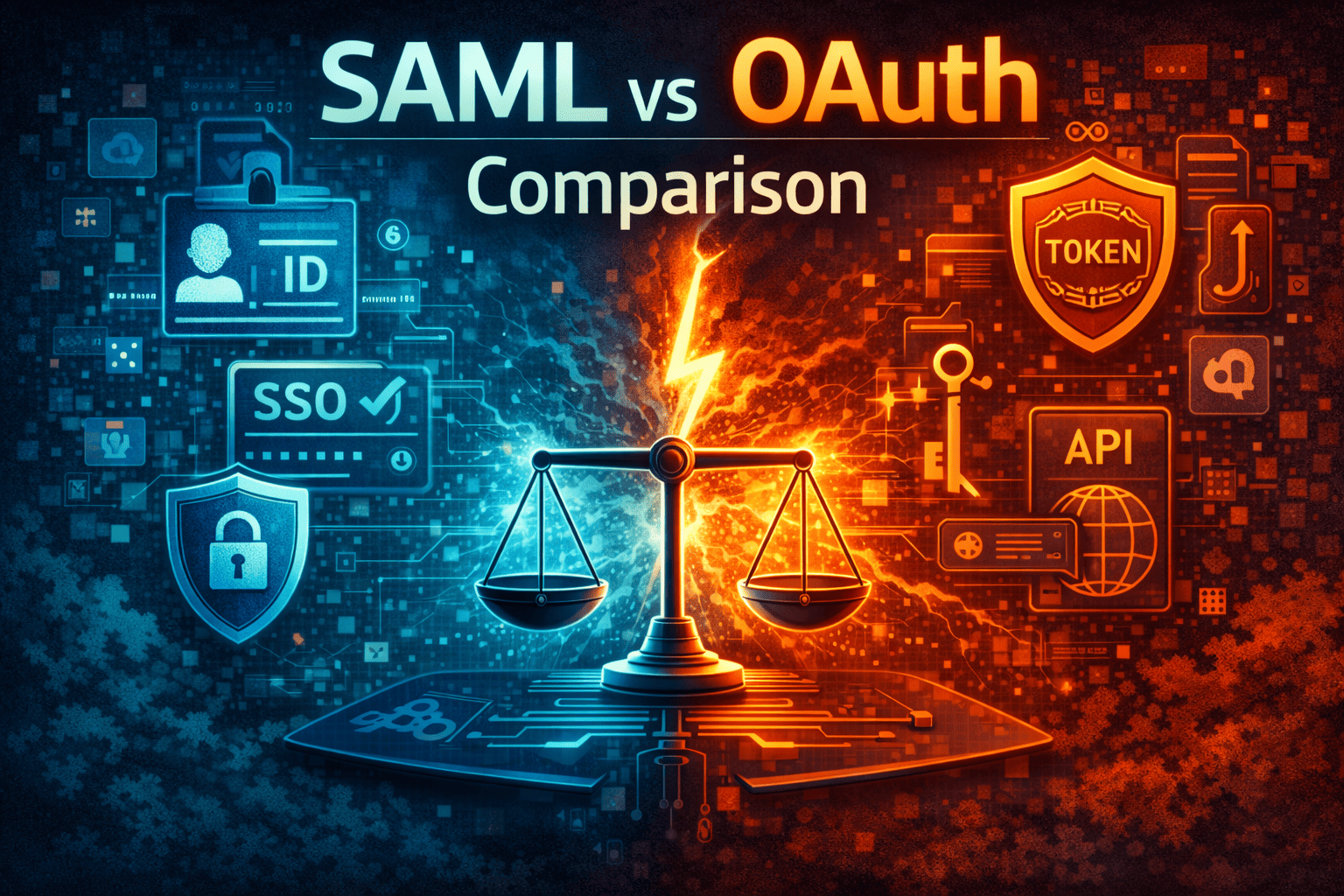
SAML vs OAuth Comparison: Key Differences, Use Cases, and Security Insights
Updated on February 19, 2026, by Xcitium
When it comes to modern authentication and authorization, one question often arises: SAML vs OAuth — which one should your organization use?
As businesses adopt cloud applications, SaaS platforms, and mobile apps, managing secure access becomes more complex. Single sign-on (SSO), identity federation, and API authorization are no longer optional—they are business-critical.
Understanding the SAML vs OAuth comparison helps IT managers, cybersecurity professionals, and executives make informed decisions about identity and access management (IAM). While both protocols enhance security and streamline authentication, they serve different purposes.
In this comprehensive guide, we’ll break down how SAML and OAuth work, highlight key differences, explore real-world use cases, and provide actionable advice for selecting the right solution.
What Is SAML?
Security Assertion Markup Language (SAML) is an XML-based authentication protocol used primarily for enterprise single sign-on (SSO).
SAML enables users to log in once and access multiple applications without re-entering credentials.
How SAML Works
SAML operates between three main parties:
-
User (Principal)
-
Identity Provider (IdP)
-
Service Provider (SP)
Here’s a simplified process:
-
A user attempts to access an application.
-
The application redirects the user to the Identity Provider.
-
The IdP authenticates the user.
-
A SAML assertion (authentication token) is sent back.
-
The user gains access without entering credentials again.
SAML is widely used in enterprise environments such as Microsoft Azure AD, Okta, and corporate SaaS platforms.
What Is OAuth?
OAuth (Open Authorization) is an authorization framework that allows third-party applications to access user data without exposing passwords.
Unlike SAML, OAuth focuses on authorization, not authentication.
How OAuth Works
OAuth involves:
-
Resource Owner (User)
-
Client Application
-
Authorization Server
-
Resource Server
The process typically follows:
-
The user grants permission to a third-party app.
-
The app receives an access token.
-
The app uses the token to access resources securely.
OAuth is commonly used in:
-
Social login (Google, Facebook login)
-
API integrations
-
Mobile applications
-
Cloud-based services
Understanding this distinction is crucial in any SAML vs OAuth comparison.
SAML vs OAuth Comparison: Core Differences
Although both protocols improve security, they are not interchangeable.
1. Purpose
-
SAML: Primarily for authentication and SSO.
-
OAuth: Primarily for authorization and API access.
2. Data Format
-
SAML: Uses XML-based assertions.
-
OAuth: Uses JSON-based tokens (often JWT).
3. Primary Use Case
-
SAML: Enterprise web applications and SSO.
-
OAuth: Mobile apps, APIs, delegated access.
4. Complexity
-
SAML: More complex to implement.
-
OAuth: Flexible but requires proper token management.
5. Mobile Compatibility
-
SAML: Less optimized for mobile apps.
-
OAuth: Designed for modern web and mobile environments.
This SAML vs OAuth comparison highlights why organizations often use both.
When to Use SAML
SAML works best in centralized enterprise environments.
Ideal Scenarios
-
Corporate single sign-on (SSO)
-
Internal enterprise applications
-
SaaS integrations with identity providers
-
Federated identity across business partners
Benefits of SAML
-
Strong authentication controls
-
Mature enterprise adoption
-
Centralized identity management
-
Reduced password fatigue
For IT managers handling large employee directories, SAML simplifies identity governance.
When to Use OAuth
OAuth excels in modern, API-driven environments.
Ideal Scenarios
-
Third-party app integrations
-
Social media login
-
Cloud-native applications
-
Mobile authentication flows
-
Microservices architecture
Benefits of OAuth
-
Secure delegated access
-
Token-based authorization
-
Reduced password sharing
-
API-friendly architecture
In a SAML vs OAuth comparison, OAuth stands out for scalability and flexibility.
How SAML and OAuth Work Together
Many organizations combine both protocols.
For example:
-
SAML handles enterprise SSO authentication.
-
OAuth manages API authorization and delegated access.
Additionally, OpenID Connect (OIDC) builds on OAuth to add authentication capabilities.
This layered approach strengthens identity security.
Security Considerations in SAML vs OAuth
Both protocols are secure when implemented properly. However, misconfiguration introduces risks.
Common Risks with SAML
-
XML signature wrapping attacks
-
Improper assertion validation
-
Expired certificates
-
Weak identity provider configuration
Common Risks with OAuth
-
Token leakage
-
Insecure redirect URIs
-
Over-permissioned access scopes
-
Improper token expiration
Security teams must monitor:
-
Token lifetimes
-
Session management
-
Access logs
-
Privilege escalation attempts
Proper endpoint security and monitoring are essential.
SAML vs OAuth in Cloud Security Strategy
Modern enterprises rely heavily on cloud applications.
A robust cloud security strategy should include:
-
Identity and access management (IAM)
-
Multi-factor authentication (MFA)
-
Zero Trust principles
-
Endpoint detection and response (EDR)
The SAML vs OAuth comparison plays a key role in designing secure cloud authentication systems.
Performance and Scalability Comparison
SAML
-
Heavier XML payloads
-
More suitable for browser-based apps
-
Slightly slower in mobile contexts
OAuth
-
Lightweight JSON tokens
-
Better performance in APIs
-
Ideal for distributed systems
Organizations prioritizing API scalability often lean toward OAuth.
Compliance and Regulatory Considerations
Regulated industries must ensure secure authentication protocols.
Industries such as:
-
Healthcare (HIPAA)
-
Finance (PCI DSS)
-
Government
-
SaaS providers (SOC 2)
Both SAML and OAuth support compliance—but require proper implementation and monitoring.
Common Misconceptions About SAML vs OAuth
“OAuth replaces SAML.”
Not entirely. They solve different problems.
“SAML is outdated.”
While older, SAML remains widely used in enterprise SSO.
“OAuth handles authentication.”
OAuth handles authorization. Authentication typically requires OpenID Connect.
Understanding these nuances clarifies the SAML vs OAuth comparison.
Decision Framework: Which Should You Choose?
Ask these questions:
-
Are you building a web-based enterprise SSO system? → Consider SAML.
-
Are you enabling third-party API access? → Choose OAuth.
-
Do you need both authentication and API delegation? → Combine SAML and OAuth.
-
Are you designing a mobile-first application? → OAuth with OpenID Connect is likely best.
In many cases, the answer isn’t “either/or”—it’s “both.”
Best Practices for Secure Implementation
1. Enforce Multi-Factor Authentication
Add MFA to prevent credential compromise.
2. Implement Least Privilege Access
Limit access scopes and user permissions.
3. Monitor Authentication Logs
Detect unusual login patterns.
4. Secure Tokens Properly
Encrypt tokens and enforce expiration policies.
5. Use Endpoint Protection
Authentication protocols protect access—but endpoints remain vulnerable without advanced threat detection.
FAQ: SAML vs OAuth Comparison
1. What is the main difference in the SAML vs OAuth comparison?
SAML focuses on authentication and single sign-on, while OAuth handles authorization and API access.
2. Can SAML and OAuth be used together?
Yes. Many enterprises use SAML for authentication and OAuth for API authorization.
3. Is OAuth more secure than SAML?
Both are secure when implemented correctly. Security depends on configuration and monitoring.
4. What is OpenID Connect?
OpenID Connect (OIDC) is an authentication layer built on OAuth 2.0.
5. Which protocol is better for mobile apps?
OAuth (with OpenID Connect) is generally better suited for mobile and API-driven environments.
Final Thoughts: Choosing the Right Identity Strategy
The SAML vs OAuth comparison isn’t about which protocol is superior—it’s about choosing the right tool for your security architecture.
As organizations embrace cloud services, SaaS platforms, and API integrations, identity security becomes the foundation of cyber resilience.
Strong authentication protocols combined with endpoint security and proactive monitoring reduce risk dramatically.
If you’re ready to strengthen your authentication strategy and protect your organization from advanced threats, take the next step.
👉 Request a personalized demo today:
https://www.xcitium.com/request-demo/
Secure access. Protect identities. Stay ahead of cyber threats.