What Is NVMe? A Complete Guide to Modern High-Speed Storage
Updated on January 13, 2026, by Xcitium
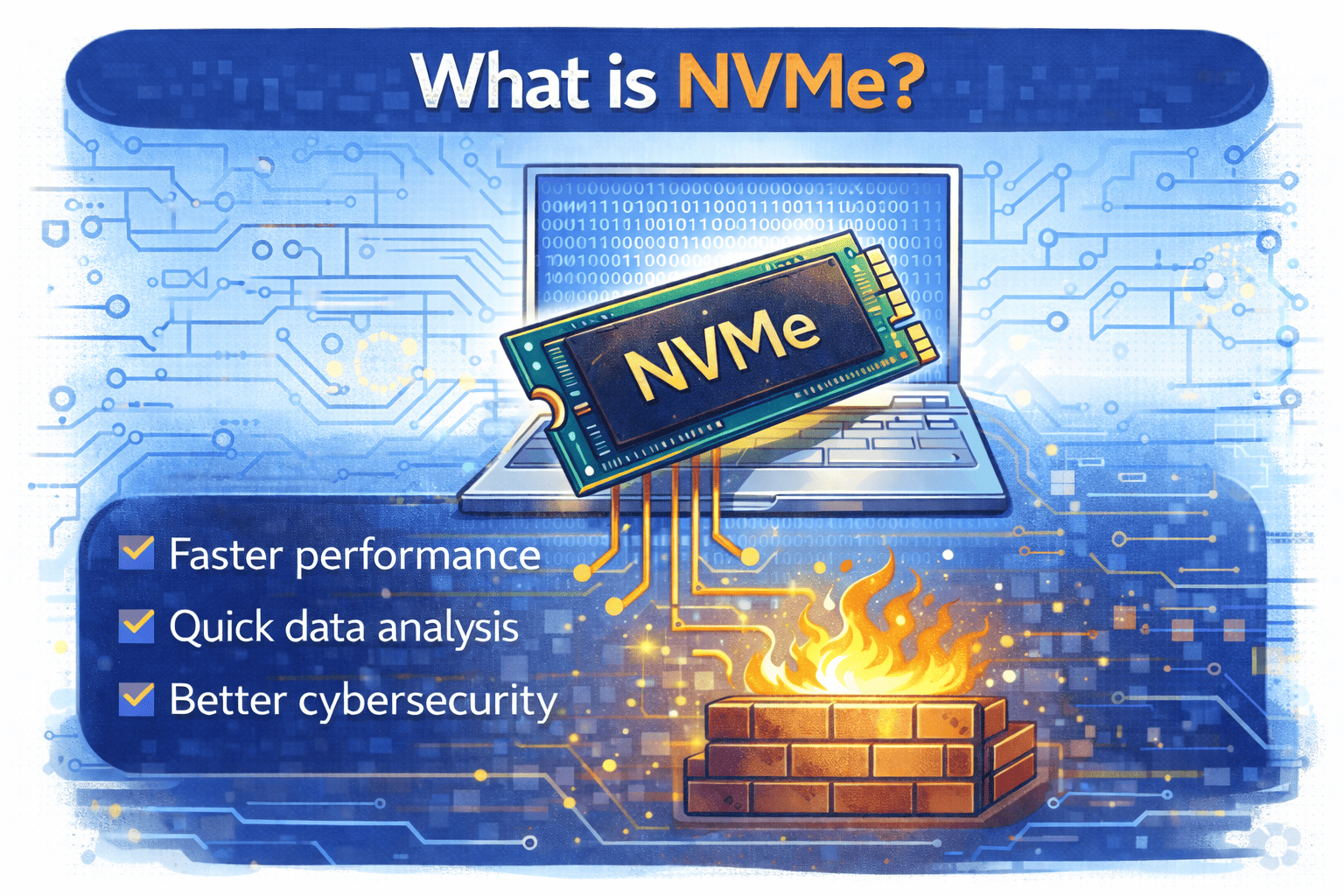
If you’ve ever wondered what is NVMe and why it’s becoming the standard for modern computing, you’re not alone. As applications grow more data-intensive and users demand faster performance, traditional storage technologies are struggling to keep up. NVMe has emerged as a game-changer, delivering blazing-fast speeds and low latency that older storage interfaces simply can’t match.
Understanding what is NVMe is essential for IT managers, cybersecurity teams, and business leaders who rely on fast, reliable systems. From cloud infrastructure to endpoint performance, NVMe directly impacts productivity, security response times, and scalability.
In this guide, we’ll break down what NVMe is, how it works, why it matters, and when you should consider upgrading.
What Is NVMe?
What is NVMe? NVMe stands for Non-Volatile Memory Express. It is a storage protocol specifically designed for solid-state drives (SSDs) to communicate with a computer over the PCIe (Peripheral Component Interconnect Express) bus.
Unlike older interfaces such as SATA or SAS, NVMe was built from the ground up for flash memory. This allows NVMe drives to process data faster, with lower latency and greater parallelism.
Key Characteristics of NVMe
-
Designed for flash storage
-
Uses PCIe lanes for high bandwidth
-
Supports massive parallel processing
-
Extremely low latency
Understanding what is NVMe begins with recognizing that it’s not just a faster SSD—it’s a smarter way for storage to communicate with the CPU.
How NVMe Works
To truly grasp what is NVMe, it helps to understand how data moves inside a system.
Traditional storage interfaces were designed for spinning hard drives, which could only handle one request at a time. NVMe, on the other hand, supports thousands of queues, each capable of processing thousands of commands simultaneously.
NVMe Architecture Explained
-
Up to 64K queues
-
Each queue supports 64K commands
-
Direct CPU communication via PCIe
-
Minimal instruction overhead
This architecture dramatically reduces bottlenecks and enables modern workloads to run efficiently.
NVMe vs SATA vs SAS: What’s the Difference?
One of the most common follow-up questions to what is NVMe is how it compares to other storage interfaces.
| Feature | SATA SSD | SAS SSD | NVMe SSD |
|---|---|---|---|
| Interface | SATA | SAS | PCIe |
| Max Speed | ~600 MB/s | ~1,200 MB/s | 3,500–7,000+ MB/s |
| Latency | High | Medium | Ultra-low |
| Parallelism | Limited | Moderate | Massive |
| Best Use | Consumer | Enterprise | High-performance |
NVMe outperforms SATA and SAS by a wide margin, especially in demanding environments.
Why NVMe Is Faster Than Traditional SSDs
If you’re asking what is NVMe really offering over SSDs, the answer lies in efficiency.
Reasons NVMe Delivers Superior Performance
-
Direct PCIe connection to CPU
-
Reduced command overhead
-
Optimized for multi-core processors
-
High-speed data lanes
NVMe removes the translation layers that slow down older storage technologies.
Key Benefits of NVMe Storage
Understanding what is NVMe also means understanding its benefits across different environments.
Performance Benefits
-
Faster boot times
-
Instant application launches
-
Reduced system lag
-
Improved database performance
Business Benefits
-
Increased productivity
-
Faster analytics and reporting
-
Reduced downtime
-
Better user experience
For organizations that rely on speed and efficiency, NVMe offers a competitive advantage.
What Is NVMe Used For?
NVMe isn’t just for enthusiasts—it’s used across industries.
Common NVMe Use Cases
-
Enterprise servers
-
Cloud data centers
-
Gaming and content creation
-
AI and machine learning workloads
-
Cybersecurity monitoring tools
When milliseconds matter, NVMe makes a measurable difference.
What Is NVMe’s Role in Cybersecurity?
For security teams, understanding what is NVMe goes beyond speed—it’s about response time.
Cybersecurity Advantages of NVMe
-
Faster log analysis
-
Quicker threat detection
-
Improved SIEM performance
-
Reduced incident response time
Security platforms benefit from NVMe’s ability to handle massive data throughput without delays.
NVMe Form Factors Explained
NVMe drives come in multiple physical formats.
Common NVMe Form Factors
-
M.2 – Compact, common in laptops and desktops
-
U.2 – Enterprise-grade, hot-swappable
-
PCIe Add-In Cards – Maximum performance
Understanding form factors helps when planning upgrades after learning what is NVMe.
NVMe vs M.2: Are They the Same?
A common misconception tied to what is NVMe is confusing it with M.2.
-
NVMe is a protocol
-
M.2 is a form factor
Not all M.2 drives use NVMe—some still use SATA. Always verify specifications before purchasing.
Is NVMe Worth It for Businesses?
For business decision-makers, the value of NVMe depends on workload.
NVMe Is Worth It If You:
-
Run cloud-based applications
-
Manage large databases
-
Use virtualization or containers
-
Handle real-time analytics
For basic office tasks, SATA SSDs may still be sufficient.
Power Consumption and Heat Considerations
NVMe drives are powerful, but they generate more heat.
Best Practices
-
Ensure proper airflow
-
Use heat sinks when needed
-
Monitor drive temperature
Efficient cooling ensures NVMe performance remains stable.
How to Choose the Right NVMe Drive
When selecting NVMe storage:
Key Factors to Consider
-
PCIe version (Gen 3, 4, or 5)
-
Read/write speeds
-
Endurance rating (TBW)
-
Capacity requirements
-
Vendor reliability
Choosing wisely ensures you maximize the benefits of what is NVMe.
Future of NVMe Technology
NVMe continues to evolve.
What’s Coming Next
-
PCIe Gen 5 and Gen 6 support
-
Higher capacities
-
Lower latency
-
NVMe over Fabrics (NVMe-oF)
NVMe is positioned to dominate enterprise and cloud storage for years to come.
Common Myths About NVMe
Myth 1: NVMe Only Matters for Gamers
Reality: Enterprises benefit just as much, if not more.
Myth 2: NVMe Is Too Expensive
Reality: Prices are dropping rapidly.
Myth 3: NVMe Isn’t Secure
Reality: NVMe supports modern encryption and secure erase standards.
Understanding what is NVMe helps separate fact from fiction.
Frequently Asked Questions (FAQ)
1. What is NVMe in simple terms?
NVMe is a high-speed storage protocol designed for modern SSDs using PCIe connections.
2. Is NVMe faster than SSD?
Yes. NVMe SSDs are significantly faster than SATA-based SSDs.
3. Do I need NVMe for everyday use?
Not always. It’s most beneficial for demanding workloads.
4. Is NVMe good for cybersecurity tools?
Absolutely. Faster storage improves detection and response times.
5. Can older systems use NVMe?
Only if the motherboard and BIOS support NVMe.
Final Thoughts: Why Understanding What Is NVMe Matters
As data volumes grow and performance demands increase, understanding what is NVMe becomes critical for future-proofing your systems. NVMe delivers the speed, efficiency, and scalability required by modern applications, from cybersecurity platforms to cloud infrastructure.
If your organization values performance, reliability, and rapid response, NVMe is no longer optional—it’s essential.
👉 See how advanced security solutions perform best on modern infrastructure—request a demo today:
https://www.xcitium.com/request-demo/