In a world where speed, security, and reliability define success, businesses can no longer afford silos between development and operations. But what is DevOps exactly? DevOps is a cultural and technical movement that integrates software development (Dev) with IT operations (Ops), aiming to automate and streamline the software delivery lifecycle.
According to a 2024 State of DevOps report, organizations that embrace DevOps practices deploy code 46x more frequently and recover from incidents 96x faster. For cybersecurity professionals, IT managers, and digital-first CEOs, DevOps isn’t just a buzzword—it’s a strategic advantage.
What is DevOps?
DevOps is a set of practices, principles, and cultural philosophies that bridges the gap between software development and IT operations. It emphasizes collaboration, automation, continuous integration, continuous delivery (CI/CD), and faster time to market—without compromising security.
By implementing DevOps, organizations can:
- Reduce deployment failures
- Improve incident response time
- Enhance product quality
- Shorten development cycles
DevOps is not a tool, but a transformation in how teams work together with shared responsibility.
The DevOps Lifecycle: From Code to Customer
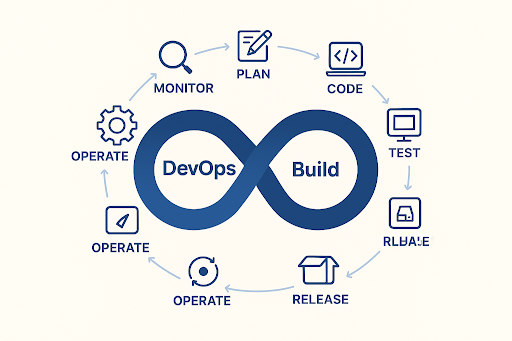
The DevOps Lifecycle includes a series of interconnected stages designed to ensure software is continuously developed, tested, released, monitored, and improved. Here’s a closer look at each phase:
1. Plan
Teams gather business requirements, define project scope, and prioritize tasks using tools like Jira or Trello.
2. Develop
Code is written, version-controlled, and peer-reviewed. Git-based tools like GitHub or GitLab are often used.
3. Build
Automated build tools like Jenkins or Bamboo compile the code, ensuring it is error-free and ready for deployment.
4. Test
Automated testing ensures the product is reliable and secure. Tools like Selenium, JUnit, or Xray are commonly used here.
5. Release
Approved code is deployed to staging and then production environments using CI/CD pipelines.
6. Deploy
Deployment strategies like blue-green or canary releases are used to minimize risk.
7. Operate
Operations teams ensure high availability and performance through container orchestration (e.g., Kubernetes).
8. Monitor
Real-time monitoring tools like Prometheus, ELK Stack, or Datadog detect anomalies and gather feedback.
🔁 This continuous loop enables feedback-driven improvements across the lifecycle.
DevOps Tools: Building the Modern Pipeline
The DevOps ecosystem thrives on automation. Here’s a breakdown of some popular DevOps tools by category:
| Stage | Tools |
| Version Control | Git, GitHub, GitLab |
| CI/CD | Jenkins, CircleCI, Travis CI |
| Configuration Management | Ansible, Puppet, Chef |
| Containerization | Docker, Kubernetes |
| Monitoring & Logging | Prometheus, Grafana, ELK Stack, Splunk |
| Security (DevSecOps) | SonarQube, Snyk, Aqua Security |
Adopting the right toolchain ensures smooth workflows and enhances your cybersecurity posture.
DevOps vs Agile: What’s the Difference?
Though closely related, DevOps and Agile serve different purposes:
| Aspect | Agile | DevOps |
| Focus | Iterative development | Continuous integration & delivery |
| Team Structure | Primarily developers | Developers + Ops + QA + Security |
| Goal | Deliver working software quickly | Automate delivery and infrastructure |
| Feedback | Customer-centric | System and performance-centric |
Agile enhances software creation, while DevOps ensures its seamless deployment and maintenance. Combined, they accelerate digital transformation.
Benefits of DevOps for IT and Cybersecurity Leaders
Embracing DevOps brings tangible benefits for organizations across industries—especially those prioritizing speed and security:
✅ Faster Time to Market
Automated pipelines eliminate bottlenecks and manual errors.
✅ Improved Security
Integration of security tools in CI/CD (DevSecOps) reduces vulnerabilities early in the lifecycle.
✅ Greater Collaboration
Cross-functional teams work in tandem, improving efficiency and innovation.
✅ Higher Stability & Reliability
Continuous monitoring helps identify and resolve issues before they escalate.
✅ Scalability & Flexibility
Containerization and infrastructure-as-code enable rapid scaling in response to demand.
For IT managers and cybersecurity leaders, DevOps is the foundation of resilience and agility.
Real-World DevOps Use Cases
- Financial Institutions: Use DevOps to automate compliance testing and ensure secure deployments.
- E-commerce Platforms: Achieve rapid rollouts of features and bug fixes, minimizing downtime.
- Healthcare Providers: Integrate secure, HIPAA-compliant pipelines for patient data applications.
Best Practices for DevOps Success
- Start with Culture – Break down silos, build trust.
- Automate Everything – From testing to deployments.
- Shift Left on Security – Integrate security early (DevSecOps).
- Measure Metrics – Track deployment frequency, MTTR, change failure rate.
- Continuous Learning – Encourage experimentation and upskilling.
Conclusion: Ready to Accelerate with DevOps?
In today’s high-stakes IT environment, knowing what DevOps is—and implementing it effectively—is critical to staying competitive, secure, and resilient. Whether you’re managing a security-first organization or scaling a digital enterprise, DevOps gives you the tools, mindset, and framework to move faster with confidence.
🔗 Want to see DevOps in action? Request a free demo and learn how to secure your software pipeline today.
Frequently Asked Questions (FAQs)
1. What is DevOps in simple terms?
DevOps is a way of working that combines development and IT operations to deliver software faster and more reliably.
2. How is DevOps different from Agile?
Agile focuses on software development speed, while DevOps focuses on automating software deployment and operations.
3. What are common DevOps tools?
Common tools include Jenkins (CI/CD), Docker (containers), Git (version control), and Prometheus (monitoring).
4. Can DevOps improve cybersecurity?
Yes. DevSecOps integrates security into every stage of the software lifecycle, reducing risk and improving compliance.
5. Is DevOps suitable for small businesses?
Absolutely. Even small teams benefit from automation, faster delivery, and reduced manual workload.
Please give us a star rating based on your experience.

 (147 votes, average: 1.15 out of 5, rated)