Every business today runs on digital assets. Customer databases, cloud workloads, payment systems, laptops, mobile devices, websites, and APIs all hold value, and every one of them can contain a weakness an attacker is looking for. New software flaws are disclosed every single day, and attackers often start scanning for them within hours of publication.
That is why organizations of every size need the best vulnerability management process they can build. Patching “when there is time” or running a scan once a year is no longer enough. A structured, continuous, risk-based process is what separates businesses that stay ahead of threats from those that end up explaining a breach to customers, regulators, and the board.
In this guide, we explain what vulnerability management really is, why it matters so much for protecting digital assets, the stages that make up a best-in-class process, and the practices that help security teams turn findings into real risk reduction.
What is Vulnerability Management
Vulnerability management is the ongoing practice of identifying, evaluating, prioritizing, remediating, and reporting on security weaknesses across an organization’s systems and software. A vulnerability can be an unpatched operating system, an outdated plugin, a misconfigured cloud storage bucket, a weak default password, or an exposed service that should never have been reachable from the internet.
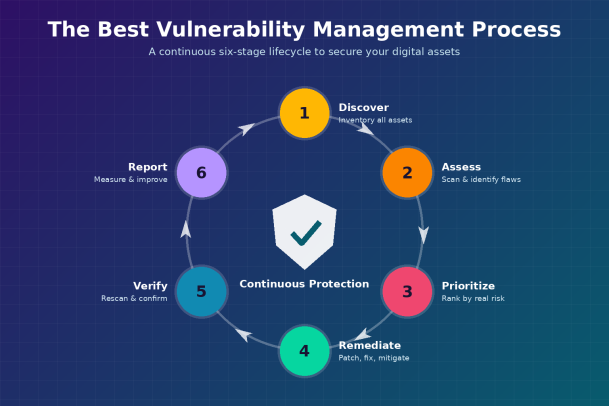
It is important to separate vulnerability management from vulnerability scanning. A scan is a single activity that produces a list of findings. Vulnerability management is the full lifecycle around that list: knowing what you own, deciding what matters most, fixing it, proving it is fixed, and repeating the cycle continuously.
What Makes a Process “the Best”?
The best vulnerability management process is not defined by a single tool. It is defined by a few key qualities:
- Continuous rather than periodic, so new exposures are caught quickly.
- Risk-based, focusing effort on the flaws most likely to be exploited and most damaging to the business.
- Complete, covering endpoints, servers, cloud, containers, network devices, and applications.
- Accountable, with clear owners, deadlines, and service-level targets for remediation.
- Measurable, with metrics that show whether risk is actually going down over time.
Why Businesses Need the Best Vulnerability Management Process
1. Attackers Move Faster Than Ever
Threat actors use automated tools to scan the entire internet for known weaknesses. Once a critical flaw is published, the window between disclosure and active exploitation can shrink to days or even hours. Without a disciplined process, security teams simply cannot close gaps before criminals find them.
2. The Attack Surface Keeps Growing
Remote work, cloud migration, SaaS adoption, IoT devices, and third-party integrations have expanded the number of assets a business must protect. Each new asset introduces new software, new configurations, and new potential weaknesses. A strong vulnerability management program keeps that expanding surface visible and under control.
3. Ransomware and Data Breaches Are Expensive
Unpatched vulnerabilities remain one of the most common entry points for ransomware and data theft. The cost of an incident goes far beyond ransom payments. It includes downtime, recovery work, legal fees, regulatory penalties, customer notification, and lost revenue. Fixing a known flaw early costs a tiny fraction of responding to a breach.
4. Compliance Demands It
Frameworks and regulations such as PCI DSS, HIPAA, ISO 27001, SOC 2, GDPR, and NIST guidance all expect organizations to identify and remediate security weaknesses in a timely, documented way. A mature process produces the evidence auditors ask for, making compliance easier and less stressful.
5. Trust Is a Business Asset
Customers and partners want to know their data is safe. A single public breach can undo years of brand building. Consistent vulnerability management shows stakeholders that the business takes security seriously and protects the data entrusted to it.
Best Practices to Strengthen Your Process
- Automate wherever possible. Automated discovery, scanning, ticket creation, and patch deployment reduce human delay and error.
- Integrate with IT operations. Security finds the problem, but IT often fixes it. Shared workflows and ticketing keep both teams aligned.
- Define remediation SLAs. For example, critical issues within 7 days, high within 30, and medium within 90. Clear targets create accountability.
- Plan for what cannot be patched. Legacy systems and vendor-controlled devices need compensating controls such as segmentation, application control, or isolation.
- Include third parties. Vendors and suppliers can introduce risk, so their exposure should be part of your assessments.
- Pair it with strong endpoint protection. Even the fastest patch cycle leaves a gap. Technologies that stop unknown or malicious code from causing damage protect you during that window.
Common Pitfalls to Avoid
Many programs stall because they treat every finding as equally urgent, which buries teams in thousands of alerts. Others scan only part of the environment, leaving blind spots in the cloud or on remote laptops. Some never verify fixes, so “closed” tickets hide open risks. The most common pitfall of all is treating vulnerability management as a project with an end date rather than a permanent, evolving discipline.
How Xcitium Helps You Build the Best Vulnerability Management Process
Xcitium helps businesses move from reactive patching to proactive protection. Its platform brings endpoint visibility, patch management, and advanced threat protection together, so security teams can see their assets, understand their exposure, and act quickly from one place.
Xcitium’s Zero Trust approach to endpoint protection adds an extra layer of defense. Unknown files can be isolated in a secure virtual environment before they can harm the system. That means even when a vulnerability has not yet been patched, attackers face a much harder path to damaging your digital assets.
Conclusion: Secure Your Digital Assets Before Attackers Find the Gaps
Vulnerabilities will never disappear. New software, new devices, and new threats guarantee a steady stream of weaknesses. What businesses can control is how quickly and intelligently they respond. The best vulnerability management process gives you complete visibility, risk-based priorities, fast remediation, verified results, and continuous improvement.
Organizations that invest in this discipline reduce breach risk, simplify compliance, cut incident costs, and earn lasting trust from customers and partners. Those that delay leave the door open for attackers who are already looking.
Don’t wait for a breach to expose your weaknesses. See how Xcitium can help you discover, prioritize, and remediate vulnerabilities while protecting every endpoint with Zero Trust security.
Please give us a star rating based on your experience.

 (21 votes, average: 2.10 out of 5, rated)